Friday, December 10, 2021

IGY Bulletin, Number 5, November 1957 - The Special World Day Program for the IGY; CSAGI rocket and satellite conference

I'll review the last two articles in the Nov. 1957 issue of the IGY Bulletin.

1. The Special World Day Program for the IGY

I've discussed the IGY calendar in a previous post, including Regular World Days. This article focuses on Special World Days, on occasions of observed increases in solar activity that could also cause geomagnetic, ionospheric, auroral, and cosmic ray disturbances. Balloon and rocket soundings were increased during these events. The IGY World Warning Agency would send out alerts whenever solar activity, e.g., an unusually active sunspot region, was high and other disturbances were expected for the following day.

Table 1 in the article lists 45 World Warning Messages sent out during the first three month of the IGY, about one every two days. When the probability remained high for enhanced activity in the Earth environment, a Special World Interval would be declared.

Two of my U.S. IGY first day covers, not to mention the U.S. IGY stamp itself, depict solar activity. I haven't shown the first before, the cachet of which mimics the theme of the IGY stamp. The second was in an earlier post as an example of a hand colored cover.

FDC US139 from my collection, cachet maker unknown

FDC US173 from my collection

2. CSAGI rocket and satellite conference

There were a number of international meetings held to organize the IGY. This document on the contents of the National Academy of Sciences archives lists five CSAGI assemblies, five regional conferences, and five disciplinary conferences (if I am counting correctly). The first of these held in the U.S. was the CSAGI  Rocket and Satellite Conference, in Washington, D.C., from Sept. 30 - Oct. 5, 1957. 

During the closing session of the conference on Oct. 5, a brief description of the Sputnik 1 launch was given by A. A. Blagonravov. The launch from Kazakhstan had been made about 5 pm (Eastern  Daylight Time) the previous day, and had been announced at a reception that evening in conjunction with the CASGI satellite conference at the Soviet Embassy in Washington.

A number of resolutions were passed, including a recommendation that the U.S. and the Soviet Union arrange for the rapid dissemination of information on satellite orbits and the sharing of publications, technical data, and instrumentation.

The first day cover below from my collection was postmarked in association with the Fifth Assembly of the CSAGI held in Moscow from July 30-August 8, 1958. That meeting discussed the practical details of IGY data collection and utilization, and held symposia at which the first results of the IGY were presented. 

International cover #212 from my collection

The Russian stamp on the cover (image below), Scott catalog #2090, was issued for the IGY. It shows the schooner Zarja which was built in Finland in 1952 for the USSR Academy of Sciences (one of 50 wooden schooners built by Finland as reparations for the Continuation War fought against the Soviet Union by Germany and Finland during World War II). The research vessel was wooden, and non-magnetic, fully equipped with Soviet-built geophysical instruments, including special shipborne magnetometers (shown on the stamp) for geomagnetic field observations. The schooner covered 60,000 miles in less than three years, crossing the Atlantic Ocean six times and the Indian Ocean five times. In doing so, it helped to delineate marine magnetic anomalies. These anomalies (a difficult concept to explain which I may return to another time) were key in developing the theory of sea-floor spreading in the 1960s.

Scott #2090 (USSR), from my collection

Here is a silent video of the Zarja

A second Soviet cover from my collection with a CSAGI V cachet is shown below:

International cover #200 from my collection

The stamp on this cover is coincidentally Scott catalog #1957, issued by the Soviet Union on July 4, 1957, three days after the beginning of the IGY. It depicts the telescope at an observatory trained on a comet.

Scott #1957 (USSR), from my collection

Monday, December 06, 2021

A satellite that failed, and a Satellite that was a hit

Today is the anniversary of the first attempt by the U.S. to put a satellite into space. It didn't go so well. According to NASA, after the Soviet Sputnik success, the U.S. accelerated its two satellite programs programs. On December 6, 1957, the Vanguard Test Vehicle 3 (TV3) rose about 4 feet into the air, when the main engine lost thrust and the rocket fell back onto the pad, exploding in a huge fireball. The press called the failed attempt “Flopnik” and “Kaputnik,” in reference to its successful Soviet counterpart. The Vanguard satellite was thrown free of the explosion and recovered.  It is currently on display at the Smithsonian Institution’s National Air and Space Museum in Washington, D.C. I've been to the museum before, but now I want to go back and hunt this down.

Here is the newsreel as it happened:


Hang on, the U.S. will succeed before, too long.

I went to Harrisburg Saturday to see a concert by one of my favorite bands, The Hooters, iconic rockers from Philadelphia. I heard them 35ish years ago performing in the gym at Franklin & Marshall College, just a 5-minute walk from home. (Unfortunately, that concert put the kibosh on my editor's attending rock concerts, the volume being a bit excessive.) Then I heard them two years ago in Philadelphia at The Met in Philadelphia, a great venue, just before covid. Saturday the band played at club XL Live in Harrisburg, a more intimate setting. Excellent show! Here is my video clip from their performance of Satellite:


Here is the original music video. The song isn't about Vanguard TV3, or any physical satellite for that matter, but about televangelism. It does have the magic word for its title!


And here is a recent performance of Day by Day, probably my favorite Hooters song:


"Nothing lasts forever, only fades away, day by day ... chance you gotta take, price you gotta pay, day by day"

More satellite songs to come in some future post. 

Friday, December 03, 2021

IGY Bulletin, Number 5, November 1957 - Preliminary report on rockoon firings in the Arctic; Peary-MacMillan Arctic Museum; Matthew Henson

Ack, my summaries of November 1957 IGY Bulletin articles have now slipped into December. Plus, the articles are continuing to repeat themes, as rockoons were discussed in another post less than a month ago. So I'll be quick about the rockoons this time, and add some other Arctic thoughts.

The article states that during a 10-day period in August 1957, 18 rockoons (balloon-launched rockets) were flown as part of the US-IGY program by scientists from the University of Iowa, under the direction of James Van Allen. The flights were made from the deck of the USS Plymouth Rock, roughly within the Arctic-subarctic zone outlined in red on the map below. A table of all 18 flights is included in the article. Seven flights recorded data throughout the balloon ascent and rocket flight portion of the missions.

Approximate map area of rockoon launches (Google Earth)

The Hawk sounding rockets were launched at balloon altitudes of about 75,000 feet, or 15 miles, reaching as high as 132 km, or about 75 miles. This took them up to the altitudes of the aurorae, in the thermosphere/ionosphere.

Scientific objectives included measurements of the geomagnetic field, cosmic ray intensities, and of electrical currents. One of the instruments flown was a proton precession magnetometer. I used such a magnetometer, the Geometrics model G856, in my (ground-based) teaching and research at archaeological and geologic sites during my career.

Since we are now "in the Arctic," I'll take the opportunity to mention a couple of "Arctic experiences" I had during a trip to the Northeast in late September. I took my first airplane flight of the covid era from Philadelphia to Portland, Maine. On my way to Acadia National Park, I visited the Peary-MacMillan Arctic Museum at Bowdoin College in Brunswick, Maine. James Tanzer, Museum Outreach Coordinator, was kind enough to arrange my visit, these days by appointment only as campus buildings are generally closed to those from outside the Bowdoin community. The museum 

Hubbard Hall, housing the Arctic Museum
"is dedicated entirely to all things Arctic. It is named after Arctic explorers and Bowdoin graduates Robert E. Peary (Class of 1877) and Donald B. MacMillan (Class of 1898)." Peary (1856 – 1920) was an American explorer and officer in the United States Navy who made several expeditions to the Arctic in the late 19th and early 20th centuries. He is best known for leading an expedition in 1909 that claimed to be the first to have reached the geographic North Pole, although he might have bean beaten by Frederick Cook. The other namesake of the Museum, Donald MacMillan, received a bachelor's degree in geology from Bowdoin. He made over 30 expeditions to the Arctic in his 46-year career, traveling over 300,000 miles.

The coolest artifacts in the museum were Peary's notes and telegram about reaching the pole:


It was also neat to see some of the surveying and scientific instruments used on the expeditions. Just like what would be done for the IGY 50 years later, temperatures and barometric pressures were measured as key weather variables.


Thermometer

Barometer

Barometric and thermometric data


I have a first day cover for  the 50th anniversary of Peary's expedition to the North Pole. The 1959 stamp (Scott #1128) shows Peary’s expedition with a team of dog sleds traveling over the ice, and the USS Nautilus’ 1957 nuclear-powered submarine journey below the ice, two rather different ways of reaching the North Pole. The postmark is from Cresson, Pennsylvania, where Peary was born.

First day cover with Scott #1128 for the stamp. The cover is  US 194 in my collection.

I appreciated learning more about Matthew Henson at the Museum. Henson (1866 - 1955) accompanied Peary on seven voyages to the Arctic over a period of nearly 23 years spending a total of 18 years on expeditions together. (Wow, that's half the lifetime of my marriage!)  He was part of the 1908–1909 expedition that claimed to have reached the geographic North Pole on April 6, 1909. Henson said he was the first of their party to reach the pole. Henson, being Black, got only subdued and belated kudos for his accomplishment. I

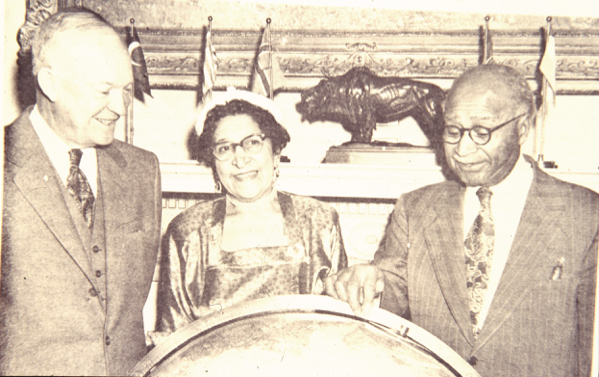
There is a small virtual exhibit at the Museum on Henson. Sadly, Henson did not live to see the IGY. But there is a picture of him from the virtual exhibit with Pres. Eisenhower, our IGY president, in 1954:
Matthew and Mrs. Henson with President Eisenhower at The White House; age 88 (Bowdoin College)

I ran into Henson again when I spent a night on the same trip in Mystic, Connecticut, and visited the Mystic Seaport Museum. Although he does not show up when you google his name through the Museum's website, there was a panel on him, shown below. It pointed out that the shipbuilding community near Mystic had sent many whaling vessels into the Arctic in the mid-1800s, before Henson went there for a different reason.
Matthew Henson panel at Mystic Seaport Museum


In my collection, I also have the USPS Souvenir Page (Scott catalog SP752) shown below, with four 22¢ stamps issued in 1986 showing Arctic explorers: Elisha Kane (Scott #2200), Adolphus Greely (Scott #2201), Vilhjalmur Stefansson (Scott #2202), and Robert Peary and Matthew Henson (Scott #2203) sharing the fourth stamp. Henson had to share a stamp, but at least he got one. 


USPS souvenir page (SP267) on Polar Explorers, including the stamp (Scott #2203) with Matthew Henson and Robert Peary

The block of four stamps together has its own designation in the Scott catalog as #2223a.

According to the Scott catalog, these souvenir pages "are post office new-issue announcement bulletins, including an illustration of the stamp's design and informative text." Although the stamps are individually listed in the regular part of the catalog, the souvenir pages are indexed separately as "back of the book" items, found further back in the Scott catalog in the same way as airmail stamps are, and bearing the extra SP prefix.