Showing posts with label space. Show all posts

Wednesday, January 04, 2023

Anniversary of the end of Sputnik 1

Happy 2023 to everyone. I notice that I did not blog once in December. I am not planning to stop, but my pace has certainly languished. I will probably not return to the biweekly pace I tended to keep for much of the last couple of years. No resolutions here, but we will see what the New Year brings.

I was looking for a historical event to post on the right sidebar, and it turns out today is the 65th anniversary of the death of Sputnik 1, first satellite into space, launched as intended during the International Geophysical Year. In a previous post I noted the anniversary of Sputnik 1's launch on Oct 4, 1957, three months into the IGY. Another post filled in additional technical details of the mission. Three months later, on Jan. 4, 1958, after 1,440 orbits each lasting 90 minutes, the satellite burned up as it re-entered the Earth's atmosphere.

Here is a cute video on how satellites stay in orbit, and why their orbits eventually decay.


By the way, the European Space agency defines low Earth orbit (LEO), where atmospheric drag degrades satellite orbits, as an elevation of less than 1,000 km above the Earth's surface. Sputnik 1's orbital elevation ranged from 215 km at perigee to 939 km at apogee, so it qualified as being in LEO.

Forbes.com actually posted an article in 2018, This Is Why Sputnik Crashed Back To Earth After Only 3 Months, by Ethan Siegel. It states that even though Sputnik's orbit was above the so-called Kármán line, hence in outer space, "Such disaster [of a satellite's demise] is inevitable due to satellite drag, which is a way to quantify how much speed a satellite loses over time due to the atmospheric particles it runs into at high relative speeds. Any satellite in low-Earth orbit will have a lifespan ranging from a few months up to a few decades, but no longer than that."

I came across an interesting web site, the Index of Objects Launched into Outer Space (including Earth satellites) from the United Nations Office for Outer Space Affairs. I could not seem to sort the table, but using the filter by launch year, I was able to obtain and graph (I love making graphs!) the number of launches by year, starting with the first two Sputnik launches in 1958 (see graph below). There are currently 10,100 still in orbit, and 4,176 objects not in orbit. After averaging 131 launches/year from 1965-2015, the number of launches has started going up exponentially, due to the Starlink program of SpaceX, which plans to deploy nearly 12,000 microsatellites to provide Internet access coverage to 45 countries and global mobile phone service. 
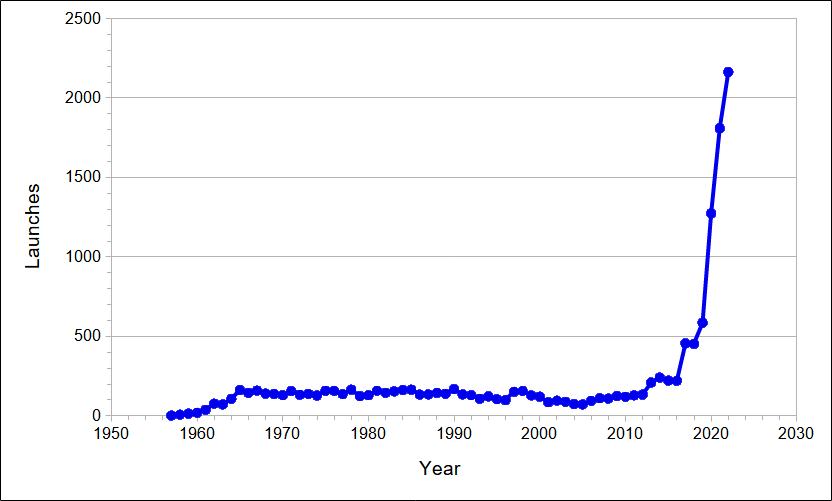
Objects launched into space by year (my graph, data from United Nations)

My editor pointed out that one of her favorite podcasts, Planet Money, had  a series, Planet Money Goes To Space, about the relative ease of getting a satellite into space these days.

We've come a long way since that 3-month lifetime of Sputnik 1!

Wednesday, April 13, 2022

IGY Bulletin, Number 9, March 1958 - Phototrack

Back to the IGY Bulletin articles. Phototrack was the designation for the program utilizing volunteers to help track Earth satellites, as noted in a previous post.

Accuracy of these observations was deemed to be "quite high," limited by timing accuracy, which was 0.1 seconds.

Photographs were taken against a fixed starfield background which yielded satellite positions. Timed breaks were inserted in the image used to track the satellites. 

Image showing the tracking of Earth Satellite 1957β, i.e. Sputnik 2 (from the Bulletin article)

Times were determined with a Phototrack camera by photographing a clock three times per picture, leaving a time mark on the image of the starfield and satellite. The clock was synchronized to radio station WWV, run by the National Bureau of Standards (now the National Institute of Standards and Technology).

Photographing the clock for timing marks (from the Bulletin article)

Other specifications for the Phototrack system are given in the Bulletin article. 

There is a Wikipedia article that summarizes this Phototrack program. There is also a nice personal recollection of participation in the Phototrack program by John Sutherland. He started worked at the Phototrack 5007 tracking operation in Walpole, MA, that had been set up during the IGY by Warren Davis and others. I tried to email Sutherland, but that was bounced back. Sutherland reminds us that "all of this ‘space’ activity happened in the slide rule era – there were no computers to help with the calculations, in fact, there were not even any hand calculators. Everything was done manually and by knowing how to create and use formulas." One of the Wikipedia article citations is "Seven Place Cosines, Sines, and Tangents For Every Tenth Microturn." That sounds pretty brute force.

My antique slide room, vintage 1972
In my undergrad days of the late 1960s and early 1970s, all calculations were done with slide rules; tables of various mathematical functions were also very useful. At some point I lost my trusty K&E slide rule, which I used daily for four years. I still own the replacement shown at right, now gathering dust on my electronics museum shelf.

The history of the slide rule goes back to the early 17th century. There is not a single postage stamp honoring the slide rule, but I think there should be!

In my first real job at Fairchild after graduation, I used a desktop mechanical calculator, a wonderful machine. My father had used one at home to work on his accounts. In grad school I finally used digital calculators, followed by programmable calculators, and then mainframe computers with terminals in the lab where I worked. It wasn't until the very end of grad school that I saw my first Apple personal computer, and then used and bought an original IBM PC soon after I started my job at Franklin & Marshall College in 1983.

My first IBM PC from 1983-84 (right); a later iMac (left)

These older technologies make me think of the women calculators of NASA, and the book and movie Hidden Figures. Kudos to trailblazer Katherine Johnson and her colleagues!