I recently bought an interesting item on eBay, one for which I was the sole bidder, so it was not very expensive. It was a sheet signed by the members of the Hungarian National Committee for the IGY. Countries participating in the IGY had national committees to organize and guide the work done by scientists from that country.
Members and signatures of the Hungarian National Committee for the IGY
I am assuming the officers were the key figures on this committee. Prof. A. Tározy-Hornoch is listed as academician, president of the committee, and representing the field of geodesy (shape and gravitational field of the Earth). Prof. L. Egyed is listed as secretary of the committee, representing the field of seismology. I found a little more information online about these two scientists.
Prof. A. Tározy-Hornoch (1900-1986) was a university professor in Sopron and one of the most prominent figures in 20th century Hungarian geodesy. He is the eponym for Hungary's Tárczy-Hornoch Antal Geodetic Laboratory, used for the development and calibration of geodetic instruments and devices.
According to Wikipedia, Prof. László Egyed (1914-1970) was a professor at the Geophysical Institute of the Eötvös-University in Budapest. He published over 100 scientific articles. He wrote the book Physics of the Solid Earth in 1956; I don't think a translation exists, but it would be interesting to read this book to survey the field of geophysics just prior to the IGY.
Egyed was a supporter of the expanding Earth hypothesis, a suggested alternative to plate tectonics. According to this post from Scientific American, Egyed based his thinking on variations of the sea level in the geological past, concluding that today's continents are the remains of the ancient crust of a smaller planet, surrounded by younger rocks generated along fractures at the mid-ocean-ridges. Popular Mechanics had an article describing expanding Earth ideas in more detail.
This document is reminiscent of my last post, about my one-page exhibit which included covers featuring three key personnel of the U.S. National Committee for the IGY: Joseph Kaplan (chairperson), A. H. Shapley (vice chairperson), and Hugh Odishaw (executive secretary).
I could not easily find much information on Hungary's activities as part of the IGY, but it did establish the Nagycenk Geophysical Observatory in 1956-57, operated during the IGY and since by the Geodetic and Geophysical Institute of the Earth Science Center, Hungarian Academy of Sciences. The observatory makes continuous records of Earth electrical currents, atmospheric electricity, ionospheric and meteorological observations.
In 2009, I was at a geophysics conference in Tározy-Hornoch's Sopron, the XIth International Association of Geomagnetism and Aeronomy (IAGA) Scientific Assembly. I sent myself a postcard prepared for the event. It is franked with what seems to be a somewhat standardized Hungarian postage stamp, similar to Scott 3926a, showing a surveying compass and map of Hungary. The word Belföld means domestic (I think), so other stamps were added to make the international postage. Magyarország is Hungarian for Hungary. The non-standardized label on the stamp margin gives the date and place of the IAGA meeting. There is a corresponding IAGA 2009 cancellation of the stamps. Maybe Prof. Tározy-Hornoch himself walked the halls of the conference building in an earlier era.
Front of self-addressed postcard from IAGA 2009, Sopron
Back of postcard from IAGA 2009, Sopron
WhileI was in Sopron, I took a wonderful bike ride into the countryside, where I saw the impressive Fertőrákos limestone quarry (photo at right). The quarry was used as early as Roman times, but nowadays there are concerts in an amphitheater among the cavernous excavations. This was also the area of the so-called Pan-European Picnic two decades earlier in 1989, the first place where East Germans on holiday were allowed to cross the border unimpeded into Austria and the West. Soon afterwards the Berlin Wall fell (I stood on top of it in the week before Christmas, 1989), and then everything else!
This exhibit in Sopron commemorated the 20th anniversary of the Pan-European picnic
Once I got to the Neusiedler Seeon my bike ride, a cold beer really hit the spot
In 2021, I contributed a 1-page exhibit derived from my IGY collection, showing one IGY stamp from each of the 19 countries that issued IGY stamps between 1957 and 1959.You can find a copy of my exhibithere.
Last year, using my other philatelic collection on North American earthquakes, my 1-pager was about the encounter of the USS Constitution, aka Old Ironsides, with the Long Beach earthquake of March 10, 1933. You can see that poster here.
This year I have returned to the IGY for my ATA 1-page exhibit. After I bought the IGY cover signed by Lloyd Berkner that I shared in my last post, I decided to do my exhibit featuring covers signed by significant figures in the IGY. That exhibit is posted here, or you can see it below. It shows 5 first day covers bearing the U.S. IGY stamp (Scott 1107) and involving arguably the top 5 (or at least 5 of the) most influential CSAGI (Chapman and Bartels) and U.S. (Kaplan, Shapley, and Odishaw) officers of the IGY. Four of the covers are signed. The Kaplan cover has no signature, but it does include a cachet with his picture.
My ATA 1-page exhibit for 2023
In an earlier post, I mentioned that CSAGI's (Comité Spécial de l'Anée Géophysique Internationale) five officers (see photo below) included Sydney Chapman (president) and Lloyd Berkner (Vice President). That post included the cover with Chapman's signature.
A meeting of the Special Committee for the International Geophysical Year, known by its French acronym CSAGI, in Brussels in June 1957, included Vladimir V. Beloussov of the Soviet Union, left, Lloyd V. Berkner of the United States, [Marcel] Nicolet [of Belgium], Jean Coulomb of France, and Sydney Chapman of the United Kingdom (NASA)
The U.S. National Committee for the IGY included Hugh Odishaw as its executive director. I also previously showed my cover signed by Odishaw.
I couldn't really find any online sites that describes the U.S. IGY Committee. In another earlier post, I mentioned that I own a copy of the Proposed United States Program for the International Geophysical Year, 1957-58, a 105-page document published in 1955 by the United States National Committee for the International Geophysical Year. It states in the introduction (p. ix) that organizations critical for each nation that developed its own IGY program would be the "adhering bodies" which would provide the focuses (foci) for those national committees and their programs. In the U.S., this body was the National Academy of Sciences-National Research Council. In turn, the Academy organized the U.S. National Committee for the IGY to "plan, direct, and execute the IGY program." The Committee members were listed inside the front cover shown, where you will see the names of Kaplan, Shapley, and Odishaw.
People on the U.S. National Committee for the IGY
I found a rather informative, chatty and interesting transcription of an oral interview with Alan Shapley by historians of science Ron Doell and Fae Korsmo, much of it about the IGY and its organization. Lots of interesting history and anecdotes, including about Chapman, Bartels, Kaplan and Odishaw, told with humor and some colorful observations of various participants. The interview was done in 2003, by which time Shapley had long survived these other luminaries (Chapman, 1888-1970; Berkner,1905-1967; Kaplan,1902-1991; Shapley, 1919-2006; Odishaw, 1916-1984), so that allowed him to be quite candid about the IGY program and its personnel:
"Berkner was the wheeler-dealer" in the formulation of the IGY.
He "didn’t want to be involved nationally in the US program ... So they hit upon Joe Kaplan, of UCLA, whose claim to fame was not really in geophysics. But he identified what are now known as the Vegard-Kaplan bands in the spectrum of the aurora. That’s almost the only thing he did except defend their football team."
"How they hit upon me [Shapley himself], I don’t know."
"Chapman that said he had to solve or take the problems globally instead of as polar-wise [like the First and Second International Polar Years]. So I don’t think Berkner should get any credit for broadening things."
"Merle Tuve ... was a member of the US National Committee, and he was a very feisty person. A wonderful person, in contrast to some of the other people."
"Odishaw’s first reaction on the International Geophysical Year was 'What the hell is that?' "
"Hugh and I were buddies. Joe Kaplan was a mouthpiece. Not to denigrate him, but Hugh and I did all the tactics and strategy."
"I was Staff Sergeant for the whole US program. Hugh and I were running the U.S. program. We manipulated Joe Kaplan as necessary."
Next year I may do a similar 1-page exhibit with signatures of 5 other prominent IGY scientists. Stay tuned.
Powers of Ten is a short film made by the designer team of Charles and Ray Eames to illustrate the vast scale of the universe, from the outermost galaxies to the innermost nucleus of an atom, with human scale approximately in the middle. Starting from a look at picnickers on the shore of Lake Michigan, the scene zooms out by a factor of 10 every 10 seconds, from a scale of 1 meter (100) to a scale of 1024 meters. Then it zooms back to the picnic, and then inwards by a factor of 10 every 10 seconds until it reaches the nuclear scale of 10-16 meters.
The best version of this film is this finished version of the Rough Sketch, now simply titled Powers of Ten, from 1977. The narration was by noted physicist and public intellectual Philip Morrison.
Other takes on the same theme include this 1996 version, also titled Powers of Ten, an IMAX film narrated by the omnipresent Morgan Freeman, starting on St. Mark's Square, Venice,
and this 1968 animated Cosmic Zoom from the National Film Board of Canada:
Every year I try to do a mini-celebration of Powers of Ten Day on Oct. 10, as I did again last month. When I worked in student life at Franklin & Marshall College in 2010, I organized a Powers of Ten event at 10:10 pm, on 10/10/10, with a showing of the film, or course.
This year I learned that these films emanate from a concept by Kees Boeke, as illustrated in his 1957 book, Cosmic View. Boeke, a Dutch reformist educator, Quaker missionary and pacifist, seems to have been a very interesting and committed individual. His idea for the scale of the universe theme was acknowledged in a couple of the films above.
You can see the pages of the Boeke's book Cosmic View at this website. Just as the Powers of Ten film was narrated by physicist Philip Morrison, this book includes an introduction by Nobel prize winner Arthur Compton.
Jacket of Cosmic View (1957)
Is it coincidental that this book was published during the International Geophysical Year? At the dawn of the space age, I think that people had an increasing awareness and wonder at the scales of the universe, and it was certainly a challenge for educators to represent this.
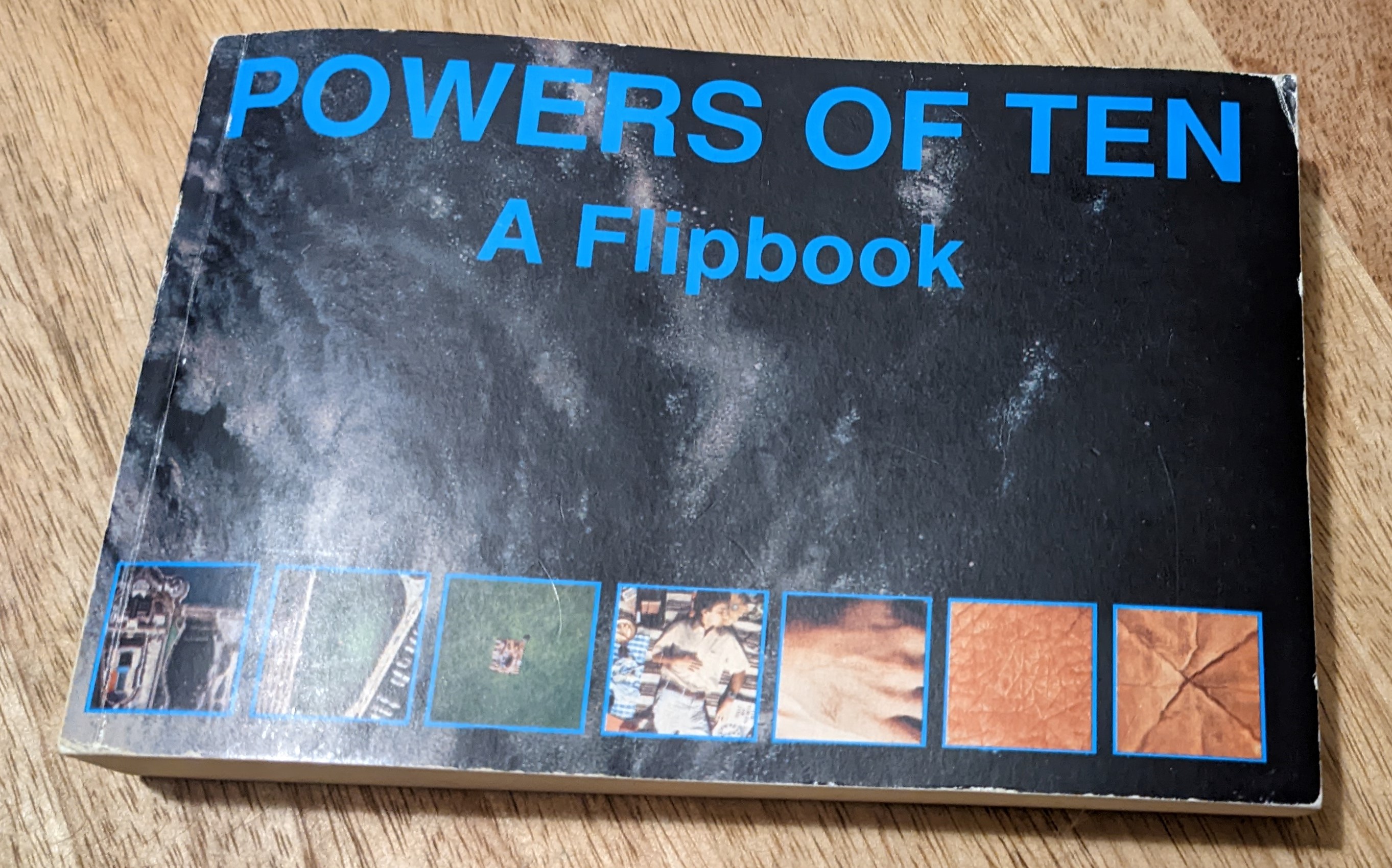
I have a couple of Eames souvenirs. There is a flipbook of Powers of Ten:
Then there is our Eames lounge chair and ottoman. It is an iconic piece of mid-century (20th) furniture, first released in 1956, just before the IGY. About 10 years ago, we bought this one, and despite needing a repair due to a design flaw with the aging epoxy, it suits us fine. The seller told us that our chair once belonged to 1984 VP candidate Geraldine Ferraro, although there is no proof of that.
And finally, the philatelic items. I have the 2008 sheet of 16 commemorative stamps showcasing the important contributions of Charles and Ray Eames to American design. The Eames lounge chair is shown in one of the stamps., top row, second from left.
Charles and Ray Eames sheet, Scott catalog 4133
And I have a first day cover with the stamp of the chair and a corresponding cachet.
Scott catalog stamp 4333f on a first day cover, canceled in Santa Monica on June 17, 2008
The place of issue for these stamps was Santa Monica, California, where the Eames's had a house and studio. In 2014, I visited this Eames House in Santa Monica Canyon on a field trip outing during the International Symposium on Archaeometry held at the Getty Museum and UCLA in Los Angeles.
My photo of the exterior of the Eames House and Studio
This article in the Bulletin begins by stating that in order for non-recoverable satellites to be used for direct observations, telemetering systems must be used that record the satellite's observations, encode them, and transmit them to ground stations. Measurements can then be made in space rather than just from the ground, unhampered by the atmosphere.
Telemetry from satellites faced the extra obstacles of cost of the satellite, the need to record for long time periods, and the impossibility of maintenance. The telemetry system had to be of low weight, and have low power consumption. For the IGY program, one type of telemetry was done in real-time as data were collected, and another type used satellite-borne tape recorders. Volunteers equipped to make tape recordings of satellite signals were solicited to help with data retrieval and storage.
One gift for my bar mitzvah in 1963 was my first reel-to-reel tape recorder, as shown here. I recorded some musical mix tapes from the radio (including My Girl from the Temptations) and exchanged letters-by-tape with a couple of friends in college. Last time I tried, the reels still moved, but the speed was not well controlled, and the playback was of poor quality. This tape recorder was almost IGY-era vintage!
The Bulletin article proceeds to describe details of telemetry systems used by IGY satellites that were collecting data on ultraviolet radiation, micro-meteoric particles, and cosmic rays. Much of the article is a little more technical than we need to go into.
The lead story in Popular Mechanics (1902-today) for the March 1958 issue was "Electronics and the IGY," the full text of which you can read here. I happen to own a copy of that issue. Below are scans of the cover and a photo from the article showing a telemetry recording system.
Scan of the cover of Popular Electronics, March 1958 issue
Scan of image in my copy of Popular Electronics. Caption: Measuring telemetered data from rockets in flight at an installation in Manitoba, Canada. At the far left is a telemetry recorder which takes data from airborne rockets; in the center is the main recorder which puts data on tape; the ballistic camera master control is at the right.
As an aside, the term "satellite telemetry" has also been applied to a form of tracking of long-distance migrating animals used since the 1980s. After an animal has been captured and a tracking device has been attached, researchers can monitor movements of that individual for extended periods of time without having to recapture it. Satellite telemetry uses attached or implanted devices that communicate via radio signals to orbiting satellites, which give positional fixes on the device, and thus, the animal. This can replace older methods of tracking based on recapturing tagged individuals, or radio-telemetry which requires an observer to physically follow the tagged animal.
Speaking of animal migration, yesterday I made my nearly annual short-distance migration to the Middle Creek Wildlife Management Area, where tens of thousands of snow geese and tundra swans layover for a couple of weeks at this time every year as part of their incredible migrations back to the far north. For the day/time we were there, the number of birds in the lake were not not that impressive. I'm not sure if they had already left the area, or were just out feeding for the day.
We did see a nice group in chevron flight
The lake was sparsely occupied by tundra swans
I only have a few videos posted on YouTube. Here is maybe my first one, from 13 years ago, pretty low quality, showing some of the snow geese at Middle Creek:
This IGY Bulletin article is a brief account of some activities in the U.S. IGY Program during its first five months (or about the first 1/4 of the 18-month IGY), from July 1 to Nov. 30, 1957. So it is effectively a review of things reported in the IGY Bulletin to date, some of which have been mentioned in previous posts. It is condensed from an article, "International Geophysical Year: A report on the United States Program," by Hugh Odishaw, Science, vol. 127. issue #3290, pp. 115-128, Jan. 17, 1958. I've mentioned Hugh Odishaw, executive director of the U.S. National Committee for the IGY, in a previous post. I own this press photo (stamped on the back as UPI, 12/29/58) of him, taken at the end of the IGY.
You can download a pdf of Odishaw's article here. The backgrounds on some of the projects it describes have been provided in previous posts. Below I will bullet-point some of the highlights of the Bulletin’s 8-page article, using headings and subheadings from that article.
Physics of the Upper Atmosphere
Solar activity
The first major solar flare observed as part the IGY program was on 28 June 1957 (just before the official start of the IGY), leading to an Alert concerning the probability of solar disturbances.
Measurements at the Mount Wilson Observatory in California found that the magnetic field at the sun's surface is about 10,000 times greater than that of the Earth.
Magnetic observatories confirmed the existence of the equatorial electro-jet, a large but narrow electric current circling the Earth's equator high in the atmosphere.
Aurora and airglow
The most complete synoptic maps ever of auroral displays were compiled, including the first confirmation that auroral displays at the north and south poles were synchronous.
Cosmic rays
The "cosmic ray equator," where the cosmic ray intensity is a minimum, was found to deviate from the geomagnetic equator, perhaps due to cosmic ray deflections by extraterrestrial magnetic fields.
With the first launch of an IGY test rocket on 5 July 1956 from Wallop's Island, Virginia, 83 rockets had been launched so far during the IGY, revealing atmospheric temperature, pressure, density, and ionization profiles.
The launches of Sputniks 1 and 2 represented an extension of rockets' probing of the high atmosphere.
The U.S. was developing two types of satellites: test spheres for the testing of the Vanguard rocket system, and instrumented satellites to be later used with Vanguard and Jupiter-C rockets.
Earth's Heat and Water Regimen
Meteorology
Synoptic meteorological maps of Antarctica were prepared for the first time, and continued on a daily basis.
The South Pole Station, 10,000 feet above sea level, reported the lowest temperature ever recorded, -102.1 °F.
Weather balloons were sent to altitudes of as much as 80,000 feet (15 miles) over Antarctica.
Atmospheric ozone was measured in Antarctica for the first time, the beginning of a database that showed progressively decreasing levels of atmospheric ozone. In the 1980s, this depletion of ozone was attributed to the release of chlorofluorocarbon pollutants, garnering the 1995 Nobel Prize in chemistry for Paul J. Crutzen, Mario J. Molina, and F. Sherwood Rowland.
Ozone ground measurements (black circles) starting at the time of the IGY, and later measurements above Antarctica (NASA)
Carbon dioxide, "another minor constituent of the atmosphere which may play a role in climatic changes," was also measured in Antarctica. A summary of early analyses of carbon dioxide in Antarctic air collected in glass flasks at the South Pole between 17 May 1957 and 6 February 1976 were reported and tabulated in the publication Antarctic Carbon Dioxide Project, Report No. 5(July 15, 1976), prepared by Charles D. Keeling, J. Alexander Adams and Carl A. Ekdahl of the Scripps Institution of Oceanography. This level has continued to increase in Antarctica, as it has worldwide. I think we can safely remove the qualifier "may" from the quote above.
In Greenland, the U.S. Army's Snow, Ice and Permafrost Research Establishment perfected techniques for drilling holes in the ice with hollow drills to obtain ice cores. The first hole drilled in Greenland in 1956 reached a depth of over 1000'. The layers of ice provide a stratigraphy of climate, precipitation, and volcanism
Seismic studies in Antarctica were used to ascertain thicknesses of the ice sheet. Byrd Station, at an elevation of 5000', sat atop ice almost 10,000' thick.
Oceanographic expeditions were used among other reasons for studying mean sea level. No mention was made in the Bulletin article about the sea level rise that has been a result of global warming.
Rise in sea levels since 1900. Pre-1940, glaciers and Greenland meltwater dominated the rise; dam projects slowed the rise in the 1970s. Recently, ice sheet and glacier melt, plus thermal expansion, dominate the rise. Tide-gauge data shown in blue and satellite data in orange. (NASA/JPL-Caltech)
Geophysicists on Drifting Station A in the Arctic Ocean used seismic and gravity measurements to infer the floe had drifted over an underlying oceanic ridge which rose more than 5,000' above the ocean floor.
Earth's Structure and Interior
Seismology
New earthquake seismographs were developed and deployed around the world, including ten long period seismographs that were especially able to detect surface waves with periods of 400 seconds, generated by only the very largest earthquakes.
Seismographs installed in the Pacific and Antarctic regions were to yield more complete patterns of global seismicity (which a decade later became critical for the theory of plate tectonics).
Seismologists probed the thickened continental "roots" beneath the Andes Mountains of South America (a topic of isostasy to be blogged about at some point).
The first successful gravity measurements were made on the open sea using a new model of gravimeter.
IGY Data
To handle the voluminous amount of data to be collected during the IGY at 2,000 stations by 10,000 scientists from 67 countries, three World Data Centers were to be established in the U.S., Europe, and the Soviet Union.
We can see that a number of strands of IGY research projects have endured, and have implications for critical issues that were barely considered at the time. That's how basic scientific research works, and why we must support it!
We move on to issue #5 of the IGY Bulletin, from November, 1957. A pdf of this issue, downloaded from the Transactions of the American Geophysical Union, can be found here. This 16-page issue consists of the following articles:
Preliminary summary of USSR satellite reports
Airglow measurements during the IGY
South Pole winter weather review
Preliminary report on rockoon firings in the Arctic
The special World Day Program for the IGY
CSAGI rocket and satellite conference
In this post, I will review #1. There is some overlap with my previous post about the anniversary of the launch of the first artificial satellite, Sputnik 1. It was successfully placed into orbit by the Soviet Union on Oct. 4, 1957, so that was reported in the IGY Bulletin published in the succeeding month.
Launch
Radio Moscow made the official announcement of the launch, which took place from a point north of the Caspian Sea. The three-stage rocket used reached a maximum velocity of 18,000 mph.
Sputnik 1 was a polished solid sphere weighing 180 pounds, almost two feet in diameter. The four antenna, 8-10 feet long, were folded back upon launch and sprang into position upon ejection from the third stage of the rocket.
Instrumentation
There were two transmitters on the satellite operating at different frequencies that could be received by shortwave radios, so amateur radio buffs around the world tuned in to listen as the satellite passed. The pulse of each signal was 0.3 seconds long, followed by a pause of similar length during which the other transmitter sounded. The power of the transmissions were one watt. AM radio stations in the U.S. today are authorized to operate up to 50,000 watts. WITF, my local NPR station, operates at 5,900 watts. The Sputnik signal died after three weeks in orbit.
Observations
The first U.S. reception of Sputnik's satellite was reported by RCA Communications. (I got stock in RCA for my bar mitzvah in 1963, and held onto it until RCA was acquired by General Electric in 1985.) It was picked up by the Naval Research Laboratory shortly afterwards. By Oct. 6, six out of the NRL's ten Minitrackstations were tuned to Sputnik's transmission frequencies to facilitate radio tracking of the satellite.
Visual observations were also made of the satellite and its co-orbiting rocket.
Orbit
The Smithsonian Astrophysical Observatory announced a precise determination of Sputnik's orbit on Oct. 11. The apogee and perigee were 583 and 143 miles above the Earth's surface, respectively. The period of the orbit was about 96 minutes, and it precessed in a retrograde direction (moving westwards in successive orbits) at about 3° per day, as shown in the figure below.
U.S. Naval Research Lab prediction of Sputnik orbit, times for 40°N (from IGY Bulletin article)
Here is a nice web site that presents several historic articles on Sputnik 1 that appeared in the New York Times in early October, 1957.
When I bought the Sputnik book by Paul Dickson, it was really just a bonus for buying Dickson's collection of space pins, some from the U.S. but most from the Soviet Union. Below are the pins showing Sputnik 1 with its fins that are dated as 1957 (rather than to anniversaries), with two showing the launch date of Oct. 4.
Sputnik 1 pins from my collection. Each is about 1/2" across.
Both the U.S. and the Soviet Union were expected to launch satellites during the IGY, so it was necessary to develop methods to track them. This article from the IGY Bulletin describes the Minitrack system developed by the Naval Research Laboratory to do that. I'll also use some supplementary material from a very useful Wikipedia article. (Much as I try to use alternate sources to sample other interesting and authoritative websites, Wikipedia truly is an amazing resource.)
The U.S. Naval Research Laboratory began operations in 1923, seven years after Thomas Edison suggested that the Government establish “a great research laboratory.” NRL developed the first operational American radar, in time for use in World War II. It became a global leader in space science and development as a predecessor to the formation of NASA in 1958.
When plans for satellites emerged in the years preceding the IGY, the question naturally arose as to how to track them. Three approaches were considered: optical tracking, radar, and the NRL plan to measure angles using radio wave interferometry. The optical and radar approaches would work with a passive target, but had the major problem of finding the target in the first place, since they had very small fields of view. The NRL technique required a transmitter be placed on the target, but could easily measure a target anywhere in a wide field of view. The NRL proposal was accepted and turned into the basis of the Minitrack system.
The Minitrack transmitter that would send the signal from the satellite had a power level of about 0.05 watts. (A cell phone today emits on the order of one watt, 20 times greater.) The frequency of the signal was 108 cycles/second (hertz), or super/very low frequency.
The figure below from the Bulletin articles suggests how this system would work. Points A1 and A2 in figure 1(a) are two receiving antennas at the ground station. If the signals were arriving vertically, there would be no phase difference between the two sinusoidal waves; in other words, the distance P1-A2 would be zero. As the angle of the satellite tilts from the vertical (as shown in the figure), the length of this phase difference increases, and indicates the angle of the satellite from being straight overhead (the zenith). With two pairs of antennas perpendicular to each other, as shown in figure 1(b), two angles would determine completely the direction of the satellite from the antennas.
IGY Bulletin, #2, Fig. 1(a) and (b) -Phase measurement in the Minitrack system
A so-called "picket fence" at longitude 75°W was to have eight stations spaced out in latitude so that the satellite would not be missed as it crossed that meridian. Two of the stations were in the U.S., two in the Caribbean, and four in South America. A photo of the station at Blossom Point, Maryland, is shown below.
I mentioned in an earlier post that, during my first "real" job with Fairchild Space and Electronics Company in Germantown, MD, I was involved in a couple of subcontracted projects with the NRL analyzing satellite power requirements for their satellites. One of these was for TIMATION-3, a satellite with technology that was a stepping stone to the development of GPS.
I still have that report from 1973! It was the first really substantial professional thing I helped write. The cover page, slightly weathered, was signed by my excellent group lead Doug Rusta and by me. I generated hundreds of pages of tables and graphs for this report, many of which were hand written and plotted on graph paper, respectively.
Title page, report on the power subsystem for NRL's TIMATION III satellite
I've had several posts mentioning Operation Deep Freeze (ODF), the U.S. Navy operation which provided infrastructure support for the IGY Antarctic program. You can use the search function on the right side of this blog page to find those earlier posts.
I have two non-philatelic items in my collection that relate to ODF. The first is a Boy Scout patch I acquired some time ago, via ebay like most of my collection.
The Boy Scouts of America (BSA) is administered through 272 local councils, with each council covering a geographic area that may vary from a single city to an entire state. There are 13 BSA local councils in Illinois. Three Fires Council was formed in 1992 from the merger of the Two Rivers and DuPage Area Councils (named for DuPage County). I'm not sure what was the particular significance of this patch. I assume it dates to 1958, but I suppose it might be an anniversary patch. One Boy Scout from my state of Pennsylvania was famous for his involvement in Antarctica and the IGY. In 1928, Paul Siple (1908-1968) was the first Eagle Scout selected for an Antarctic expedition, sailing with Richard E. Byrd. Later he served in Antarctica during Operation Deep Freeze I in 1955–1956, and was the inaugural scientific leader at the U.S. Amundsen–Scott South Pole Station 1956–1957. I may dedicate a future post to him.
Boy Scout patch from my collection, about 4" x 4"
The second memorabilia item is a recent acquisition, a very nice mug in excellent condition. We have seen plenty about the IGY and ODF in previous posts, but AIRDEVRON 6 is showing up for the first time.
ODF mug, AIRDEVRON 6, International Geophysical Year
According to Military Wiki, the Air Development Squadron Six was a United States Navy Air Development Squadron based at McMurdo Station, Antarctica. This squadron of aircraft and personnel was established in 1955 at the Naval Air Station Patuxent River, Maryland. The squadron's mission was to conduct operations in support of Operation Deep Freeze. "AIRDEVRON 6" comes from Air Development SquadronSix (6). This squadron was also know as VX-6. Navy squadron designations starting with VX indicated a group that supported Antarctic scientific research. I assume this is original to IGY times, not a reproduction, so that the mug dates to the IGY/ODF II (1957-58) or perhaps the immediately preceding ODF I (1955-56).
The logo on the mug is colorful and clear. Besides the ship and plane that presumably represent naval vessels and aircraft, there is a penguin which must be the "puckered penguin" commonly used as the nickname for AIRDEVRON 6. The bee must be a "Seabee."
"Frank" on the back of the mug does not refer to the free franking of government mail discussed in my last post, but must be somebody's name. I don't know who he is, unfortunately.
The bottom of the mug shows that it was made by Balfour, which (from Wikipedia) was an American producer of high school, college, military, and championship rings and similar stuff.
My editor here on the home front was able to make out the small writing inside the band on my high school class ring and confirm that it was also from Balfour. I lost this ring during high school while playing tennis. My parents kept asking me why I wasn't wearing it (pretty observant), so I surreptitiously ordered and paid for a replacement, a small fortune for me at the time. It was actually a rather vexing experience. I guess I have put on a little bulk over the years; it doesn't fit on my ring finger any more.
Class ring from Northwestern High School, Hyattsville, MD
Northwestern Wildcats, Class of 1968 Scholarship, Loyalty, Achievement
Cover of my FDOI program for the Battle of Gettysburg stamp, showing the first day cancellation
Committee for the Centennial program (p. 2 of the program)
I do have that stamp on an extras page in my childhood stamp album:
Heavily canceled Battle of Gettysburg stamp outlined in gray
President Eisenhower, who was living in Gettysburg after his presidency, spoke as part of the ceremonies, somberly commemorating the battle and Lincoln's Gettysburg Address.
This gift from the USSS was especially appropriate, as the battlefield is only an hour from my house. I last visited with my nephew Matthias and his wife Filiz in the summer of 2017.
Gettysburg Battlefield, August, 2017
Interestingly, on that day we ran into a news team that was doing a story on the presence of Confederate memorials in the Park, as the controversy over whom we should honor with monuments was rising in prominence.
A poem in the FDOI program, Pickett's Charge, was written by James "Jimmy" Van Alen (no, not Van Halen), perhaps best known as the founder of the National Lawn Tennis Hall of Fame in his hometown of Newport, Rhode Island, and as deviser of the now commonly used tie-break scoring system in tennis.
I have been joking with my wife and with my readers about various coincidences that I have latched onto as I have written my posts (which is why this post does not deal at all with the IGY). I thought it rather interesting that I received this gift with the poem by James Van Alen the day after my last post, which partly dealt with physicist James Van Allen. I mean, there is just one letter "l" separating these two men! This made me think about psychiatrist Carl Jung's concept of synchronicity. According to Benjamin Radford, Jung's concept of synchronicity is essentially describing "meaningful coincidences." I prefer Radford's explanation that synchronicity is really a manifestation of simple coincidence and the human desire to create connections through confirmation bias (which in these times of information bubbles we should all be wary of), as opposed to Jung's suggestion of synchronicity being due to some sort of meaningful universal connection, even if not directly causal.
Hmm, it is probably a coincidence that just last week I watched the movie A Dangerous Method (2011), directed by David Cronenberg, about the complex relationships between Jung, Sigmund Freud, and Sabina Spielrein (initially a patient of Jung and later one of the first female psychoanalysts).

 While I was in Sopron, I took a wonderful bike ride into the countryside, where I saw the impressive Fertőrákos limestone quarry (photo at right). The quarry was used as early as Roman times, but nowadays there are concerts in an amphitheater among the cavernous excavations. This was also the area of the so-called Pan-European Picnic two decades earlier in 1989, the first place where East Germans on holiday were allowed to cross the border unimpeded into Austria and the West. Soon afterwards the Berlin Wall fell (I stood on top of it in the week before Christmas, 1989), and then everything else!