Showing posts with label personal. Show all posts

Sunday, October 15, 2023

My presentation on geophilately at the Geological Society of America meeting

For those of you only want the link to the Slides show of the presentation, you will find it here:
https://docs.google.com/presentation/d/11uigQohlpkoor0E6n5_XLtwLmSy5SVKWfB4vNEo_xWQ/edit?usp=drive_link

Although I have been very quiet here, I have been keeping busy with my two geoscience-oriented philatelic collections, the one on the International Geophysical Year that I have been working on for 20-some years that I highlight in this blog, and the more recent one -- last three years or so -- on U.S. earthquakes. 

In an earlier post, I mentioned that the U.S. did not initially issue a stamp commemorating Explorer 1, which was the second satellite to orbit the Earth, after the Soviets' Sputnik 1. A document signed by CIA director Allen Dulles stated that "it might be unwise to issue such a stamp in view of the obvious disparity which now exists between our accomplishments in the satellite field and those of the USSR."

Well, apparently there is what I think is an analogous reason for the fact that the U.S. has never issued a stamp about an earthquake or any other natural disaster. I mentioned the U.S. Citizens Stamp Advisory Committee in an earlier post. The Committee stated its criteria for possible U.S. stamps in 2019 as given at https://about.usps.com/who/csac/#criteria. One criterion on the list states that:

The stamp program commemorates positive contributions to American life, history, culture and environment; therefore, negative occurrences and disasters will not be commemorated on U.S. postage stamps or stationery.

That would seem to rule out earthquake stamps, as well as being second to the Soviets. 

My collection consists of about 250 postcards, some letters, and a few cinderella stamps about U.S. (and a few other North American) earthquakes. My ideal item is a postcard that was posted from the epicentral region soon after the earth occurred with a picture of the affected region and a written message related to the earthquake.

Other nations do issue earthquake stamps, either to raise money with so called semi-postal (charity) stampsbecause of the historical significance of such events, to honor those who were impacted, or to recognize recovery efforts. (I have a few such stamps, one shown below, but I am not collecting them.)

Commemorative mini-sheet of the 1755 Lisbon earthquake, from my collection

Anyway, back to the presentation I will be giving. I winnowed my professional memberships after retirement. I had stayed a member of the American Geophysical Union, but resigned from the Geological Society of America. But a couple of months ago, I had a look at the GSA website, and noticed the GSA annual meeting was coming to Pittsburgh, in my state of Pennsylvania albeit on the other end. I had wondered whether my stamp collections in the general area I like to call geophilately would warrant a presentation at a professional meeting. You know, add a bit of professional veneer to my hobby. And I noticed a session at the meeting entitled Outside the Classroom, Beyond Fieldwork: Innovative Approaches to Informal Geoscience Education in Non-Traditional Settings with this description:

This session highlights informal education projects that combine innovative approaches to geoscience education with non-traditional settings and open unique opportunities to reach novel audiences.

I decided that my modest efforts to share my collections with both philatelic and geoscientific audiences, including this blog, could be the subject of a talk. So here is the Slides show of the resulting presentation that I will be making (still subject to edits) this coming Wednesday:
https://docs.google.com/presentation/d/11uigQohlpkoor0E6n5_XLtwLmSy5SVKWfB4vNEo_xWQ/edit?usp=drive_link

Two sample slides are shown below.


Saturday, May 13, 2023

Hungarian National Committee for the IGY, Sopron, and the Pan-European Picnic

I recently bought an interesting item on eBay, one for which I was the sole bidder, so it was not very expensive. It was a sheet signed by the members of the Hungarian National Committee for the IGY. Countries participating in the IGY had national committees to organize and guide the work done by scientists from that country.

Members and signatures of the Hungarian National Committee for the IGY

I am assuming the officers were the key figures on this committee. Prof. A. Tározy-Hornoch is listed as academician, president of the committee, and representing the field of geodesy (shape and gravitational field of the Earth). Prof. L. Egyed is listed as secretary of the committee, representing the field of seismology. I found a little more information online about these two scientists.

Prof. A. Tározy-Hornoch (1900-1986) was a university professor in Sopron and one of the most prominent figures in 20th century Hungarian geodesy. He is the eponym for Hungary's Tárczy-Hornoch Antal Geodetic Laboratory, used for the development and calibration of geodetic instruments and devices. 

According to Wikipedia, Prof. László  Egyed  (1914-1970) was a professor at the Geophysical Institute of the Eötvös-University in Budapest. He published over 100 scientific articles. He wrote the book Physics of the Solid Earth in 1956; I don't think a translation exists, but it would be interesting to read this book to survey the field of geophysics just prior to the IGY. 

Egyed was a supporter of the expanding Earth hypothesis, a suggested alternative to plate tectonics. According to this post from Scientific American, Egyed based his thinking on variations of the sea level in the geological past, concluding that today's continents are the remains of the ancient crust of a smaller planet, surrounded by younger rocks generated along fractures at the mid-ocean-ridges. Popular Mechanics had an article describing expanding Earth ideas in more detail.

This document is reminiscent of my last post, about my one-page exhibit which included covers featuring three key personnel of the U.S. National Committee for the IGY: Joseph Kaplan (chairperson), A. H. Shapley (vice chairperson), and Hugh Odishaw (executive secretary).

I could not easily find much information on Hungary's activities as part of the IGY, but it did establish the Nagycenk Geophysical Observatory in 1956-57, operated during the IGY and since by the Geodetic and Geophysical Institute of the Earth Science Center, Hungarian Academy of Sciences. The observatory makes continuous records of Earth electrical currents, atmospheric electricity, ionospheric and meteorological observations.

In 2009, I was at a geophysics conference in Tározy-Hornoch's Sopron, the XIth International Association of Geomagnetism and Aeronomy (IAGA) Scientific Assembly. I sent myself a postcard prepared for the event. It is franked with what seems to be a somewhat standardized Hungarian postage stamp, similar to Scott 3926a, showing a surveying compass and map of Hungary. The word Belföld means domestic (I think), so other stamps were added to make the international postage. Magyarország is Hungarian for Hungary. The non-standardized label on the stamp margin gives the date and place of the IAGA meeting. There is a corresponding IAGA 2009 cancellation of the stamps. Maybe Prof. Tározy-Hornoch himself walked the halls of the conference building in an earlier era.

Front of self-addressed postcard from IAGA 2009, Sopron

Back of postcard from IAGA 2009, Sopron

While I was in Sopron, I took a wonderful bike ride into the countryside, where I saw the impressive Fertőrákos limestone quarry (photo at right). The quarry was used as early as Roman times, but nowadays there are concerts in an amphitheater among the cavernous excavations. This was also the area of the so-called Pan-European Picnic two decades earlier in 1989, the first place where East Germans on holiday were allowed to cross the border unimpeded into Austria and the West. Soon afterwards the Berlin Wall fell (I stood on top of it in the week before Christmas, 1989), and then everything else! 
This exhibit in Sopron commemorated the 20th anniversary of the Pan-European picnic

Once I got to the Neusiedler See on my bike ride, a cold beer really hit the spot


Thursday, January 05, 2023

A new way to subscribe to this (and other) blogs?

If you are looking for my last post with IGY content, look at the previous one. My posts continue to be less frequent than they used to be. But I have a couple ideas for posts up my sleeve.

I briefly had this post up earlier, hence the date of Jan. 5. But I unposted it in order to do a little more testing. It seems like a few months ago, Blogger disabled the ability to subscribe to receive email notifications of blog posts, and also no longer sends out notifications of posts for those who had previously subscribed. My editor found something online verifying this had happened, although I can't relocate that. I don't know why this useful feature was disabled. As an alternative, I am planning to email previous subscribers or anyone who is interested when new posts come out. Email me if you want to opt out of that.

So I am testing one alternative with this post. I came across the website Blogtrottr. The home page says that "Blogtrottr delivers updates from all of your favourite news, feeds, and blogs directly to your email inbox, giving you the flexibility to stay updated whilst on the go." Ok, maybe it is Canadian or British, but that's ok.

From the Blogtrottr web page

To get started you input the URL of the blog feed you wish to subscribe to and your email address. I did this for myself for this blog and a few others to see if it worked.

It indeed seems to work fine, generating an email to me when one of my selected blogs has a new post. You receive an email with the text of the blog that you registered. The email does come with "personalized" ads, and you don't get the option to skip or change what some algorithm thinks is an ad that is right for you. Of course, it is hard to be sure what happens to any information about ourselves that we reveal on the internet. But you could consider using Blogtrottr if you are so inclined. If you know of an alternative approach, please let me know.

This post has pretty much nothing to do with the IGY itself, although sharing information effectively was a key part of that endeavor.

Wednesday, November 23, 2022

Powers of Ten and Cosmic View

Powers of Ten is a short film made by the designer team of Charles and Ray Eames to illustrate the vast scale of the universe, from the outermost galaxies to the innermost nucleus of an atom, with human scale approximately in the middle. Starting from a look at picnickers on the shore of Lake Michigan, the scene zooms out by a factor of 10 every 10 seconds, from a scale of 1 meter (100) to a scale of 1024 meters. Then it zooms back to the picnic, and then inwards by a factor of 10 every 10 seconds until it reaches the nuclear scale of 
10-16 meters.

I saw a black-and-white predecessor of this film in my first-year physics course at Cornell in 1968, titled A Rough Sketch for a Proposed Film Dealing With the Powers of Ten. I was kind of blown away by it.

The best version of this film is this finished version of the Rough Sketch, now simply titled Powers of Ten, from 1977. The narration was by noted physicist and public intellectual Philip Morrison.

Other takes on the same theme include this 1996 version, also titled Powers of Ten, an IMAX film narrated by the omnipresent Morgan Freeman, starting on St. Mark's Square, Venice,

and this 1968 animated Cosmic Zoom from the National Film Board of Canada:

Every year I try to do a mini-celebration of Powers of Ten Day on Oct. 10, as I did again last month. When I worked in student life at Franklin & Marshall College in 2010, I organized a Powers of Ten event at 10:10 pm, on 10/10/10, with a showing of the film, or course.

This year I learned that these films emanate from a concept by Kees Boeke, as illustrated in his 1957 book, Cosmic View. Boeke, a Dutch reformist educator, Quaker missionary and pacifist, seems to have been a very interesting and committed individual. His idea for the scale of the universe theme was acknowledged in a couple of the films above.

You can see the pages of the Boeke's book Cosmic View at this website. Just as the Powers of Ten film was narrated by physicist Philip Morrison, this book includes an introduction by Nobel prize winner Arthur Compton. 

Jacket of Cosmic View (1957)

Is it coincidental that this book was published during the International Geophysical Year? At the dawn of the space age, I think that people had an increasing awareness and wonder at the scales of the universe, and it was certainly a challenge for educators to represent this.

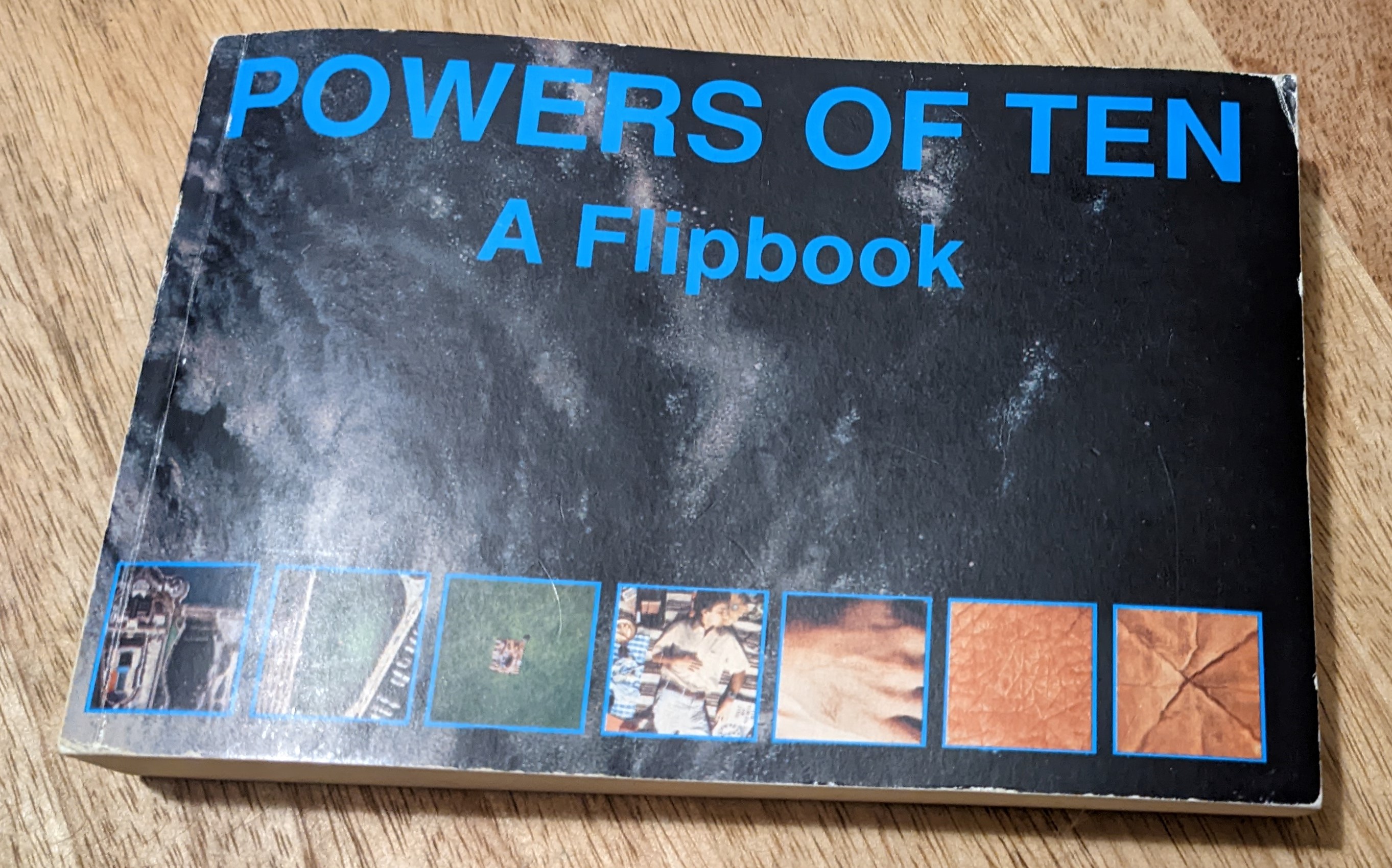
I have a couple of Eames souvenirs. There is a flipbook of Powers of Ten:

Then there is our Eames lounge chair and ottoman. It is an iconic piece of mid-century (20th) furniture, first released in 1956, just before the IGY. About 10 years ago, we bought this one, and despite needing a repair due to a design flaw with the aging epoxy, it suits us fine. The seller told us that our chair once belonged to 1984 VP candidate Geraldine Ferraro, although there is no proof of that.

And finally, the philatelic items. I have the 2008 sheet of 16 commemorative stamps showcasing the important contributions  of Charles and Ray Eames to American design. The Eames lounge chair is shown in one of the stamps., top row, second from left.

Charles and Ray Eames sheet, Scott catalog 4133

And I have a first day cover with the stamp of the chair and a corresponding cachet. 

Scott catalog stamp 4333f on a first day cover, canceled in Santa Monica on June 17, 2008 

The place of issue for these stamps was Santa Monica, California, where the Eames's had a house and studio. In 2014, I visited this Eames House in Santa Monica Canyon on a field trip outing during the International Symposium on Archaeometry held at the Getty Museum and UCLA in Los Angeles.

My photo of the exterior of the Eames House and Studio

Happy Thanksgiving, everyone.

Thursday, October 20, 2022

Belated happy anniversary, Sputnik; Antarctic post office welcomes four new employees

I'm still not up to my preferred blogging speed, but I thought I had better check in. Can I offer a partial excuse that I was on vacation in Switzerland for three weeks, enjoying cultural attractions in Bern, the mountain landscape of the Wallis Alps in Saas-Fee, and the lakeside pleasures of Ascona and Lago Maggiore. Not to mention food and drink in all of those places! 

Allalin Glacier, Wallis, Switzerland

Oops, that trip is fading into the past, so now I also have to blame watching the baseball playoffs. My son Sam and I saw the hometown Phillies knock the Braves out last Saturday. I'm also rooting for my childhood team, the Yankees, so if they meet in the World Series, I'm not sure what I will do.

October 4 was the 65th anniversary of the launching of Sputnik, the first artificial satellite ever launched into orbit around the Earth. This NASA web page on Sputnik is informative. Below is a cover recently added to my collection that commemorates the first satellites of both the USSR and the USA. The postmark date of Dec. 31, 2018, was 60 years after the end of the IGY. It mentions the Belgian ionospheric scientist Marcel Nicolet who was the secretary general of the IGY. I have been searching for a cover signed by him or some other interesting memorabilia related to him, but so far, no luck. Do you have any leads?

My IGY cover #US 245. The stamp is Scott US 4502, issued as a 44¢ forever stamp on March 25, 2011. According to the Mystic Stamp website, this second “Celebrate!” stamp was designed by USPS art director Phil Jordan, working with neon artist Michael Flechtner.

Along with satellite launches, probably the other most noteworthy scientific aspect of IGY studies, and the other area of research that most captivated public interest, was the exploration of Antarctica. The Guardian had a recent story on the four women -- Mairi Hilton, Lucy Bruzzone, Clare Ballantyne and Natalie Corbett -- picked by the UK Antarctic Heritage Trust to run the world’s most remote, coldest post office (also Britains's most southerly post office) on Goudier Island in Port Lockroy, off the Antarctic Peninsula as part of the British Antarctic Territory (BAT), a place with no permanent residents. They will also be in charge of monitoring the island’s colony of 1,500 gentoo penguins; hence, Port Lockroy is also known as the Penguin Post Office. Around 70,000 pieces of mail are posted each year to over 100 countries.

The location of Goudier Island is shown with the arrow on the map below:

British Antarctic Territory government website

The post office and the penguins are shown in this BBC news clip:


Below are two of my covers commemorating the 30th anniversary of the IGY, each franked with a set of four stamps issued in 1987 by the British Antarctic Territory (Scott 141-144).

British Antarctic Territory cover (IN 041 in my collection) with stamps Scott 141-144. The 24p stamp is captioned "Port Lockroy" (in a very small font). The cachet shows the Antarctic Peninsula in teal, the location of Port Lockroy, and the general area of the BAT, but strangely does not indicate the full latitudinal extent of the BAT, which extends from 60°S to the South Pole in latitude, and from 20°W- 80°W in longitude.

British Antarctic Territory cover (IN 042 in my collection), registered, with an orbiting satellite shown in the cachet 

While I am at it, my latest IGY cover postmarked from Antarctica is shown below:

IGY cover US 247 in my collection

It is not the prettiest cover, rather misaligned, but  it is postmarked from the Amundsen-Scott IGY South Pole Station in 1958 during the IGY, and sent to Palmyra, Pennsylvania, outside of Hershey, about 25 miles from me. It bears the slogan Operation Deep Freeze. The air mail postage stamp used is Scott C39, issued in 1949 for the increase of the airmail postage rate from 5¢ to 6¢.  The DC-4 Skymaster in the image was a four-engine propeller plane that was used during World War II, for the Berlin Airlift, and later as a passenger airplane and for the delivery of airmail.

Sunday, June 12, 2022

Where have you gone, Joe Dimaggio?

I have been missing in non-action for a month now. I've just kind of lost motivation, at least for now, to keep the blog going using the pace and rubric I've been mostly following for close to a year: summarizing articles from the IGY Bulletin, one by one. And I've just been languishing a bit in general. So I hope to regain forward momentum soon, perhaps using a different rubric. 

I also decided to break my NY Times crossword solving streak at 800+. I realized that although I usually enjoyed doing them and the blog, those activities were sometimes controlling me rather than the other way around. Staring at my computer screen was also starting to make my brain feel congested. Plus, I will need some time in the near future to attend to some other issues, like cleaning out my office at the College, which I am finally vacating this summer. So overall I am trying to change the balance of my activities for now, you might say.

Well, music is a good pick-me-up. The song containing the lyric in this post's title is Mrs. Robinson, by Simon and Garfunkel. You remember ... it goes something like this:


It is from the album Bookends, which was one of my favorites as an undergraduate. It is a concept album about life's journey. I'd best listen to it again, since my location on that route has progressed considerably. I owned the LP for many years, but now I own the CD. For me, the best song on the album was A Hazy Shade of Winter: "Hang on to your hopes my friend. that's an easy thing to say, but if your hopes should pass away simply pretend that you can build them again."

The song was also part of the soundtrack of one of my favorite movies, The Graduate, including the breakout role for Dustin Hoffman. Am I remembering correctly that I saw this in the movie theater with my high school friend Carol? (I guess you wouldn't know.) She was a good person, I wonder what happened to her.

Joe Dimaggio, one of the greatest Yankees and baseball players of all time, finds his way into the title of this post. The years of the IGY, 1957-58, were when I first became aware of professional sports. My family was not into sports, and I gravitated towards the best teams of that era -- the New York Yankees (baseball), Boston Celtics (basketball), and the Baltimore Colts (football) -- rather than the local teams, which weren't very good -- the Washington Senators (baseball) and the Washington football team (there was no regional NBA team). Baseball has always been my favorite sport; I still like the Yankees (and now the Phillies), and am enjoying their amazing run so far this year. I still very casually root for the Celtics, so it is nice to see them in the NBA finals. I'm not even sure where the Colts play any more.

My favorite players from those teams, all hall-of famers, were Johnny Unitas of the Colts,  Bob Cousy and Bill Russell (Celtics), and my favorite athletic "hero" ever, Mickey Mantle of the Yankees.

(I recently read Amy Bloom's In Love, a moving account of her husband's assisted suicide. It took me a while to realize that her husband, Brian Ameche, was the son of another Colts star, running back Alan Ameche, who scored the winning touchdown in sudden death overtime in the 1958 NFL championship game against the NY Giants, sometimes called "the greatest game ever played.")

Mickey Mantle, who replaced Joe Dimaggio as the Yankees' center fielder, was no saint (and why should a ballplayer be one), but he was one of the greatest baseball players ever. As a kid and a fan,  I used to argue that he was the best of the New York center fielders of the IGY years, but now I would have to concede that Willie Mays of the NY Giants had a better career overall. Sorry, Duke Snider of the Brooklyn Dodgers  still comes in third. Mantle was the American League triple crown winner in 1956, the AL most valuable player in 1956 and 1957, an all-star in 1956-1958, World Series champion in 1956 and 1958, and AL champion in 1957. Quite a good run in those IGY years! I started reading Jane Leavy's acclaimed biography of The Mick a couple of years ago. I think I'll go back and finish it!


My figurine of The Mick, with me since 1962 or so

Sunday, April 24, 2022

Self-promotion for a presentation about my IGY collection and blog

A few years ago I joined my local stamp club, the Philatelic Society of Lancaster County. I finally made it to a live meeting just before the covid era, after which meetings were moved online. And there they still remain.

Meetings via Zoom have been held twice a month, agendas including business of the chapter, a keynote speaker, and sharing of items of interest by attendees. Although there are dues-paying memberships for the local chapter, anyone can drop in on these meetings.

At the meeting this coming Wednesday, I will be the keynote speaker. I'll be leading attendees through a powerpoint (using Google Slides presentation software, which I've been very pleased with) focusing on my IGY collections of philatelic and other materials, and on this blog. The Zoom meeting will begin at 6:30 pm (EDST), and my presentation will start after the business portion of the meeting has been completed. My guess is that I will speak for about 45 minutes. The meeting will be recorded. I hope to have a recording of my presentation that I can edit and make available, along with the presentation file. But in case you would like to attend live, here is the Zoom invitation:

Join the Zoom Meeting, Wednesday 27 April, 2022, 6:30 pm Eastern Daylight Savings Time:

The American Philatelic Society lists about 400 stamps clubs from around the world. Maybe there is one near you!


Wednesday, April 13, 2022

IGY Bulletin, Number 9, March 1958 - Phototrack

Back to the IGY Bulletin articles. Phototrack was the designation for the program utilizing volunteers to help track Earth satellites, as noted in a previous post.

Accuracy of these observations was deemed to be "quite high," limited by timing accuracy, which was 0.1 seconds.

Photographs were taken against a fixed starfield background which yielded satellite positions. Timed breaks were inserted in the image used to track the satellites. 

Image showing the tracking of Earth Satellite 1957β, i.e. Sputnik 2 (from the Bulletin article)

Times were determined with a Phototrack camera by photographing a clock three times per picture, leaving a time mark on the image of the starfield and satellite. The clock was synchronized to radio station WWV, run by the National Bureau of Standards (now the National Institute of Standards and Technology).

Photographing the clock for timing marks (from the Bulletin article)

Other specifications for the Phototrack system are given in the Bulletin article. 

There is a Wikipedia article that summarizes this Phototrack program. There is also a nice personal recollection of participation in the Phototrack program by John Sutherland. He started worked at the Phototrack 5007 tracking operation in Walpole, MA, that had been set up during the IGY by Warren Davis and others. I tried to email Sutherland, but that was bounced back. Sutherland reminds us that "all of this ‘space’ activity happened in the slide rule era – there were no computers to help with the calculations, in fact, there were not even any hand calculators. Everything was done manually and by knowing how to create and use formulas." One of the Wikipedia article citations is "Seven Place Cosines, Sines, and Tangents For Every Tenth Microturn." That sounds pretty brute force.

My antique slide room, vintage 1972
In my undergrad days of the late 1960s and early 1970s, all calculations were done with slide rules; tables of various mathematical functions were also very useful. At some point I lost my trusty K&E slide rule, which I used daily for four years. I still own the replacement shown at right, now gathering dust on my electronics museum shelf.

The history of the slide rule goes back to the early 17th century. There is not a single postage stamp honoring the slide rule, but I think there should be!

In my first real job at Fairchild after graduation, I used a desktop mechanical calculator, a wonderful machine. My father had used one at home to work on his accounts. In grad school I finally used digital calculators, followed by programmable calculators, and then mainframe computers with terminals in the lab where I worked. It wasn't until the very end of grad school that I saw my first Apple personal computer, and then used and bought an original IBM PC soon after I started my job at Franklin & Marshall College in 1983.

My first IBM PC from 1983-84 (right); a later iMac (left)

These older technologies make me think of the women calculators of NASA, and the book and movie Hidden Figures. Kudos to trailblazer Katherine Johnson and her colleagues!


Monday, April 11, 2022

Other International Years observed by the United Nations

Sorry about the greater than usual number of typos in the last post. I correct errors I find afterwards in the blog, but those edits are not forwarded to subscribers. I always thought that posts went out the next morning once the blog was published, but that one went out in the evening after my afternoon's work, before I came back to do another proofreading.

I've been a little blah on blogging lately, but I found a topic that tickled my fancy. I was cleaning up some piles of stamps from my childhood collection when I came across a couple of other "international year" stamps. That made me wonder about so-called international years.

This web page for the United Nations with a list of international years states:

The United Nations designates specific days, weeks, years and decades as occasions to mark particular events or topics in order to promote, through awareness and action, the objectives of the Organization. Usually, it is one or more Member States that propose these observances and the General Assembly establishes them with a resolution. On occasion, these celebrations are declared by the specialized agencies of the United Nations, such as UNESCO, UNICEF, FAO, etc., when they concern issues that fall within the scope of their competencies. Some of them may be later adopted by the General Assembly.

The list contains 88 international years from 1961 to 2024, with more than one for some calendar years.

The IGY in 1957-58 was not a UN designated international year, coming before such declarations began. In an earlier post, I explained that CSAGI (acronym for Comité Spécial de l'Anée Géophysique Internationale, French for The Special Committee for the International Geophysical Year) was formed by the International Council for Scientific Unions (ICSU), now the International Council for Science. The ICSU's mission was to strengthen international science for the benefit of society. It was one of the oldest non-governmental organizations in the world, its predecessor organizations dating back to the start of the 19th century. Thus, it far predates the United Nations, organized in 1945.

We have seen in an earlier post that the UN was involved in the IGY via the cooperation of the World Meteorological Organization (and perhaps in other ways I am not aware of).

I have put the list of UN International Years in tabular form, which you can see here. A number of these do have scientific or environmental themes. The six such years for which the U.S. issued postage stamps were:


I have the first two of these stamps in my childhood collection, and the last one in my IGY collection. This Fourth International Polar Year followed 50 years after the IGY, which was initially going to be the Third International Polar Year.

World Refugee Year, Scott 1149 (1960), canceled, from my childhood collection, mounted in Minkus' The New World Wide Postage Stamp Album.

World Refugee Year, Scott 1149 (1960), mint, more recently purchased. Designed by Ervine Metzl, who also designed the U.S. IGY stamp

International Cooperation Year, Scott 1266 (1965)

International Polar Year, Scott 4123 (2007)

News flash! I forgot I had ordered another U.S. philatelic item for a UN International Year, and it just arrived. It is an aerogram for the 1983 World Communications Year. I consider this IGY-related, since 1983 also happened to be the 25th anniversary of the first U.S. satellite put in orbit during the IGY. An aerogram  is "a sheet of paper with a strategically placed stamp-like indicium that prepays air mail postage. After the message and the name and address of the recipient are written, the sheet is folded, sealed, and mailed. No enclosures are permitted" (Encyclopedia of United States Stamps and Stamp Collecting glossary). My mother exchanged aerograms (the most economical way to write internationally) with overseas relatives when I was young;  I should have a trove of those sent to her somewhere. The U.S. issued a total of 25 aerograms from 1947 to 1999, when their production ceased due to the decline in postal communications (Wikipedia).

Air post stamped envelopes and air letter sheets (aerograms) have a special "back of the book" (items listed in different categories in the Scott catalogs following regular postage stamps) designation in the Scott catalogs, UC.

Front, World Communication Year themed U.S. aerogram, Scott UC56 (1983)

Back, World Communication Year themed U.S. aerogram, Scott UC56 (1983)

The indicium on the front shows a world map with the locations of satellite tracking stations. The cachet on the front of this first day cover shows a satellite and a tracking station. The satellite looks like a Tiros weather satellite, with panels of solar cells surrounding the body.

The image on the back of the aerogram shows another type of satellite and its partner tracking station. The satellite has solar cell arrays deployed on panels that could rotate to orient towards the sun.

Remember that my first non-summer job with Fairchild Space and Electronics Co. involved working on space power subsystems -- solar cell arrays and batteries -- for communications satellites.

Monday, March 07, 2022

IGY Bulletin, Number 8, February 1958 - Satellite telemetry

This article in the Bulletin begins by stating that in order for non-recoverable satellites to be used for direct observations, telemetering systems must be used that record the satellite's observations, encode them, and transmit them to ground stations. Measurements can then be made in space rather than just from the ground, unhampered by the atmosphere.

Telemetry from satellites faced the extra obstacles of cost of the satellite, the need to record for long time periods, and the impossibility of maintenance. The telemetry system had to be of low weight, and have low power consumption. For the IGY program, one type of telemetry was done in real-time as data were collected, and another type used satellite-borne tape recorders. Volunteers equipped to make tape recordings of satellite signals were solicited to help with data retrieval and storage.

One gift for my bar mitzvah in 1963 was my first reel-to-reel tape recorder, as shown here.  I recorded some musical mix tapes from the radio (including My Girl from the Temptations) and exchanged letters-by-tape with a couple of friends in college. Last time I tried, the reels still moved, but the speed was not well controlled, and the playback was of poor quality. This tape recorder was almost IGY-era vintage!

The Bulletin article proceeds to describe details of telemetry systems used by IGY satellites that were collecting data on ultraviolet radiation, micro-meteoric particles, and cosmic rays. Much of the article is a little more technical than we need to go into.

The lead story in Popular Mechanics (1902-today) for the March 1958 issue was "Electronics and the IGY," the full text of which you can read here. I happen to own a copy of that issue. Below are scans of the cover and a photo from the article showing a telemetry recording system.

Scan of the cover of Popular Electronics, March 1958 issue

Scan of image in my copy of Popular Electronics. Caption: Measuring telemetered data from rockets in flight at an installation in Manitoba, Canada. At the far left is a telemetry recorder which takes data from airborne rockets; in the center is the main recorder which puts data on tape; the ballistic camera master control is at the right. 

As an aside, the term "satellite telemetry" has also been applied to a form of tracking of long-distance migrating animals used since the 1980s. After an animal has been captured and a tracking device has been attached, researchers can monitor movements of that individual for extended periods of time without having to recapture it. Satellite telemetry uses attached or implanted devices that communicate via radio signals to orbiting satellites, which give positional fixes on the device, and thus, the animal. This can replace older methods of tracking based on recapturing tagged individuals, or radio-telemetry which requires an observer to physically follow the tagged animal.

Speaking of animal migration, yesterday I made my nearly annual short-distance migration to the Middle Creek Wildlife Management Area, where tens of thousands of snow geese and tundra swans layover for a couple of weeks at this time every year as part of their incredible migrations back to the far north. For the day/time we were there, the number of birds in the lake were not not that impressive. I'm not sure if they had already left the area, or were just out feeding for the day.

We did see a nice group in chevron flight

The lake was sparsely occupied by tundra swans

I only have a few videos posted on YouTube. Here is maybe my first one, from 13 years ago, pretty low quality, showing some of the snow geese at Middle Creek: