Showing posts with label International Geophysical Year. Show all posts

Sunday, November 05, 2023

Antarctic ice thickness sounding, and the Commonwealth Trans-Antarctic Expedition during the IGY

I try to be careful about expanding the scope of my two topical collections (IGY and North American earthquakes). This is a short explanation of the decision to expand of my IGY collection to include the Commonwealth Trans-Antarctic Expedition of 1955–1958.

I was catching up on reading some old issues of magazines and journals, and I came across an article entitled "How Thick Is Antarctic Ice, and What Is Underneath? Scientists used electromagnetic fields to determine the thickness of fast ice," by Saima May Sidik, in Eos, 104, published by the American Geophysical Union,  22 February 2023.

This news article describes a paper by Langhorne et al. that provided more reliable estimates of Antarctic fast ice (sea ice that is "fastened" to the coastline, to the sea floor along shoals, or to grounded icebergs - see figure below) thickness by using a technique of airborne geophysics, specifically electromagnetic induction sounding. A sensor called a “bird” is towed beneath the aircraft at an altitude of 15 meters above ground level. A magnetic field is transmitted through the ice into the conductive seawater  below which then induces electric currents that the bird can detect. The resulting data are used to infer the ice thickness. This technique has several advantages over previous methods: a wider geographic range than drilling into the ice; penetration of saline sea ice, unlike radar; and more certain estimates than satellites.

Some of the most common sea-ice related features, including  fast ice. The bear provides an approximate scale for this scenario (Wikipedia)

The researchers used the system to survey a 700-km-long section of coast in the Ross Sea, home to the Scott Base, McMurdo, and Zucchelli research stations (see a map of the stations in this post). The area is known for its floating glaciers and ice shelves which are stabilized by fast ice. Fast ice in the region was found to be typically 2-3 meters thick. 

A search revealed that a stamp issued in 2022 by New Zealand's Ross Dependency depicts this method (Scott NZ-RO L177), showing a helicopter towing a bird (see right). This image is from colnect, not my collection. This stamp is one of four stamps comprising a Science on Ice miniature sheet.
Determining Antarctic ice thickness was also a goal of the IGY, although more for the continental ice sheet rather than for fast ice. For example, right after I left off my reviews in this blog of the IGY Bulletin with Number 9, issue Number 10 started with an article on "IGY Antarctic oversnow traverses." It describes three major oversnow traverses planned by the U.S. IGY Committee for the 1957-58 summer season, shown on the map below.
Traverses across the Ross Ice Shelf from the Little America Station, over parts of Marie Byrd Land and the Ellsworth Highland from Byrd Station, and across the Filchner Ice Shelf and parts of Edith Ronne Land from Ellsworth Station.

On these traverses, coring along with ground-based geophysical methods of seismics, gravity, and geomagnetism were used to infer continental ice sheet thicknesses of as much as 10,000 feet (3000 m).

Simplified cross-sectional profiles of the continental ice sheets in Greenland and Antarctica (https://opentextbc.ca/geology/chapter/16-2-how-glaciers-work/)

Scott GB-AT 47, my collection
I wondered if there were any IGY stamps that focused on Antarctic ice thickness. Another search in colnect led me to such a stamp on s
eismic depth sounding from the British Antarctic Territory (Scott GB-AT 147, shown at right), issued in 1988 to commemorate the 30th anniversary of the Commonwealth Antarctic Expedition of 1955-58. This was from a four-stamp series which I then bought. 

The other three stamps in the series, shown here, have themes of the aurorae, aircraft, and a Sno-cat.

I also bought this first day cover with cachet including all four of the stamps.
Cover showing all four stamps from the BAT 1988 set commemorating the 30th anniversary of the Commonwealth Trans-Antarctic Expedition (scanned from online, since my purchase has not yet arrived).

I decided this Expedition and its anniversary would be legitimate components of my IGY collection. According to Wikipedia:

The Commonwealth Trans-Antarctic Expedition (CTAE) of 1955–1958 was a Commonwealth-sponsored expedition that successfully completed the first overland crossing of Antarctica, via the South Pole. It was the first expedition to reach the South Pole overland for 46 years, preceded only by Amundsen's expedition and Scott's expedition in 1911 and 1912.

It was headed by British explorer Vivian Fuchs, with New Zealander [mountaineer] Sir Edmund Hillary leading the New Zealand Ross Sea Support team. The New Zealand party included scientists participating in International Geophysical Year [emphasis mine] research while the British team were separately based at Halley Bay.

Route map of the Commonwealth Trans-Antarctic Expedition (Reed Gallery)

The British Antarctic Territory (consisting of the South Shetland Islands, South Orkney Islands and the Antarctic Peninsula with a sector of the continent extending to the South Pole) issued stamps in 1963, 1966, 1969, 1971, 1972, 1973, 1974, and then annually since 1977. It's interesting that the BAT only issued these four Antarctic stamps in 1988, the lowest number in any one year. A smoothed graph I made of the issuances per year shows a 5-year decline starting after 1983, then a general rise until 2012 and another decrease since then. Whatever significance there may be in these trends is beyond me.

Issuance of stamps by British Antarctic Territory. Data from Colnect.

More on related covers in future posts.

Saturday, July 01, 2023

Happy 66th birthday, IGY

Today marks the 66th anniversary of the beginning of the IGY. 

An earlier post discussed the role of President Eisenhower in the IGY, including a video of his speech for its opening,

The Eisenhower Library lists a number of online docuuments about the IGY. That web page also excerpts a quote from President Eisenhower's speech in a video from the post above, that "the most important result of the International Geophysical Year is that demonstration of the ability of peoples of all nations to work together harmoniously for the common good. I hope this can become common practice in other fields of human endeavor."

Apropos of the international aspect of the IGY, I recently bought  my first IGY-related cover with United Nations stamps.

Cover IN245 in my collection

The stamps are United Nations (New York) 49 and 50 in the Scott catalog, representing weather satellites launched by the World Meteorological Organization. The role of the WMO in the IGY was mentioned in a previous post .

The postmark was from the USS Wyandot, dated during the IGY, and the cachet lauds its roll during Operation Deep Freeze, which provided critical infrastructure in support of the IGY program in Antarctica.

As Eisenhower hoped, if only that IGY and United Nations spirit of international cooperation in the name of scientific advances for the good of humanity were more widespread today!

Sunday, June 11, 2023

Recent 65th anniversary of the issuance of the U.S. IGY stamp

The U.S. IGY stamp was issued on May 31, 1958. Recently we saw the 65th anniversary of that date. Happy, birthday, 1107! Congratulations on becoming a senior citizen.

I recently bought a cover which contained 5 of these stamps. 

Cover IGY 254 (front) from my collection

Cover IGY 254 (back) from my collection

This cover has several notable characteristics:

  1. It is franked with a block of  four IGY stamps (Scott 1107).
  2. The block has a first day of issue (5-31-58) cancellation for this stamp.
  3. A single additional IGY stamp on the cover was cancelled (using a barrel/football) with a postmark from Quaker Hill, CT, on 7-26-1958. The cover was addressed to Mr. and Mrs. L.C. Maples in Quaker Hill.
  4. Typed on the cover: "Carried on USS Skate (SSN578) on first under-ice crossing under North Pole. Achieved 12 August 1958." 
  5. The cover is signed by James F. Calvert, the distinguished commander of the Skate.
  6. Typed on the cover: "Courtesy of F.G. Weigle", an acoustic physicist who sailed on the Skate. I'm not sure exactly what "courtesy of " means in this case; perhaps he typed on the text and secured the signature.
  7. The front includes the Artmaster IGY cachet (Mellone 4).
  8. On the back of the cover is a nice cachet noting the USS Skate's polar ice cap cruise during the IGY.

The USS Skate (SSN-578) was: the lead ship of the Skate class of nuclear submarines; the third nuclear submarine commissioned by the U.S. the second submarine to reach the North Pole (8-11-58 during this voyage, after the USS Nautilus had done so in 1957); the first to surface at the North Pole through the ice cap (in 1959); and the first to make a completely submerged trans-Atlantic crossing.

The history of this cover is not 100% clear to me. I assume the International Geophysical Year FDC was produced first. The cover was postmarked again on 7-26-1958 in CT, near the ship's home in Groton. This date was before the Skate departed for the North Pole  on July 30. But the text says the cover was carried on the USS Skate's voyage underneath the polar ice cap. So I don't understand how the dates mesh. Could it have been postmarked before the ship departed, traveled on the ship, and then delivered after the expedition without an additional franking? Or sent on the ship without a postal marking, managed by Weigle, and then mailed to Quaker Hill upon its return (I lean towards this interpretation)? Or could there be another explanation? It may be worth noting that the submarine base in New London, CT, the Skate's base, is only 4 miles from Quaker Hill. Thanks for any suggestions.

I appealed for help to better understand this cover to the Facebook group of the Universal Ship Cancellation Society, and although I got some appreciation of the item, no one completely answered my questions. If any of you, dear readers, can shed additional light, please let me  know.

Saturday, May 13, 2023

Hungarian National Committee for the IGY, Sopron, and the Pan-European Picnic

I recently bought an interesting item on eBay, one for which I was the sole bidder, so it was not very expensive. It was a sheet signed by the members of the Hungarian National Committee for the IGY. Countries participating in the IGY had national committees to organize and guide the work done by scientists from that country.

Members and signatures of the Hungarian National Committee for the IGY

I am assuming the officers were the key figures on this committee. Prof. A. Tározy-Hornoch is listed as academician, president of the committee, and representing the field of geodesy (shape and gravitational field of the Earth). Prof. L. Egyed is listed as secretary of the committee, representing the field of seismology. I found a little more information online about these two scientists.

Prof. A. Tározy-Hornoch (1900-1986) was a university professor in Sopron and one of the most prominent figures in 20th century Hungarian geodesy. He is the eponym for Hungary's Tárczy-Hornoch Antal Geodetic Laboratory, used for the development and calibration of geodetic instruments and devices. 

According to Wikipedia, Prof. László  Egyed  (1914-1970) was a professor at the Geophysical Institute of the Eötvös-University in Budapest. He published over 100 scientific articles. He wrote the book Physics of the Solid Earth in 1956; I don't think a translation exists, but it would be interesting to read this book to survey the field of geophysics just prior to the IGY. 

Egyed was a supporter of the expanding Earth hypothesis, a suggested alternative to plate tectonics. According to this post from Scientific American, Egyed based his thinking on variations of the sea level in the geological past, concluding that today's continents are the remains of the ancient crust of a smaller planet, surrounded by younger rocks generated along fractures at the mid-ocean-ridges. Popular Mechanics had an article describing expanding Earth ideas in more detail.

This document is reminiscent of my last post, about my one-page exhibit which included covers featuring three key personnel of the U.S. National Committee for the IGY: Joseph Kaplan (chairperson), A. H. Shapley (vice chairperson), and Hugh Odishaw (executive secretary).

I could not easily find much information on Hungary's activities as part of the IGY, but it did establish the Nagycenk Geophysical Observatory in 1956-57, operated during the IGY and since by the Geodetic and Geophysical Institute of the Earth Science Center, Hungarian Academy of Sciences. The observatory makes continuous records of Earth electrical currents, atmospheric electricity, ionospheric and meteorological observations.

In 2009, I was at a geophysics conference in Tározy-Hornoch's Sopron, the XIth International Association of Geomagnetism and Aeronomy (IAGA) Scientific Assembly. I sent myself a postcard prepared for the event. It is franked with what seems to be a somewhat standardized Hungarian postage stamp, similar to Scott 3926a, showing a surveying compass and map of Hungary. The word Belföld means domestic (I think), so other stamps were added to make the international postage. Magyarország is Hungarian for Hungary. The non-standardized label on the stamp margin gives the date and place of the IAGA meeting. There is a corresponding IAGA 2009 cancellation of the stamps. Maybe Prof. Tározy-Hornoch himself walked the halls of the conference building in an earlier era.

Front of self-addressed postcard from IAGA 2009, Sopron

Back of postcard from IAGA 2009, Sopron

While I was in Sopron, I took a wonderful bike ride into the countryside, where I saw the impressive Fertőrákos limestone quarry (photo at right). The quarry was used as early as Roman times, but nowadays there are concerts in an amphitheater among the cavernous excavations. This was also the area of the so-called Pan-European Picnic two decades earlier in 1989, the first place where East Germans on holiday were allowed to cross the border unimpeded into Austria and the West. Soon afterwards the Berlin Wall fell (I stood on top of it in the week before Christmas, 1989), and then everything else! 
This exhibit in Sopron commemorated the 20th anniversary of the Pan-European picnic

Once I got to the Neusiedler See on my bike ride, a cold beer really hit the spot


Wednesday, March 29, 2023

My third annual one-page philatelic exhibit - administrator-scientists of the IGY

The American Topical Association has now posted its 3rd annual round of 1-page exhibits on philatelic topics.

In 2021, I contributed a 1-page exhibit derived from my IGY collection, showing one IGY stamp from each of the 19 countries that issued IGY stamps between 1957 and 1959.You can find a copy of my exhibit here.

Last year, using my other philatelic collection on North American earthquakes, my 1-pager was about the encounter of the USS Constitution, aka Old Ironsides, with the Long Beach earthquake of March 10, 1933. You can see that poster here.

This year I have returned to the IGY for my ATA 1-page exhibit.  After I bought the IGY cover signed by Lloyd Berkner that I shared in my last post, I decided to do my exhibit featuring covers signed by significant figures in the IGY. That exhibit is posted here, or you can see it below. It shows 5 first day covers bearing the U.S. IGY stamp (Scott 1107) and involving arguably the top 5 (or at least 5 of the) most influential CSAGI (Chapman and Bartels) and U.S. (Kaplan, Shapley, and Odishaw) officers of the IGY. Four of the covers are signed. The Kaplan cover has no signature, but it does include a cachet with his picture.

My ATA 1-page exhibit for 2023

In an earlier post, I mentioned that CSAGI's (Comité Spécial de l'Anée Géophysique Internationale) five officers (see photo below) included Sydney Chapman (president) and Lloyd Berkner (Vice President). That post included the cover with Chapman's signature.

 A meeting of the Special Committee for the International Geophysical Year, known by its French acronym CSAGI, in Brussels in June 1957, included Vladimir V. Beloussov of the Soviet Union, left, Lloyd V. Berkner of the United States, [Marcel] Nicolet [of Belgium], Jean Coulomb of France, and Sydney Chapman of the United Kingdom (NASA)


The U.S. National Committee for the IGY included Hugh Odishaw as its executive director. I also previously showed my cover signed by Odishaw.

I couldn't really find any online sites that describes the U.S. IGY Committee. In another earlier post, I mentioned that I own a copy of the Proposed United States Program for the International Geophysical Year, 1957-58, a 105-page document published in 1955 by the United States National Committee for the International Geophysical Year. It states in the introduction (p. ix) that organizations critical for each nation that developed its own IGY program would be the "adhering bodies" which would provide the focuses (foci) for those national committees and their programs. In the U.S., this body was the National Academy of Sciences-National Research Council. In turn, the Academy organized the U.S. National Committee for the IGY to "plan, direct, and execute the IGY program." The Committee members were listed inside the front cover shown, where you will see the names of Kaplan, Shapley, and Odishaw.

People on the U.S. National Committee for the IGY

I found a rather informative, chatty and interesting transcription of an oral interview with Alan Shapley by historians of science Ron Doell and Fae Korsmo, much of it about the IGY and its organization. Lots of interesting history and anecdotes, including about Chapman, Bartels, Kaplan and Odishaw, told with humor and some colorful observations of various participants. The interview was done in 2003, by which time Shapley had long survived these other luminaries (Chapman, 1888-1970; Berkner,1905-1967; Kaplan,1902-1991; Shapley, 1919-2006; Odishaw, 1916-1984), so that allowed him to be quite candid about the IGY program and its personnel: 

"Berkner was the wheeler-dealer" in the formulation of the IGY. 

He "didn’t want to be involved nationally in the US program ... So they hit upon Joe Kaplan, of UCLA, whose claim to fame was not really in geophysics. But he identified what are now known as the Vegard-Kaplan bands in the spectrum of the aurora. That’s almost the only thing he did except defend their football team." 

"How they hit upon me [Shapley himself], I don’t know."

"Chapman that said he had to solve or take the problems globally instead of as polar-wise [like the First and Second International Polar Years]. So I don’t think Berkner should get any credit for broadening things."

"Merle Tuve ... was a member of the US National Committee, and he was a very feisty person. A wonderful person, in contrast to some of the other people." 
"Odishaw’s first reaction on the International Geophysical Year was 'What the hell is that?' "

"Hugh and I were buddies. Joe Kaplan was a mouthpiece. Not to denigrate him, but Hugh and I did all the tactics and strategy."

"I was Staff Sergeant for the whole US program. Hugh and I were running the U.S. program. We manipulated Joe Kaplan as necessary."

Next year I may do a similar 1-page exhibit with signatures of 5 other prominent IGY scientists. Stay tuned.

Friday, March 10, 2023

A notable new acquisition - an IGY first day cover signed by Lloyd Berkner

 I recently was lucky to find a cover with a specific signature I had been looking for, at a modest price no less.

Lloyd Berkner signature on cacheted first day cover for U.S. IGY stamp            (cover US250 in my collection)

The first day cover features the U.S. IGY stamp (Scott 1107). The cachet is a common one by Art Craft, with one image showing (seismic?) measurements being made in Antarctica, and the other a montage of a rocket launch/Earth-orbiting satellite/tracking station.

But what makes this cover special is the signature by Lloyd V. Berkner, Vice president of CSAGI. Berkner (1905-1967) had a distinguished career as a radio engineer (including with the 1933 Byrd Antarctic expedition and later with the Navy in WWII), ionospheric scientist, and proponent of international cooperation in science.

Lloyd Berkner (Hales, 1992)

Berkner was vice president of CSAGI, as shown in his signature. "CSAGI is the acronym for Comité Spécial de l'Anée Géophysique Internationale, French for The Special Committee for the International Geophysical Year. This group was formed by the International Council for Scientific Unions (ICSU) to develop and coordinate the IGY. CSAGI met for the first time in October, 1952, almost 5 years before the start of the IGY, and organized a number of meetings after that to coordinate the various national committees working on the different subdisciplines of the IGY" (from an earlier post).

One of Berkner's greatest contributions to international science was his suggestion that after the First International Polar Year in 1882-83 and the Second International Polar Year 25 years later in 1932-33,  a Third International Polar Year should be scheduled twenty-five years after the second, instead of after another fifty years. Initial plans for this 3rd IPY took place in April, 1950, at a dinner party at the home of James Van Allen in Silver Spring, Maryland (where I lived from 1968-1972). Sidney Chapman later suggested it be called the International Geophysical Year (Korsmo, 2007). Berkner argued that technologies developed during World War II would enable improved studies of Antarctica, that 1957-58 would be a year of sun spot maximum, and that those present at the party would presumably still be alive and able to participate in such an endeavor in 1957-58 but not 25 years later in 1982-83 (Hales, 1992).

I have this book, published shortly after the IGY, in my library: Science in Space, Lloyd V. Berkner and Hugh Odishaw (editors), McGraw Hill, New York, 1961, 458 p.

The 20 articles review basic science that can be done in space and the use of experiments in space to learn about the Earth and our solar system.

I'll return to Lloyd Berker and Hugh Odishaw in an upcoming post.

Wednesday, January 04, 2023

Anniversary of the end of Sputnik 1

Happy 2023 to everyone. I notice that I did not blog once in December. I am not planning to stop, but my pace has certainly languished. I will probably not return to the biweekly pace I tended to keep for much of the last couple of years. No resolutions here, but we will see what the New Year brings.

I was looking for a historical event to post on the right sidebar, and it turns out today is the 65th anniversary of the death of Sputnik 1, first satellite into space, launched as intended during the International Geophysical Year. In a previous post I noted the anniversary of Sputnik 1's launch on Oct 4, 1957, three months into the IGY. Another post filled in additional technical details of the mission. Three months later, on Jan. 4, 1958, after 1,440 orbits each lasting 90 minutes, the satellite burned up as it re-entered the Earth's atmosphere.

Here is a cute video on how satellites stay in orbit, and why their orbits eventually decay.


By the way, the European Space agency defines low Earth orbit (LEO), where atmospheric drag degrades satellite orbits, as an elevation of less than 1,000 km above the Earth's surface. Sputnik 1's orbital elevation ranged from 215 km at perigee to 939 km at apogee, so it qualified as being in LEO.

Forbes.com actually posted an article in 2018, This Is Why Sputnik Crashed Back To Earth After Only 3 Months, by Ethan Siegel. It states that even though Sputnik's orbit was above the so-called Kármán line, hence in outer space, "Such disaster [of a satellite's demise] is inevitable due to satellite drag, which is a way to quantify how much speed a satellite loses over time due to the atmospheric particles it runs into at high relative speeds. Any satellite in low-Earth orbit will have a lifespan ranging from a few months up to a few decades, but no longer than that."

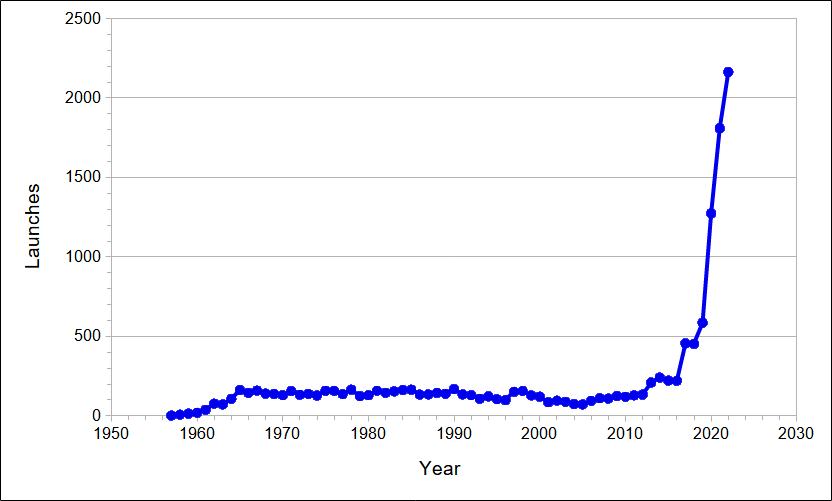
I came across an interesting web site, the Index of Objects Launched into Outer Space (including Earth satellites) from the United Nations Office for Outer Space Affairs. I could not seem to sort the table, but using the filter by launch year, I was able to obtain and graph (I love making graphs!) the number of launches by year, starting with the first two Sputnik launches in 1958 (see graph below). There are currently 10,100 still in orbit, and 4,176 objects not in orbit. After averaging 131 launches/year from 1965-2015, the number of launches has started going up exponentially, due to the Starlink program of SpaceX, which plans to deploy nearly 12,000 microsatellites to provide Internet access coverage to 45 countries and global mobile phone service. 

Objects launched into space by year (my graph, data from United Nations)

My editor pointed out that one of her favorite podcasts, Planet Money, had  a series, Planet Money Goes To Space, about the relative ease of getting a satellite into space these days.

We've come a long way since that 3-month lifetime of Sputnik 1!

Wednesday, November 23, 2022

Powers of Ten and Cosmic View

Powers of Ten is a short film made by the designer team of Charles and Ray Eames to illustrate the vast scale of the universe, from the outermost galaxies to the innermost nucleus of an atom, with human scale approximately in the middle. Starting from a look at picnickers on the shore of Lake Michigan, the scene zooms out by a factor of 10 every 10 seconds, from a scale of 1 meter (100) to a scale of 1024 meters. Then it zooms back to the picnic, and then inwards by a factor of 10 every 10 seconds until it reaches the nuclear scale of 
10-16 meters.

I saw a black-and-white predecessor of this film in my first-year physics course at Cornell in 1968, titled A Rough Sketch for a Proposed Film Dealing With the Powers of Ten. I was kind of blown away by it.

The best version of this film is this finished version of the Rough Sketch, now simply titled Powers of Ten, from 1977. The narration was by noted physicist and public intellectual Philip Morrison.

Other takes on the same theme include this 1996 version, also titled Powers of Ten, an IMAX film narrated by the omnipresent Morgan Freeman, starting on St. Mark's Square, Venice,

and this 1968 animated Cosmic Zoom from the National Film Board of Canada:

Every year I try to do a mini-celebration of Powers of Ten Day on Oct. 10, as I did again last month. When I worked in student life at Franklin & Marshall College in 2010, I organized a Powers of Ten event at 10:10 pm, on 10/10/10, with a showing of the film, or course.

This year I learned that these films emanate from a concept by Kees Boeke, as illustrated in his 1957 book, Cosmic View. Boeke, a Dutch reformist educator, Quaker missionary and pacifist, seems to have been a very interesting and committed individual. His idea for the scale of the universe theme was acknowledged in a couple of the films above.

You can see the pages of the Boeke's book Cosmic View at this website. Just as the Powers of Ten film was narrated by physicist Philip Morrison, this book includes an introduction by Nobel prize winner Arthur Compton. 

Jacket of Cosmic View (1957)

Is it coincidental that this book was published during the International Geophysical Year? At the dawn of the space age, I think that people had an increasing awareness and wonder at the scales of the universe, and it was certainly a challenge for educators to represent this.

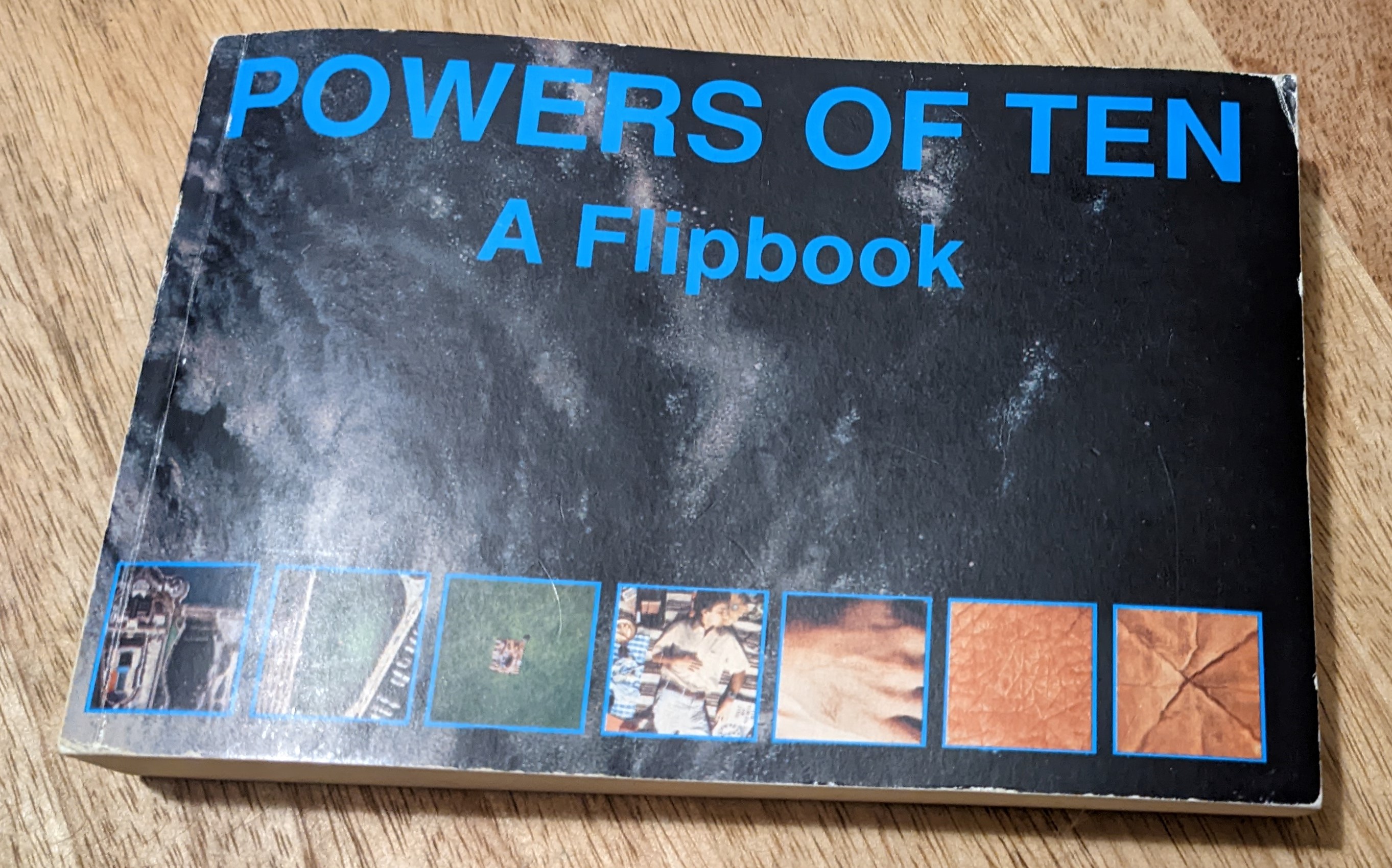
I have a couple of Eames souvenirs. There is a flipbook of Powers of Ten:

Then there is our Eames lounge chair and ottoman. It is an iconic piece of mid-century (20th) furniture, first released in 1956, just before the IGY. About 10 years ago, we bought this one, and despite needing a repair due to a design flaw with the aging epoxy, it suits us fine. The seller told us that our chair once belonged to 1984 VP candidate Geraldine Ferraro, although there is no proof of that.

And finally, the philatelic items. I have the 2008 sheet of 16 commemorative stamps showcasing the important contributions  of Charles and Ray Eames to American design. The Eames lounge chair is shown in one of the stamps., top row, second from left.

Charles and Ray Eames sheet, Scott catalog 4133

And I have a first day cover with the stamp of the chair and a corresponding cachet. 

Scott catalog stamp 4333f on a first day cover, canceled in Santa Monica on June 17, 2008 

The place of issue for these stamps was Santa Monica, California, where the Eames's had a house and studio. In 2014, I visited this Eames House in Santa Monica Canyon on a field trip outing during the International Symposium on Archaeometry held at the Getty Museum and UCLA in Los Angeles.

My photo of the exterior of the Eames House and Studio

Happy Thanksgiving, everyone.

Thursday, October 20, 2022

Belated happy anniversary, Sputnik; Antarctic post office welcomes four new employees

I'm still not up to my preferred blogging speed, but I thought I had better check in. Can I offer a partial excuse that I was on vacation in Switzerland for three weeks, enjoying cultural attractions in Bern, the mountain landscape of the Wallis Alps in Saas-Fee, and the lakeside pleasures of Ascona and Lago Maggiore. Not to mention food and drink in all of those places! 

Allalin Glacier, Wallis, Switzerland

Oops, that trip is fading into the past, so now I also have to blame watching the baseball playoffs. My son Sam and I saw the hometown Phillies knock the Braves out last Saturday. I'm also rooting for my childhood team, the Yankees, so if they meet in the World Series, I'm not sure what I will do.

October 4 was the 65th anniversary of the launching of Sputnik, the first artificial satellite ever launched into orbit around the Earth. This NASA web page on Sputnik is informative. Below is a cover recently added to my collection that commemorates the first satellites of both the USSR and the USA. The postmark date of Dec. 31, 2018, was 60 years after the end of the IGY. It mentions the Belgian ionospheric scientist Marcel Nicolet who was the secretary general of the IGY. I have been searching for a cover signed by him or some other interesting memorabilia related to him, but so far, no luck. Do you have any leads?

My IGY cover #US 245. The stamp is Scott US 4502, issued as a 44¢ forever stamp on March 25, 2011. According to the Mystic Stamp website, this second “Celebrate!” stamp was designed by USPS art director Phil Jordan, working with neon artist Michael Flechtner.

Along with satellite launches, probably the other most noteworthy scientific aspect of IGY studies, and the other area of research that most captivated public interest, was the exploration of Antarctica. The Guardian had a recent story on the four women -- Mairi Hilton, Lucy Bruzzone, Clare Ballantyne and Natalie Corbett -- picked by the UK Antarctic Heritage Trust to run the world’s most remote, coldest post office (also Britains's most southerly post office) on Goudier Island in Port Lockroy, off the Antarctic Peninsula as part of the British Antarctic Territory (BAT), a place with no permanent residents. They will also be in charge of monitoring the island’s colony of 1,500 gentoo penguins; hence, Port Lockroy is also known as the Penguin Post Office. Around 70,000 pieces of mail are posted each year to over 100 countries.

The location of Goudier Island is shown with the arrow on the map below:

British Antarctic Territory government website

The post office and the penguins are shown in this BBC news clip:


Below are two of my covers commemorating the 30th anniversary of the IGY, each franked with a set of four stamps issued in 1987 by the British Antarctic Territory (Scott 141-144).

British Antarctic Territory cover (IN 041 in my collection) with stamps Scott 141-144. The 24p stamp is captioned "Port Lockroy" (in a very small font). The cachet shows the Antarctic Peninsula in teal, the location of Port Lockroy, and the general area of the BAT, but strangely does not indicate the full latitudinal extent of the BAT, which extends from 60°S to the South Pole in latitude, and from 20°W- 80°W in longitude.

British Antarctic Territory cover (IN 042 in my collection), registered, with an orbiting satellite shown in the cachet 

While I am at it, my latest IGY cover postmarked from Antarctica is shown below:

IGY cover US 247 in my collection

It is not the prettiest cover, rather misaligned, but  it is postmarked from the Amundsen-Scott IGY South Pole Station in 1958 during the IGY, and sent to Palmyra, Pennsylvania, outside of Hershey, about 25 miles from me. It bears the slogan Operation Deep Freeze. The air mail postage stamp used is Scott C39, issued in 1949 for the increase of the airmail postage rate from 5¢ to 6¢.  The DC-4 Skymaster in the image was a four-engine propeller plane that was used during World War II, for the Berlin Airlift, and later as a passenger airplane and for the delivery of airmail.

Wednesday, May 04, 2022

IGY Bulletin, Number 9, March 1958 - Cruise of the Brown Bear

The ocean deeps are some of the most remote places on the Earth's surface (take the water out of the ocean, and the seafloor is the surface). Both the nature of the seafloor itself and the currents of  the ocean waters were of interest during the IGY. This article describes the cruise of the oceanographic vessel Brown Bear, of the University of Washington. 

R/V Brown Bear, photo provided by V. Lundquist, from NOAA Alaska Fisheries Science Center (https://www.ocean.washington.edu/story/School_History)


In the beginning of the IGY, the Brown Bear made investigations at 36 oceanographic stations in the Gulf of Alaska, the Bering Sea, and parts of the Northeast Pacific, as shown in the map below from the Bulletin article. The proposed cruise for 1958 is also shown, as are stations occupied by the Carnegie in 1929. The Carnegie  (you should read the fascinating article in the link) was a brigantine nonmagnetic yacht used to investigate the Earth's magnetic field for the Carnegie Institution's Department of Terrestrial Magnetism. That 1929 voyage was its last, as it exploded and sank while anchored in Samoa that November.

The Brown Bear's measurements were to look at both latitudinal and vertical movement of waters in the ocean, and the factors that affected them. According to the National Oceanographic and Atmospheric Administration (NOAA):

Differences in water density, resulting from the variability of water temperature (thermo) and salinity (haline), also cause ocean currents. This process is known as thermohaline circulation. In cold regions, such as the North Atlantic Ocean, ocean water loses heat to the atmosphere and becomes cold and dense. When ocean water freezes, forming sea ice, salt is left behind causing surrounding seawater to become saltier and denser. Dense-cold-salty water sinks to the ocean bottom. Surface water flows in to replace the sinking water, which in turn becomes cold and salty enough to sink. This "starts" the global conveyer belt, a connected system of deep and surface currents that circulate around the globe on a 1000 year time span. This global set of ocean currents is a critical part of Earth’s climate system as well as the ocean nutrient and carbon dioxide cycles.

Ocean circulation patterns are also nicely explained and depicted in this Ted-Ed video, Surface currents are the focus of the first half of the video, while deep currents are described in the second half.


The major objectives of the Brown Bear's 1957 cruise were: to gather data for a north-south profile of water properties (temperature and chemistry) extending from the surface to the ocean bottom; and for a preliminary survey of ocean water circulation in the Aleutians. Hauls of marine organisms were also made at various depths. Deep waters were dated using carbon-14 methods. The article goes on to cite specific preliminary findings. 

It turns out that I have a relevant first day cover in my collection for today's post.  It's a first day of issue cover of the U.S. IGY stamp, with a cachet of the R.V. (research vessel) Brown Bear. And, it is addressed to Richard Fleming (1909-1989), who was the director of the Department of Oceanography at the University of Washington.

FDC US141 from my collection

Richard Fleming (School of Oceanography, Univ. of Washington)