Showing posts with label satellites and space. Show all posts

Wednesday, January 04, 2023

Anniversary of the end of Sputnik 1

Happy 2023 to everyone. I notice that I did not blog once in December. I am not planning to stop, but my pace has certainly languished. I will probably not return to the biweekly pace I tended to keep for much of the last couple of years. No resolutions here, but we will see what the New Year brings.

I was looking for a historical event to post on the right sidebar, and it turns out today is the 65th anniversary of the death of Sputnik 1, first satellite into space, launched as intended during the International Geophysical Year. In a previous post I noted the anniversary of Sputnik 1's launch on Oct 4, 1957, three months into the IGY. Another post filled in additional technical details of the mission. Three months later, on Jan. 4, 1958, after 1,440 orbits each lasting 90 minutes, the satellite burned up as it re-entered the Earth's atmosphere.

Here is a cute video on how satellites stay in orbit, and why their orbits eventually decay.


By the way, the European Space agency defines low Earth orbit (LEO), where atmospheric drag degrades satellite orbits, as an elevation of less than 1,000 km above the Earth's surface. Sputnik 1's orbital elevation ranged from 215 km at perigee to 939 km at apogee, so it qualified as being in LEO.

Forbes.com actually posted an article in 2018, This Is Why Sputnik Crashed Back To Earth After Only 3 Months, by Ethan Siegel. It states that even though Sputnik's orbit was above the so-called Kármán line, hence in outer space, "Such disaster [of a satellite's demise] is inevitable due to satellite drag, which is a way to quantify how much speed a satellite loses over time due to the atmospheric particles it runs into at high relative speeds. Any satellite in low-Earth orbit will have a lifespan ranging from a few months up to a few decades, but no longer than that."

I came across an interesting web site, the Index of Objects Launched into Outer Space (including Earth satellites) from the United Nations Office for Outer Space Affairs. I could not seem to sort the table, but using the filter by launch year, I was able to obtain and graph (I love making graphs!) the number of launches by year, starting with the first two Sputnik launches in 1958 (see graph below). There are currently 10,100 still in orbit, and 4,176 objects not in orbit. After averaging 131 launches/year from 1965-2015, the number of launches has started going up exponentially, due to the Starlink program of SpaceX, which plans to deploy nearly 12,000 microsatellites to provide Internet access coverage to 45 countries and global mobile phone service. 
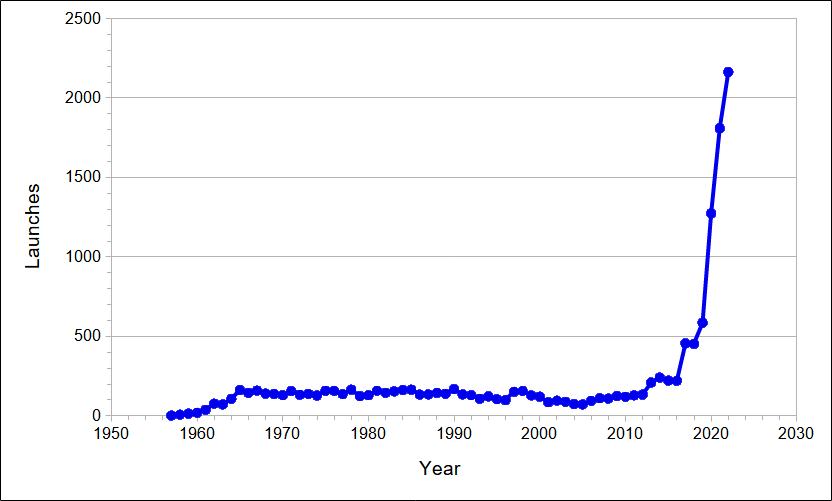
Objects launched into space by year (my graph, data from United Nations)

My editor pointed out that one of her favorite podcasts, Planet Money, had  a series, Planet Money Goes To Space, about the relative ease of getting a satellite into space these days.

We've come a long way since that 3-month lifetime of Sputnik 1!

Wednesday, November 23, 2022

Powers of Ten and Cosmic View

Powers of Ten is a short film made by the designer team of Charles and Ray Eames to illustrate the vast scale of the universe, from the outermost galaxies to the innermost nucleus of an atom, with human scale approximately in the middle. Starting from a look at picnickers on the shore of Lake Michigan, the scene zooms out by a factor of 10 every 10 seconds, from a scale of 1 meter (100) to a scale of 1024 meters. Then it zooms back to the picnic, and then inwards by a factor of 10 every 10 seconds until it reaches the nuclear scale of 
10-16 meters.

I saw a black-and-white predecessor of this film in my first-year physics course at Cornell in 1968, titled A Rough Sketch for a Proposed Film Dealing With the Powers of Ten. I was kind of blown away by it.

The best version of this film is this finished version of the Rough Sketch, now simply titled Powers of Ten, from 1977. The narration was by noted physicist and public intellectual Philip Morrison.

Other takes on the same theme include this 1996 version, also titled Powers of Ten, an IMAX film narrated by the omnipresent Morgan Freeman, starting on St. Mark's Square, Venice,

and this 1968 animated Cosmic Zoom from the National Film Board of Canada:

Every year I try to do a mini-celebration of Powers of Ten Day on Oct. 10, as I did again last month. When I worked in student life at Franklin & Marshall College in 2010, I organized a Powers of Ten event at 10:10 pm, on 10/10/10, with a showing of the film, or course.

This year I learned that these films emanate from a concept by Kees Boeke, as illustrated in his 1957 book, Cosmic View. Boeke, a Dutch reformist educator, Quaker missionary and pacifist, seems to have been a very interesting and committed individual. His idea for the scale of the universe theme was acknowledged in a couple of the films above.

You can see the pages of the Boeke's book Cosmic View at this website. Just as the Powers of Ten film was narrated by physicist Philip Morrison, this book includes an introduction by Nobel prize winner Arthur Compton. 

Jacket of Cosmic View (1957)

Is it coincidental that this book was published during the International Geophysical Year? At the dawn of the space age, I think that people had an increasing awareness and wonder at the scales of the universe, and it was certainly a challenge for educators to represent this.

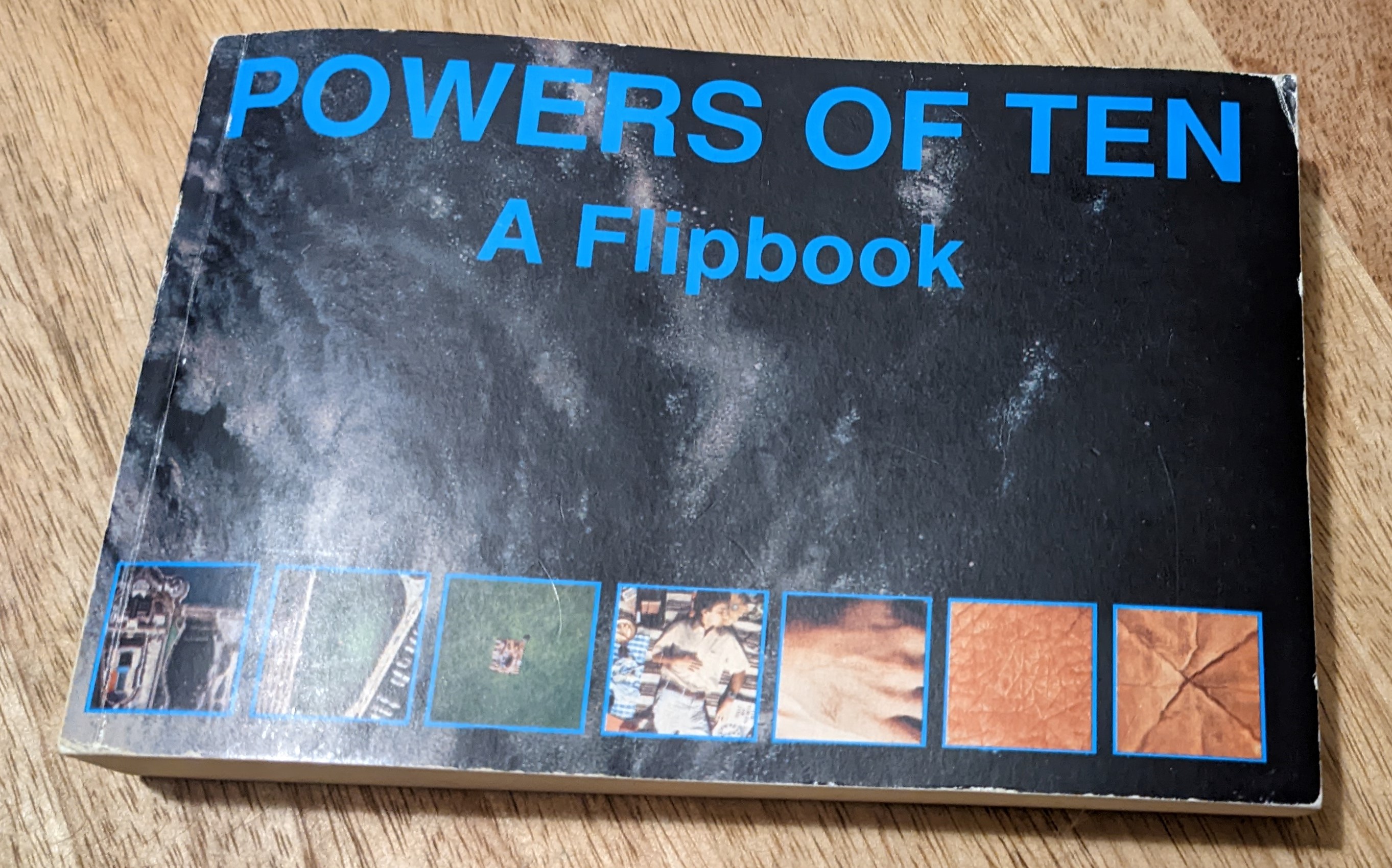
I have a couple of Eames souvenirs. There is a flipbook of Powers of Ten:

Then there is our Eames lounge chair and ottoman. It is an iconic piece of mid-century (20th) furniture, first released in 1956, just before the IGY. About 10 years ago, we bought this one, and despite needing a repair due to a design flaw with the aging epoxy, it suits us fine. The seller told us that our chair once belonged to 1984 VP candidate Geraldine Ferraro, although there is no proof of that.

And finally, the philatelic items. I have the 2008 sheet of 16 commemorative stamps showcasing the important contributions  of Charles and Ray Eames to American design. The Eames lounge chair is shown in one of the stamps., top row, second from left.

Charles and Ray Eames sheet, Scott catalog 4133

And I have a first day cover with the stamp of the chair and a corresponding cachet. 

Scott catalog stamp 4333f on a first day cover, canceled in Santa Monica on June 17, 2008 

The place of issue for these stamps was Santa Monica, California, where the Eames's had a house and studio. In 2014, I visited this Eames House in Santa Monica Canyon on a field trip outing during the International Symposium on Archaeometry held at the Getty Museum and UCLA in Los Angeles.

My photo of the exterior of the Eames House and Studio

Happy Thanksgiving, everyone.

Thursday, October 20, 2022

Belated happy anniversary, Sputnik; Antarctic post office welcomes four new employees

I'm still not up to my preferred blogging speed, but I thought I had better check in. Can I offer a partial excuse that I was on vacation in Switzerland for three weeks, enjoying cultural attractions in Bern, the mountain landscape of the Wallis Alps in Saas-Fee, and the lakeside pleasures of Ascona and Lago Maggiore. Not to mention food and drink in all of those places! 

Allalin Glacier, Wallis, Switzerland

Oops, that trip is fading into the past, so now I also have to blame watching the baseball playoffs. My son Sam and I saw the hometown Phillies knock the Braves out last Saturday. I'm also rooting for my childhood team, the Yankees, so if they meet in the World Series, I'm not sure what I will do.

October 4 was the 65th anniversary of the launching of Sputnik, the first artificial satellite ever launched into orbit around the Earth. This NASA web page on Sputnik is informative. Below is a cover recently added to my collection that commemorates the first satellites of both the USSR and the USA. The postmark date of Dec. 31, 2018, was 60 years after the end of the IGY. It mentions the Belgian ionospheric scientist Marcel Nicolet who was the secretary general of the IGY. I have been searching for a cover signed by him or some other interesting memorabilia related to him, but so far, no luck. Do you have any leads?

My IGY cover #US 245. The stamp is Scott US 4502, issued as a 44¢ forever stamp on March 25, 2011. According to the Mystic Stamp website, this second “Celebrate!” stamp was designed by USPS art director Phil Jordan, working with neon artist Michael Flechtner.

Along with satellite launches, probably the other most noteworthy scientific aspect of IGY studies, and the other area of research that most captivated public interest, was the exploration of Antarctica. The Guardian had a recent story on the four women -- Mairi Hilton, Lucy Bruzzone, Clare Ballantyne and Natalie Corbett -- picked by the UK Antarctic Heritage Trust to run the world’s most remote, coldest post office (also Britains's most southerly post office) on Goudier Island in Port Lockroy, off the Antarctic Peninsula as part of the British Antarctic Territory (BAT), a place with no permanent residents. They will also be in charge of monitoring the island’s colony of 1,500 gentoo penguins; hence, Port Lockroy is also known as the Penguin Post Office. Around 70,000 pieces of mail are posted each year to over 100 countries.

The location of Goudier Island is shown with the arrow on the map below:

British Antarctic Territory government website

The post office and the penguins are shown in this BBC news clip:


Below are two of my covers commemorating the 30th anniversary of the IGY, each franked with a set of four stamps issued in 1987 by the British Antarctic Territory (Scott 141-144).

British Antarctic Territory cover (IN 041 in my collection) with stamps Scott 141-144. The 24p stamp is captioned "Port Lockroy" (in a very small font). The cachet shows the Antarctic Peninsula in teal, the location of Port Lockroy, and the general area of the BAT, but strangely does not indicate the full latitudinal extent of the BAT, which extends from 60°S to the South Pole in latitude, and from 20°W- 80°W in longitude.

British Antarctic Territory cover (IN 042 in my collection), registered, with an orbiting satellite shown in the cachet 

While I am at it, my latest IGY cover postmarked from Antarctica is shown below:

IGY cover US 247 in my collection

It is not the prettiest cover, rather misaligned, but  it is postmarked from the Amundsen-Scott IGY South Pole Station in 1958 during the IGY, and sent to Palmyra, Pennsylvania, outside of Hershey, about 25 miles from me. It bears the slogan Operation Deep Freeze. The air mail postage stamp used is Scott C39, issued in 1949 for the increase of the airmail postage rate from 5¢ to 6¢.  The DC-4 Skymaster in the image was a four-engine propeller plane that was used during World War II, for the Berlin Airlift, and later as a passenger airplane and for the delivery of airmail.

Saturday, April 02, 2022

Explorer 3 launch anniversary stamps

So far I have posted on each successful satellite launch during the IGY to note the launch anniversary dates, and separately posted more information when articles become available in the IGY Bulletin. Today I want to honor (belatedly) the March 26, 1958, launch of Explorer 3 (which was my father's 52nd birthday)

I will save more technical information on this satellite until I get to the relevant article in the May 1958 issue of the IGY Bulletin.

Explorer 3 was the third successful U.S. satellite launch of the IGY, after Explorer 1 and Vanguard 1. According to JPL, "data from Explorer 3 - combined with earlier measurements from Explorer 1 - confirmed principal investigator James Van Allen's theory that radiation belts trapped by Earth's magnetic field exist around the planet." That discovery ranks as one of the most important of the IGY, becoming the basis of what we now call space weather. 

So, I tried to find a U.S. cover commemorating that mission. I found two on eBay with Explorer 3 cachets that were postmarked on the date of the launch. These each cost over $100, so I decided not to spring for those yet. You'll find nine U.S. covers with Explorer 3 themes listed in the wonderful database on satellite stamps compiled by Garry Toth and Don Hillger.

I did find a nice set of 2008 stamps from Antigua marking the 50th anniversary of the launch. According to the same database, these are the only postage stamps from any country specifically featuring Explorer 3. I've just bought them on eBay, so I show images (taken from Toth and Hillger) of them below, soon to become a part of my physical collection.

Miniature sheet, Scott catalog AG 3014; image from Toth and Hillger

Miniature sheet, Scott catalog AG 3016; image from Toth and Hillger

Miniature sheet, Scott catalog #3018; image from Toth and Hillger

When collecting philatelic items about American achievements during the IGY, I focus on collecting U.S. stamps and covers. I am not sure if the island of Antigua and Barbuda falls into this category, but there are smaller countries (and heck, even the U.S. with that Elvis stamp) that issue stamps on popular topics, like space and cute animals, fully expecting most stamps to be bought by collectors. These will never be used to mail anything and pay for postal services, meaning extra income for the country. Such stamps tend to be attractive, and of interest to topical collectors (Hayward, 2008). 

Listverse, a website of lists, in a piece on 10 Bizarre Ways That Tiny Countries Make Money, includes #5, The Islands Where Postage Stamps Are The Main Export. This piece highlights the islands of Ascension, Saint Helena, and Tristan da Cunha, together comprising a British Overseas Territory on the Mid-Atlantic RidgeAscension (current population of 1,000) issues five sets of stamps every year, for which 400 collectors maintain standing orders. The island itself is so small (34 square miles) that mail delivery is infrequent, and there is no national postal delivery service. Tristan da Cunha, the world’s most remote permanent settlement (population of 264, area 71 square miles) has been financially self-sufficient since 1980 thanks to a crayfish factory and the local post office, which sells its stamps around the world. 

One of my books, Stamp Collecting (1992), by Charles F. Adams, includes a section on Bhutan - The Kingdom of Fanciful Collecting (pp. 155-156). To quote: "When serious philatelists hear the mention of Bhutan, they instantly roll their eyes. No one really takes the stamps of Bhutan seriously, they say. Those aren't really stamps: they're junk, silly, ridiculous junk." Apparently some stamps are rather gimmicky, like miniature phonograph records, and "debate rages as to whether any of these 'stamps' have ever actually been postally used. But "even though they may be worthless, they sure are fun." And what could be wrong with having fun?


Saturday, March 19, 2022

IGY Bulletin, Number 9, March 1958 - First US-IGY satellite

On to the IGY Bulletin issue #9 from March, 1958. The download of this 16-page issue from the AGU website can be found here. The articles in this issue are:

  1. First US-IGY satellite
  2. Phototrack
  3. Life sciences in the IGY
  4. Cruise of the Brown Bear

Here I will summarize the first article. In an earlier post, I wrote about the successful launch into orbit of Explorer 1 on the anniversary of that historic event. This Bulletin article starts by summarizing rocket and satellite characteristics. The payload instrumentation was for measuring the cosmic ray intensity, the density of meteoric matter, and temperatures inside and on the skin of the satellite. A geiger counter was used to measure cosmic rays. Impact of solid meteoric particles was measured by a microphone and also by erosion gages based on changes in electrical characteristics. Thermal probes measured temperatures.

A schematic of the 80" long satellite, scanned from the article, is shown below:


Two radio transmitters allowed tracking by the Minitrack system. A telescopic sighting was reported from the Moonwatch team in Alamogordo, NM, and a naked-eye sighting reported from a Moonwatch team in Manhattan, KS. The latter reported the brightness to be that of a fifth-magnitude star, about 15 times dimmer than Polaris (the North Star).

In my post from a month ago, I showed the stamp that was finally issued at the turn of the 20th century to commemorate this launch, somewhat ignored until then because the U.S. was second into space. I have now acquired covers with cachets postmarked on the 15th (1973), 20th (1978), and 25th (1983) anniversaries of the launch, shown below.

One of 100 covers from the Smithsonian Milestones of Flight series, Stamp is the IGY president Eisenhower 8¢ (Scott #1393, 1970).

The 20th anniversary cover is franked with the 13¢ Kennedy definitive (Scott #1287, an older stamp from 1967).


This cover was not postmarked, but has a cancellation honoring the launch of Explorer 1. The cachet showing the rocket, satellite, and Wernher von Braun actually seems to commemorate the 25th anniversary of the founding of NASA, later in the year on 1 Oct. 1958. The 20¢ stamp shows the U.S. flag (Scott #1894, 1981).

The 15th anniversary cover included a small leaflet from the National Air and Space Museum. 

It stated that Explorer 1's cosmic ray measurements showed a lower than anticipated cosmic ray count. James Van Allen (who signed another Explorer 1 cover shown earlier) suggested the reading was spurious because the instrument had been saturated by a strong belt of radiation trapped in the Earth's magnetic field. This was to be verified by the Explorer 3 satellite, launched on 26 March 1958, one of the most significant findings of the IGY.

Wednesday, March 16, 2022

First successful Vanguard satellite launch into orbit, March 17, 1958

Let's commemorate the second successful U.S. satellite launch, Vanguard 1, on this date in 1958.

The U.S. had two competing satellite programs during the IGY, Explorer and Vanguard.

Project Vanguard was a program managed by the United States Navy Naval Research Laboratory (NRL), which intended to launch the first artificial satellite into low Earth orbit using a Vanguard rocket. The Navy proposal included all three aspects of the mission: launch vehicle, payload satellite, and ground tracking stations. 

In response to the launch of Sputnik 1 on 4 Oct. 1957, the U.S. revived the Explorer program, directed by Wernher von Braun under the aegis of the the Army Ballistic Missile Agency (ABMA). 

Ironically, the Air Force proposal was not pursued.

As discussed in an earlier post, the first three-stage Vanguard test rocket, TV-3, was launched on 6 Dec. 1957, but lost thrust, settled back on the launch pad, and exploded. The next Vanguard launch on 5 Feb 1958 flew for just 1 minute the vehicle lost control and then  broke up.

Meanwhile, ABMA, together with the Jet Propulsion Laboratory (JPL), built Explorer 1 and successfully launched the first U.S. satellite on 1 Feb. 1958, as discussed in this post.

On 17 March 1958, Vanguard 1, aka TV-4, became the second artificial satellite successfully placed in Earth orbit by the United States. Three times a charm! It was the first solar cell powered satellite. Just 6" in diameter and weighing 3 lb., Vanguard 1 was much smaller than Sputniks 1 and 2, hence dubbed as the "grapefruit satellite" by Soviet Premier Nikita Khrushchev. Vanguard 1, and the upper stage of its launch vehicle, are the oldest artificial satellites still in space, as Vanguard's predecessors, Sputnik 1, Sputnik 2, and Explorer 1, have decayed from orbit. Primary scientific objectives of this mission were to determine atmospheric density and the shape of the earth. The solar powered transmitter operated until May, 1964.

Below is a cover from my collection postmarked from Cape Canaveral on the 15th anniversary of Vanguard 1's launch. The cahet shows images of the rocket and satellite. The stamp is Scott #1402 (1971), bearing the image of Dwight Eisenhower, who had been president during the IGY. It is signed by John P. Hagen, director of the Vanguard program.

Cover from my collection for the 15th anniversary of the Vanguard 1 launch

Scott Manley has a nice YouTube video on these two programs and their launches:


My first real job out of college with Fairchild Space and Electronics Co. was in the space power subsystems group. We designed and sometimes fabricated solar cell array-battery power subsystems for satellites, a legacy of the Vanguard 1 mission.

Wednesday, March 09, 2022

IGY Bulletin, Number 8, February 1958 - IGY satellite program notes

Just a 1-page article to summarize today. It is a reprint of a short piece by Hugh Odishaw, titled "Soviet satellite carrier rocket," from Science magazine, vol. 126, no. 3287, 27 Dec. 1957, p. 1334.

It reports that on 8 Dec. 1957 a cable was sent by A. N. Nesmeyanov, chief scientific secretary of the Soviet Union, to Detlev Bronk, the president of the U.S. National Academy of Sciences. The letter stated that some unburnt parts of the rocket that carried Sputnik 1 into space might have been scattered on a line between Alaska and the west coast of the United States (Alaska was not yet a state.) Nesmeyanov asked that any recovered pieces be returned to the USSR Academy of Sciences. Bronk responded that no such finds had been made.

According to NASA, the Sputnik 1 rocket body, a Semyorka R-7 ICBM, was the second stage, or "core booster", that carried the Sputnik satellite into orbit. The rocket body itself (about 55' high by 10' across) also reached orbit and was visible from the ground as a magnitude 1 object. In fact, this was actually the "Sputnik" people saw from the ground over the next few months. The much smaller (2' diameter) Sputnik 1 satellite was barely visible at magnitude 6, one hundred times fainter than the rocket.

Below are two depictions of the Sputnik 1 rocket from my collections.

Schematic of the Sputnik 1 rocket (source is a booklet in my collection: Soviet Sputniks, 1959, p. 28)

The Sputnik rocket and satellite depicted on North Korean stamp from my collection (Scott #134, issued 26 March 1958)

Sunday, February 27, 2022

IGY Bulletin, Number 7, January 1958 - Ionospheric studies using Earth satellites

This is a summary the last article from the January 1958 issue of the IGY Bulletin.

By the end of January, 1958, three satellites had been successfully launched: Sputnik 1 (launched Oct. 4, 1957), Sputnik 2 (Nov. 3, 1957), and Explorer 1 (Jan. 31, 1958).

The article starts by stating that a conference on the study of the ionosphere by using radio observations of satellites was help on Nov. 5, 1957 (just after the launch of Sputnik 2), at the Central Radio Propagation Laboratory of the National Bureau of Standards (now the National Institute of Standard and Technology), under the direction of Alan H. Shapley.

Twelve projects that had utilized radio observations of Sputnik 1 are tabulated in the article.

The article is fairly dry, but a good summary of how Sputnik 1 could be used to infer ionospheric properties is given in: Sputnik 1 and the First Satellite Ionospheric Experiment, a poster co-authored by V. D. Kuznetsov (Pushkov Institute of Terrestrial Magnetism, Ionosphere and Radio Wave Propagation) as a contribution to the 40th COSPAR Scientific Assembly, August, 2014. His explanation is as follows:

Any luminous body such as an artificial satellite, moving along a closed orbit around the earth, becomes optically visible at an observation point on the earth’s surface when it rises above the horizon at that point. The rays of visible light propagate in the atmosphere and space on a nearly perfectly straight path. The moving body optically disappears, at the same observation point, when the body falls below a straight line to the opposite horizon. ... The propagation paths of the radio waves emitted by satellite, however, are curved [refracted] in the ionosphere, that is, in the ionized part of the atmosphere where free electrons and ions are produced. ... The curvature of the radio waves' paths becomes appreciable at altitudes of 60-70 km above the surface of the earth; it is greatest at about 250-350 km, and disappears at about 1000-1500 km, where the paths of the waves ... are approximately straight. Therefore, the radio appearance of a satellite precedes its optical visibility. Similarly, in disappearing from view, the radio disappearance of the satellite is late with respect to the disappearing optical view. This effect depends upon the ionization level of the ionosphere and, in particular, on the altitude distribution of the density of free electrons and ions, which are produced in the atmosphere by ultraviolet solar radiation [emphasis mine]. Therefore, to determine the times of the rise and set of the radio signal, it is necessary to know the altitude dependence of the electron density in the ionosphere. On the other hand, if you know these times and the position of the body, and if you also have some initial data, that is, some characteristics of the ionosphere at that time, you can find the average, smoothed altitude dependence of electron concentration [emphasis mine].

From Kuznetsov (2014). The position labeled O on the Earth's surface is the observation point. Note that the optical set points are on the horizon, while the radio set points are below the horizon.

This is similar to the phenomenon of the Fata Morgana discussed in a previous post.

In my collection, I have a 1959 issue of the Proceedings of the Institute of Radio Engineers, the cover of which is shown below.


Articles in this issue related to IGY studies of the ionosphere 

Article authors include IGY luminaries Lloyd Berkner, Sydney Chapman, and Marcel Nicolet.

In the preface, guest editor Millett G. Morgan describes the issue as follows: 
The issue opens with a guest editorial by L. V. berkner. The first papers describe the undisturbed ionosphere, and the succeeding ones, the severe disturbances which are produced by solar flares. Following these are
papers describing rocket and satellite measurements in both the undisturbed and the disturbed ionosphere. As an addendum, papers have been added describing some of the special purpose radio equipment used in making ionospheric measurements, and the global system of warning and communication developed for the IGY. 

Sunday, February 06, 2022

IGY Bulletin, Number 7, January 1958 - Rocket Flare Patrol Program

This next article in the IGY Bulletin points out that several rockets were launched in July and August of 1957 to collect data on solar X-rays during times of solar flares. These missions were part of the Rocket Flare Patrol Program. (I can't find ANY links for this program online!)

I've mentioned solar flares in this previous post and this one also.

Here is a short NASA video tutorial on solar flares:


The Rocket Flare Patrol Program was designed to learn more about radio fadeouts caused by solar flares. Thirteen DAN program rocket flights that were sent up after solar flares were observed are listed in the Bulletin article. Altitudes ranged from 2 to 50 miles above the Earth's surface. The article goes on to describe some of the underlying ionospheric physics, rocket technology, and early results of this program, although I won't delve into these details. The program was conducted by the Naval Research Lab directed by the eminent physicist and space scientist Herbert Friedman; this blog post from the American Philosophical Society Library summarizes his scientific accomplishments as well as discussing the conservation of some of his medals in the collections of the APS.

According to this web page from the Stanford Solar Center, the Earth's ionosphere is composed of three main parts: the D, E, and F regions, ranging from about 50-150 miles above the Earth's surface. 

Earth's atmosphere and ionosphere (Stanford)

The ionosphere is of major importance to us because it influences radio wave propagation across distances. The ionosphere and the ground produce a “waveguide” through which radio signals can bounce back and forth, making their way around the curved Earth.  At night, without ionization by normal solar radiation, the D layer disappears, leaving the ionosphere with only the E and F layers. So radio waves from Earth echo back from these higher layers, and travel further around the Earth. That's why people on the East Coast can sometimes pick up night-time baseball game radio broadcasts from teams in the Midwest.

Radio wave propagation in the waveguide between the Earth's surface and the ionospheric D layer (Stanford)

When a solar flare occurs, the flare’s enhanced X-ray emissions (by a factor of ten or more according to the DAN program) compared to more quiet solar conditions cause an increase in the ionization of all the ionospheric layers, including the lowermost D. The ion content of D now becomes abundant enough to reflect the radio waves from a lower altitude. So during a solar flare, the waves travel a shorter distance by bouncing off D instead of E or F. Thus a so-called sudden ionospheric disturbance (SID) results from the abnormally high ionization density in the D region resulting from solar flares. The SID also causes an increase in radio-wave absorption (called radio fadeouts in the Bulletin article) which often interferes with telecommunications systems.

Space weather and its effects on our technological systems has become an increasingly important area of study since the IGY, especially as we have moved into the age of satellites and telecommunications.

Tuesday, February 01, 2022

64th anniversary of the successful launch of Explorer 1, America's first satellite

We've already talked in earlier posts about the successful launches of Sputnik 1 and Sputnik 2, and the failed launch of Vanguard TV3.

On this date, Jan. 31, in 1958, the U.S. successfully launched its first satellite, Explorer 1, into orbit. Much credit was given to the team of: William H. Pickering, director of the Jet Propulsion Laboratory which built and operated the satellite; James A. Van Allen, physicist at the State University of Iowa who designed and built the instrument on Explorer that discovered the eponymous radiation; and Wernher von Braun, leader of the Army's Redstone Arsenal team which built the first stage Redstone booster that was part of the Jupiter C rocket that carried Explorer 1 into space. The Army had replaced the Navy as the developer of the rocket after the failure of Vanguard TV3, a coup for the ambitious von Braun.

William Pickering, James Van Allen and Wernher von Braun (NASA)

This short JPL video summarizes the preparation, launch, and celebration of Explorer 1:


Explorer 1's orbit had a perigee of 220 miles and an apogee of 1,600 miles. It made one orbit every 115 minutes. The satellite weighed 30 pounds, and was 80 inches long, the same (or similar) size as the model shown in the upstretched arms of the men above. Explorer 1 made its final transmission on May 23, 1958. It entered Earth's atmosphere and burned up on March 31, 1970, after more than 58,000 orbits. 

The U.S. did not initially issue a stamp commemorating Explorer 1. I had speculated to myself that the U.S. did not want to highlight this great accomplishment because it was beaten into space by its Cold War rival, the Soviet Union. This was confirmed for me by Matin Modarressi, who I mentioned in a previous post. Matin sent me the link to this document from the Operations Coordinating Board (OCB), dated on Oct. 8, 1958, signed by CIA director Allen Dulles. It states in item #3 that

A suggestion by the Army was then brought up having to do with the possibility of a commemorative postage stamp in honor of the launching of Explorer 1. The majority of the Board felt that it might be unwise to issue such a stamp in view of the obvious disparity which now exists between our accomplishments in the satellite field and those of the USSR.

Fascinating! Also present at that OCB meeting was Abbott Wasburn, mentioned in earlier posts as Deputy Director of the United States Information Agency and a member of the Citizens' Stamp Advisory Committee and also as the head of public relations for General Mills, which was involved in Cold War biological warfare. I am so grateful that Matin shared this with me. 

Matin has a very interesting presentation about The Role of Stamps in U.S. Foreign Relations:


Finally, in 1999, Explorer 1 got its philatelic due, as part of the series of 10 sheets with the theme of Celebrate the Century:

Scott catalog #3187d (1999), Explorer 1

Obverse of Scott catalog #3187d

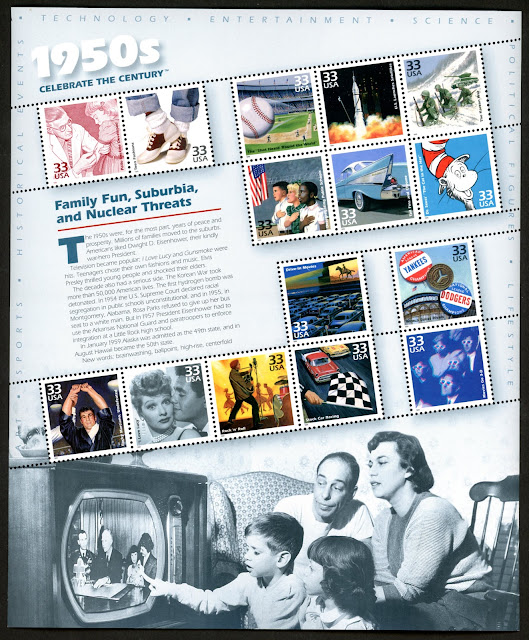
From my collection - Celebrate the Century: 1950s, Scott catalog #3187, with 15 se-tenant stamps

There have also been IGY covers issued on various anniversaries of the Explorer 1 launch. I showed one with a cachet in an earlier post, with Van Allen's signature. I'll show a few more when I review the IGY Bulletin article on Explorer 1 in its March 1958 issue. 

I am currently watching on PBS the new adaptation of Around the World in 80 Days. It's different from both the original 1872 novel by Jules Verne and the 1956 (IGY-era) film adaptation

starring David Niven, Cantinflas, and Shirley MacLaine, complemented with a slew of cameo appearances (including flamenco legend José Greco, who was a visiting professor here at Franklin & Marshall College in the last few years of his life). I saw the film (which won the Oscar for Best Picture of the year) as a youngster, and just re-bought a related book that I had owned for many years after we bought it at the movie theater so long ago.

I am now also re-reading -- after maybe 55 years -- Verne's novel (a free Kindle version is available on Amazon). I was thinking that the latest film adaptation was unfaithful to the book. Then I realized that the hot air balloon trip over the Alps in the new adaptation was also in the 1956 movie but was not in the book, so faithfulness is, well, relative. Anyway, the current adaptation is a new version of the story for a new era, and that's fair enough. I can't help but think that the 1956 movie was made at such a time as to be envisioning the imminent satellite journeys around the Earth. Those newest circumnavigations would take only two hours, about 1000 times faster than Phileas Fogg's trip around the world in 80 days.

Thursday, January 20, 2022

Two Sputnik 2 - Laika first day covers from Romania

When working on yesterday's post, I forgot to check my cover albums to see if Laika was lurking there. During the night I recalled that I had two first day covers of the 1957 Sputnik 2-Laika stamps from Romania. The scans are below. Cancellation dates are Dec. 20, 1957, the date of issuance of the stamps (as you would expect for a first day cover). The top cover is postmarked from Timasoara, which is the main economic, social and cultural center in western Romania. Bucharest, the capital and largest city, is in the southeast. I can't make out the postmark location on the second one. Both covers have cachets denoting the IGY/Geophysical Year, and both denote orbits, the top one suggesting electrons orbiting an atomic nucleus, the bottom one clearly showing a satellite orbiting Earth. 


Wednesday, January 19, 2022

IGY Bulletin, Number 6, December 1957 - Second Soviet satellite

This issue of the IGY Bulletin closes with a short piece on the launch of Sputnik 2 on Nov. 3, 1957. The text issued by the Russian news agency Tass was included verbatim. It stated that the satellite was instrumented to measure solar ultraviolet radiation and x-rays, cosmic rays, temperature, and pressure. Data were transmitted to Earth via radio waves for a week after launch.

This satellite project was giving the go-ahead after the successful launch of Sputnik 1, and was completed within a month to launch in time to honor the 40th anniversary of the Russian Revolution. 

Sputnik 2 weighed 1100 pounds, about six times as much as Sputnik 1. Clearly, the Soviet rockets were able to carry significant payloads. Sputnik 2 stayed in orbit through April 14, 1958, when it burned up in the atmosphere. It completed 2,370 revolutions around the Earth.

Sputnik 2 also carried the first animal into orbit, the dog Laika, as described in this article on the 60th anniversary of its launch.  The Soviet Union had already gained experience in launching animals via rockets into the stratosphere. Laika had implanted gauges for measuring blood pressure, respiration, and tracing of electrocardiograms. Laika was doomed to die since there was no way at that time to return to Earth. She survived the launch, but it was revealed years later that she died not long afterwards due to excessive heat. Laika's fate stimulated some of the early protests for animal rights.

November 13, 1957. Dog Laika in a hermetic cabin before installation on the satellite (Tass)

This post from the Drew Ex Machina blog provides more information on the Sputnik 2 mission and Laika.

I own a 52-page booklet entitled Soviet Sputniks, published during the IGY in 1958 by Soviet News as booklet #25. It focuses on the basics of the Soviet satellite program, and specifically on Sputniks 1 and 2.

Scan of cover of Soviet Sputniks

The booklet contains a figure showing the biological monitoring of Laika.

I was inspired by this dog's tale (not her tail) to order the eponymous prize-winning graphic novel Laika, published in 2007 by Nick Abadzis.

Cover of Laika

Images from the graphic novel have also been set to music by Luca Tozzi in this video.

The Sputniks have been well represented on stamps. The Soviet Union issued a set of four stamps in 1957 and 1958 (Scott #2032-2036) honoring Sputnik 2, depicting the allegorical statue "To the Stars" by artist and sculptor Yevgeny Vuchetich.

Russia Sputnik 2 stamps (Scott #2032-2036) from my collection

Laika, the "first space traveler," was commemorated earliest along with Sputnik 2 on two Romanian stamps (Scott #1200-1201) issued on Dec. 20, 1957.

Romania Sputnik 2-Laika stamps (Scott #1200-1201) from my collection

While searching for some information on this post, I also came across a pretty cool Tass web page about Sputnik 1.

The U.S. would soon get its turn for sending a satellite into space. Stay tuned.