Showing posts with label culture. Show all posts

Wednesday, November 23, 2022

Powers of Ten and Cosmic View

Powers of Ten is a short film made by the designer team of Charles and Ray Eames to illustrate the vast scale of the universe, from the outermost galaxies to the innermost nucleus of an atom, with human scale approximately in the middle. Starting from a look at picnickers on the shore of Lake Michigan, the scene zooms out by a factor of 10 every 10 seconds, from a scale of 1 meter (100) to a scale of 1024 meters. Then it zooms back to the picnic, and then inwards by a factor of 10 every 10 seconds until it reaches the nuclear scale of 
10-16 meters.

I saw a black-and-white predecessor of this film in my first-year physics course at Cornell in 1968, titled A Rough Sketch for a Proposed Film Dealing With the Powers of Ten. I was kind of blown away by it.

The best version of this film is this finished version of the Rough Sketch, now simply titled Powers of Ten, from 1977. The narration was by noted physicist and public intellectual Philip Morrison.

Other takes on the same theme include this 1996 version, also titled Powers of Ten, an IMAX film narrated by the omnipresent Morgan Freeman, starting on St. Mark's Square, Venice,

and this 1968 animated Cosmic Zoom from the National Film Board of Canada:

Every year I try to do a mini-celebration of Powers of Ten Day on Oct. 10, as I did again last month. When I worked in student life at Franklin & Marshall College in 2010, I organized a Powers of Ten event at 10:10 pm, on 10/10/10, with a showing of the film, or course.

This year I learned that these films emanate from a concept by Kees Boeke, as illustrated in his 1957 book, Cosmic View. Boeke, a Dutch reformist educator, Quaker missionary and pacifist, seems to have been a very interesting and committed individual. His idea for the scale of the universe theme was acknowledged in a couple of the films above.

You can see the pages of the Boeke's book Cosmic View at this website. Just as the Powers of Ten film was narrated by physicist Philip Morrison, this book includes an introduction by Nobel prize winner Arthur Compton. 

Jacket of Cosmic View (1957)

Is it coincidental that this book was published during the International Geophysical Year? At the dawn of the space age, I think that people had an increasing awareness and wonder at the scales of the universe, and it was certainly a challenge for educators to represent this.

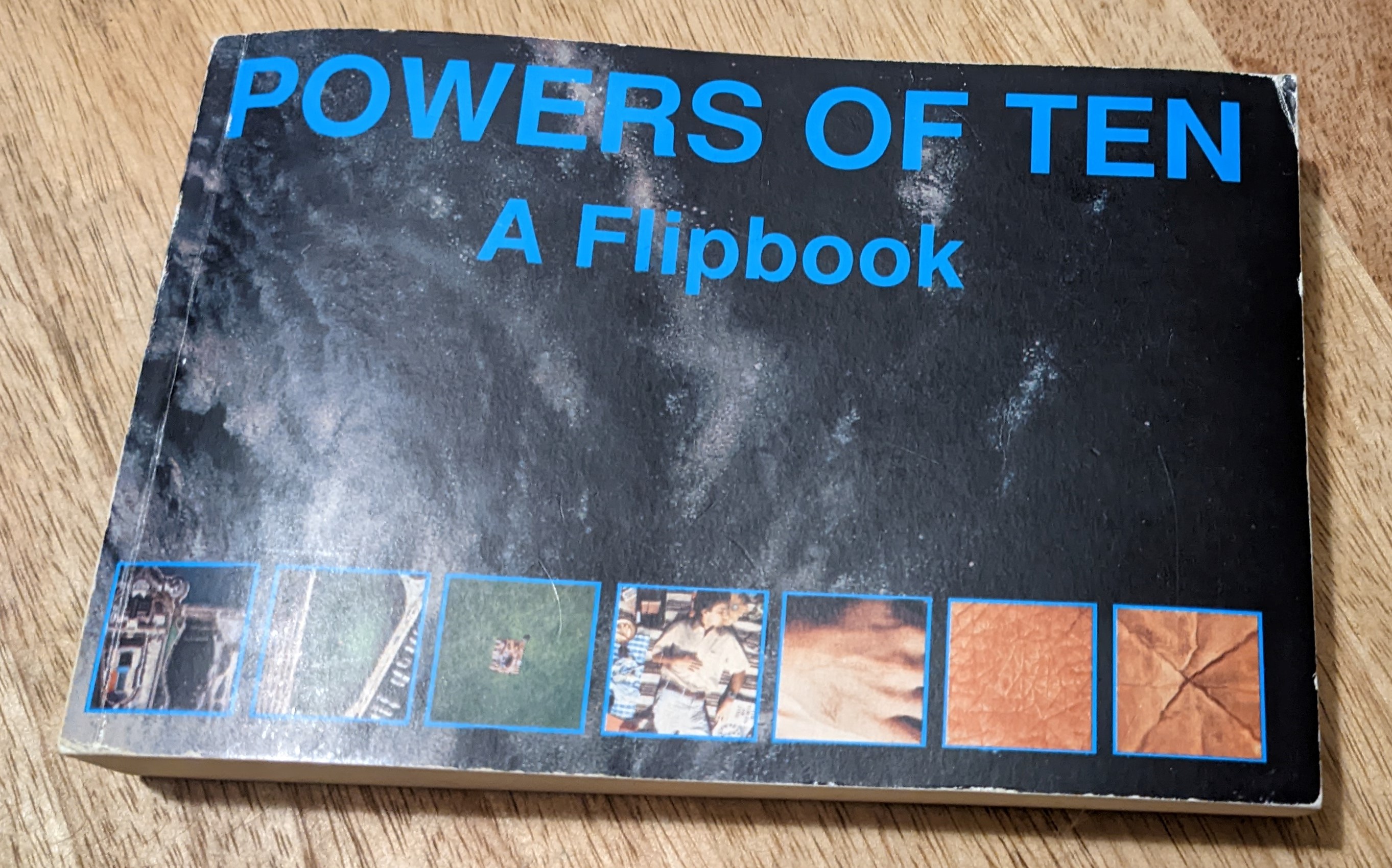
I have a couple of Eames souvenirs. There is a flipbook of Powers of Ten:
Then there is our Eames lounge chair and ottoman. It is an iconic piece of mid-century (20th) furniture, first released in 1956, just before the IGY. About 10 years ago, we bought this one, and despite needing a repair due to a design flaw with the aging epoxy, it suits us fine. The seller told us that our chair once belonged to 1984 VP candidate Geraldine Ferraro, although there is no proof of that.

And finally, the philatelic items. I have the 2008 sheet of 16 commemorative stamps showcasing the important contributions  of Charles and Ray Eames to American design. The Eames lounge chair is shown in one of the stamps., top row, second from left.

Charles and Ray Eames sheet, Scott catalog 4133

And I have a first day cover with the stamp of the chair and a corresponding cachet. 

Scott catalog stamp 4333f on a first day cover, canceled in Santa Monica on June 17, 2008 

The place of issue for these stamps was Santa Monica, California, where the Eames's had a house and studio. In 2014, I visited this Eames House in Santa Monica Canyon on a field trip outing during the International Symposium on Archaeometry held at the Getty Museum and UCLA in Los Angeles.

My photo of the exterior of the Eames House and Studio

Happy Thanksgiving, everyone.

Wednesday, November 02, 2022

Julie Powell passes away

In the very first post for this blog, I mentioned that I had been inspired to start it by the story of Julie Powell. I had just watched the movie Julie and Julia (2009), contrasting the early years of Julia Childs' culinary career with the life of Julie Powell, who aspired to cook all 524 recipes in Child's cookbook Mastering the Art of French Cooking (1961) in 365 days, an endeavor she described in a blog. I thought afterwards that a blog of my own could be a good way to present some of my thoughts about the IGY and my collection.

Then I said: "If I do one entry a week (and stay with it!!), I can get 524 blog entries done before the diamond (75th) anniversary of the IGY in 2032-33!" I've now done 113 posts in two years, or just about one a week, so I am on target for my more modest pace, although recently I have slowed down considerably. My efforts have left me even more impressed with the blogging (not to mention cooking) task that Julie Powell set for herself, and at which she succeeded.

Sadly she has died at the age of 49. She kept writing, but never quite matched the success of her blog and resulting book, Julie & Julia: 365 Days, 524 Recipes, 1 Tiny Apartment Kitchen

Author Julie Powell attends the premiere of Julie & Julia at The Ziegfeld Theatre in New York, on July 30, 2009 (Peter Kramer/AP)

According to this Daily Meal webpage, one of the 25 best selling cookbooks of all time, Julia Child's cookbook (with co-authors Louisette Bertholle and Simone Beck), Mastering the Art of French Cooking (1961), was published not long after the IGY, selling about 1.5 million copies. The two cookbooks on the list published before and closest to the beginning of the IGY were Betty Crocker's Cookbook (1950, 65 million), and the Better Homes and Gardens New Junior Cookbook (1955, 2.6 million). Ahh, makes me think of fish sticks and jello mold!

Saturday, April 02, 2022

Explorer 3 launch anniversary stamps

So far I have posted on each successful satellite launch during the IGY to note the launch anniversary dates, and separately posted more information when articles become available in the IGY Bulletin. Today I want to honor (belatedly) the March 26, 1958, launch of Explorer 3 (which was my father's 52nd birthday)

I will save more technical information on this satellite until I get to the relevant article in the May 1958 issue of the IGY Bulletin.

Explorer 3 was the third successful U.S. satellite launch of the IGY, after Explorer 1 and Vanguard 1. According to JPL, "data from Explorer 3 - combined with earlier measurements from Explorer 1 - confirmed principal investigator James Van Allen's theory that radiation belts trapped by Earth's magnetic field exist around the planet." That discovery ranks as one of the most important of the IGY, becoming the basis of what we now call space weather. 

So, I tried to find a U.S. cover commemorating that mission. I found two on eBay with Explorer 3 cachets that were postmarked on the date of the launch. These each cost over $100, so I decided not to spring for those yet. You'll find nine U.S. covers with Explorer 3 themes listed in the wonderful database on satellite stamps compiled by Garry Toth and Don Hillger.

I did find a nice set of 2008 stamps from Antigua marking the 50th anniversary of the launch. According to the same database, these are the only postage stamps from any country specifically featuring Explorer 3. I've just bought them on eBay, so I show images (taken from Toth and Hillger) of them below, soon to become a part of my physical collection.

Miniature sheet, Scott catalog AG 3014; image from Toth and Hillger

Miniature sheet, Scott catalog AG 3016; image from Toth and Hillger

Miniature sheet, Scott catalog #3018; image from Toth and Hillger

When collecting philatelic items about American achievements during the IGY, I focus on collecting U.S. stamps and covers. I am not sure if the island of Antigua and Barbuda falls into this category, but there are smaller countries (and heck, even the U.S. with that Elvis stamp) that issue stamps on popular topics, like space and cute animals, fully expecting most stamps to be bought by collectors. These will never be used to mail anything and pay for postal services, meaning extra income for the country. Such stamps tend to be attractive, and of interest to topical collectors (Hayward, 2008). 

Listverse, a website of lists, in a piece on 10 Bizarre Ways That Tiny Countries Make Money, includes #5, The Islands Where Postage Stamps Are The Main Export. This piece highlights the islands of Ascension, Saint Helena, and Tristan da Cunha, together comprising a British Overseas Territory on the Mid-Atlantic RidgeAscension (current population of 1,000) issues five sets of stamps every year, for which 400 collectors maintain standing orders. The island itself is so small (34 square miles) that mail delivery is infrequent, and there is no national postal delivery service. Tristan da Cunha, the world’s most remote permanent settlement (population of 264, area 71 square miles) has been financially self-sufficient since 1980 thanks to a crayfish factory and the local post office, which sells its stamps around the world. 

One of my books, Stamp Collecting (1992), by Charles F. Adams, includes a section on Bhutan - The Kingdom of Fanciful Collecting (pp. 155-156). To quote: "When serious philatelists hear the mention of Bhutan, they instantly roll their eyes. No one really takes the stamps of Bhutan seriously, they say. Those aren't really stamps: they're junk, silly, ridiculous junk." Apparently some stamps are rather gimmicky, like miniature phonograph records, and "debate rages as to whether any of these 'stamps' have ever actually been postally used. But "even though they may be worthless, they sure are fun." And what could be wrong with having fun?


Tuesday, February 01, 2022

64th anniversary of the successful launch of Explorer 1, America's first satellite

We've already talked in earlier posts about the successful launches of Sputnik 1 and Sputnik 2, and the failed launch of Vanguard TV3.

On this date, Jan. 31, in 1958, the U.S. successfully launched its first satellite, Explorer 1, into orbit. Much credit was given to the team of: William H. Pickering, director of the Jet Propulsion Laboratory which built and operated the satellite; James A. Van Allen, physicist at the State University of Iowa who designed and built the instrument on Explorer that discovered the eponymous radiation; and Wernher von Braun, leader of the Army's Redstone Arsenal team which built the first stage Redstone booster that was part of the Jupiter C rocket that carried Explorer 1 into space. The Army had replaced the Navy as the developer of the rocket after the failure of Vanguard TV3, a coup for the ambitious von Braun.

William Pickering, James Van Allen and Wernher von Braun (NASA)

This short JPL video summarizes the preparation, launch, and celebration of Explorer 1:


Explorer 1's orbit had a perigee of 220 miles and an apogee of 1,600 miles. It made one orbit every 115 minutes. The satellite weighed 30 pounds, and was 80 inches long, the same (or similar) size as the model shown in the upstretched arms of the men above. Explorer 1 made its final transmission on May 23, 1958. It entered Earth's atmosphere and burned up on March 31, 1970, after more than 58,000 orbits. 

The U.S. did not initially issue a stamp commemorating Explorer 1. I had speculated to myself that the U.S. did not want to highlight this great accomplishment because it was beaten into space by its Cold War rival, the Soviet Union. This was confirmed for me by Matin Modarressi, who I mentioned in a previous post. Matin sent me the link to this document from the Operations Coordinating Board (OCB), dated on Oct. 8, 1958, signed by CIA director Allen Dulles. It states in item #3 that

A suggestion by the Army was then brought up having to do with the possibility of a commemorative postage stamp in honor of the launching of Explorer 1. The majority of the Board felt that it might be unwise to issue such a stamp in view of the obvious disparity which now exists between our accomplishments in the satellite field and those of the USSR.

Fascinating! Also present at that OCB meeting was Abbott Wasburn, mentioned in earlier posts as Deputy Director of the United States Information Agency and a member of the Citizens' Stamp Advisory Committee and also as the head of public relations for General Mills, which was involved in Cold War biological warfare. I am so grateful that Matin shared this with me. 

Matin has a very interesting presentation about The Role of Stamps in U.S. Foreign Relations:


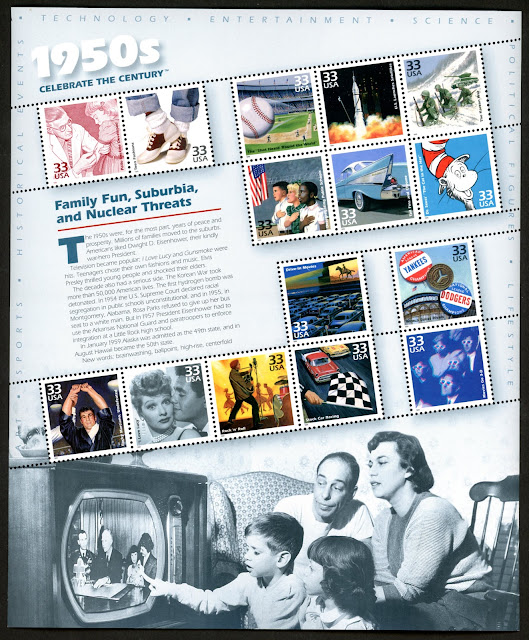
Finally, in 1999, Explorer 1 got its philatelic due, as part of the series of 10 sheets with the theme of Celebrate the Century:

Scott catalog #3187d (1999), Explorer 1

Obverse of Scott catalog #3187d

From my collection - Celebrate the Century: 1950s, Scott catalog #3187, with 15 se-tenant stamps

There have also been IGY covers issued on various anniversaries of the Explorer 1 launch. I showed one with a cachet in an earlier post, with Van Allen's signature. I'll show a few more when I review the IGY Bulletin article on Explorer 1 in its March 1958 issue. 

I am currently watching on PBS the new adaptation of Around the World in 80 Days. It's different from both the original 1872 novel by Jules Verne and the 1956 (IGY-era) film adaptation

starring David Niven, Cantinflas, and Shirley MacLaine, complemented with a slew of cameo appearances (including flamenco legend José Greco, who was a visiting professor here at Franklin & Marshall College in the last few years of his life). I saw the film (which won the Oscar for Best Picture of the year) as a youngster, and just re-bought a related book that I had owned for many years after we bought it at the movie theater so long ago.

I am now also re-reading -- after maybe 55 years -- Verne's novel (a free Kindle version is available on Amazon). I was thinking that the latest film adaptation was unfaithful to the book. Then I realized that the hot air balloon trip over the Alps in the new adaptation was also in the 1956 movie but was not in the book, so faithfulness is, well, relative. Anyway, the current adaptation is a new version of the story for a new era, and that's fair enough. I can't help but think that the 1956 movie was made at such a time as to be envisioning the imminent satellite journeys around the Earth. Those newest circumnavigations would take only two hours, about 1000 times faster than Phileas Fogg's trip around the world in 80 days.

Wednesday, January 19, 2022

IGY Bulletin, Number 6, December 1957 - Second Soviet satellite

This issue of the IGY Bulletin closes with a short piece on the launch of Sputnik 2 on Nov. 3, 1957. The text issued by the Russian news agency Tass was included verbatim. It stated that the satellite was instrumented to measure solar ultraviolet radiation and x-rays, cosmic rays, temperature, and pressure. Data were transmitted to Earth via radio waves for a week after launch.

This satellite project was giving the go-ahead after the successful launch of Sputnik 1, and was completed within a month to launch in time to honor the 40th anniversary of the Russian Revolution. 

Sputnik 2 weighed 1100 pounds, about six times as much as Sputnik 1. Clearly, the Soviet rockets were able to carry significant payloads. Sputnik 2 stayed in orbit through April 14, 1958, when it burned up in the atmosphere. It completed 2,370 revolutions around the Earth.

Sputnik 2 also carried the first animal into orbit, the dog Laika, as described in this article on the 60th anniversary of its launch.  The Soviet Union had already gained experience in launching animals via rockets into the stratosphere. Laika had implanted gauges for measuring blood pressure, respiration, and tracing of electrocardiograms. Laika was doomed to die since there was no way at that time to return to Earth. She survived the launch, but it was revealed years later that she died not long afterwards due to excessive heat. Laika's fate stimulated some of the early protests for animal rights.

November 13, 1957. Dog Laika in a hermetic cabin before installation on the satellite (Tass)

This post from the Drew Ex Machina blog provides more information on the Sputnik 2 mission and Laika.

I own a 52-page booklet entitled Soviet Sputniks, published during the IGY in 1958 by Soviet News as booklet #25. It focuses on the basics of the Soviet satellite program, and specifically on Sputniks 1 and 2.

Scan of cover of Soviet Sputniks

The booklet contains a figure showing the biological monitoring of Laika.

I was inspired by this dog's tale (not her tail) to order the eponymous prize-winning graphic novel Laika, published in 2007 by Nick Abadzis.

Cover of Laika

Images from the graphic novel have also been set to music by Luca Tozzi in this video.

The Sputniks have been well represented on stamps. The Soviet Union issued a set of four stamps in 1957 and 1958 (Scott #2032-2036) honoring Sputnik 2, depicting the allegorical statue "To the Stars" by artist and sculptor Yevgeny Vuchetich.

Russia Sputnik 2 stamps (Scott #2032-2036) from my collection

Laika, the "first space traveler," was commemorated earliest along with Sputnik 2 on two Romanian stamps (Scott #1200-1201) issued on Dec. 20, 1957.

Romania Sputnik 2-Laika stamps (Scott #1200-1201) from my collection

While searching for some information on this post, I also came across a pretty cool Tass web page about Sputnik 1.

The U.S. would soon get its turn for sending a satellite into space. Stay tuned.

Monday, January 17, 2022

Back from vacation in a geologic paradise; MLK stamps

I just returned from three weeks of family vacation. I thought I would summarize the last article in the December 1957 IGY Bulletin before I left, then I thought I'd do it while I was away, but I just ended up taking a break. So that post will come in the next couple of days.

Anyway, Happy New Year. Although the USPS regularly issues stamps to honor the Chinese New Year, it has never done so for our secular January 1st holiday.

Today is Martin Luther King Jr. Day in the U.S., honoring the birthday and legacy of the civil rights leader. King. By the time of the IGY in 1957-58, the 28 year old King had already played a leadership role in the Montgomery bus boycott (1955) and was a co-founder of the Southern Christian Leadership Conference (1957). The IGY may have been a time of international scientific cooperation, but there was also plenty of domestic strife over issues of racism, economic inequality, and civil liberties.

Two U.S. stamps have been issued in King's honor. I don't own either, but I scanned images from my recently purchased Harris U.S. Postage Stamp Catalog. I didn't really need the book, but after looking at it in the public library I couldn't resist the tactile and visual appeal of those glossy pages and pictures.

Cover scan of my catalog

Martin Luther King Jr. commemorative, 1979, Scott #1771

MLK stamp (Scott 3188a, 1999), part of the 1960s Celebrate the Century sheet

I visited the King Center during the Society for American Archaeology annual meeting in Atlanta in 2009.

Martin Luther King Jr. and Coretta Scott King burial monuments, King Center, Atlanta

Anyway, the recent vacation took the four of us to Germany to visit family, and then to Gran Canaria (Spain, but off the west coast of Africa) for two weeks of sunshine and relaxation. We bought our tickets before the onset of Omicron, so we went ahead and took the risk. We avoided indoor crowds, and thankfully made it back ok. 

The geology of the island provided a dramatic background to the trip. The seven major islands of the Canaries archipelago are volcanic in origin, formed atop a hotspot in the Earth's mantle as the African tectonic plate drifted over the stationary hotspot, similar to the formation of the Hawaiian Islands. (The idea of hotspots was not yet understood in the pre-plate tectonic days of the IGY.) The Cumbre Vieja volcano on the westernmost island of La Palma, currently over the hotspot, has been recently active and in the news. We stayed near the Bandama Caldera for a week, hiked around it, and even played golf adjacent to it. I didn't play that well, but lost no balls into the caldera or anywhere else during my 9 holes.

My photo of Bandama Caldera, with Pico de Bandama in the background

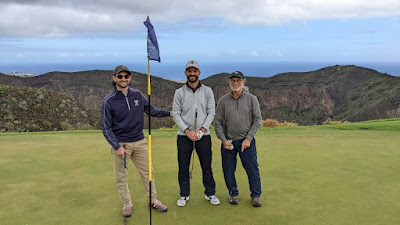
Max, Sam, and myself with the Bandama Caldera behind us at the Real Club de Golf de Las Palmas

The day we moved down to the south coast for another week, we left cooler and cloudy weather behind on the north slope of the central highlands (orographic effect). We did get a lot of wind as we walked a ways into the Maspalomas sand dune area, but at least the wind seemed to keep away the naked hordes that apparently frequent this area.

My photo of the Maspalomas sand dunes


Sunrise from Bandama
I did think a little about celestial orbits on the trip. We watched sunrises from our patio in Bandama the first week, and the second week Max started a golf round before sunrise at the Anfi Tauro golf club. I was surprised to realize that in early January, sunrise was still occurring slightly later each day, even though the shortest day of the year in the northern hemisphere had already occurred at the solstice on Dec. 21. And here is the explanation why! In early January, at 20°N latitude, the sunrise gets slightly later, but so does the sunset, such that the days do indeed become longer.

Times of sunrise and sunset. Gran Canaria is near 20°N latitude.

On the flight home, one of the two movies I watched was Jailhouse Rock, with Elvis Presley. It was released in the Fall of 1957, so it is an IGY era movie. I hadn't seen it in many years. It is light fare, and pretty standard bad boy-makes-good movie, but Elvis and his music were endearing enough. The title song was well choreographed, and Elvis' gyrations elicited an appreciative laugh from me:


The song topped the Billboard charts for seven weeks.

Back to the IGY proper next time.

Saturday, December 18, 2021

IGY Bulletin, Number 6, December 1957 - Whistlers and related phenomena

According to the start of this article in the IGY Bulletin, "whistlers are naturally occurring audio frequency radio waves which, received on an antenna, amplified, and fed to a transducer for conversion into sound, can be heard as long descending whistles."

What do these sound like? Check out this YouTube video of a recording by amateur Mark Dennison in 2010:


This image of the spectrum of a whistler


shows the descending frequency (High pitch to low) of a 3-second whistler signal from over 2.5 kilohertz to about 500 hertz. This falls within the audio spectrum of human hearing from 20 hertz to 20 kilohertz. (Other animals can hear much higher frequencies than humans). 

A figure in the article shows a frequency-vs.-time graph for a whistler that looks the same as the above.

Figure 3 from the Bulletin article, for a whistler bouncing between Alaska and New Zealand. Dispersion D increases with time.

I had my first audiogram two years ago, and although I have the typical moderate falloff for older folks at higher frequencies, I fit into the range above:
My left ear

The Bulletin article points out that the significance of whistlers is that they can provide information about the very high atmosphere, above the altitudes accessible by rocket soundings.

As mentioned in an earlier post, whistlers are generated by the propagation of sferics which then exhibit the property of dispersion whereby signal velocity depends on the frequency. Sferics are transient radio waves arising from naturally occurring electric discharges in the atmosphere. The most intense sferics are produced by lightning.

The figure below from the article indicates how whistler will penetrate the ionosphere, then bounce back and forth between places like Annapolis and Cape Horn that are at the same geomagnetic latitudes in the northern and southern hemispheres, following flux lines (like the dashed one) of the geomagnetic dipole field. Data collected earlier in the year verified such whistler paths that had previously been theoretically calculated.


The article further lists stations set up for whistle observations for the US-IGY program, and gives some of the preliminary findings as of this December article.

I guess if you were an ionospheric scientist working on whistlers, this would be your theme song:


Interesting to read about Adriana Caselotti, the uncredited voice of Snow White.

Friday, December 17, 2021

IGY Bulletin, Number 6, December 1957 - Moonwatch observing methods

This short article in issue #6 of the IGY Bulletin (December, 1957) is an extension of the previous piece.

Moonwatch stations for visual observations of satellites were coordinated by the Smithsonian Astrophysical Observatory, organized by noted astronomer Fred Whipple despite some opposition from professional astronomers. The basic principle was to create a "meridional fence" and observe when that fence was crossed by a satellite. 

In what the article calls the "fundamental method" of observing, a team of observers would train their telescopes on the local meridian (longitude) as indicated by a north-south line and a vertical mast, such that the observing period spanned intervals of time and elevations where the satellite was expected. Then they could note the exact time (right ascension, in one celestial frame of reference) and elevation angle (aka the declination, but not to be confused with geomagnetic declination) where the satellite was seen. As indicated in the figure to the right from the article, the observers had overlapping fields of view so as not to miss the satellite. This must be what the "telescope array" photo that I included in the last post must be showing. Here is a frontal view of an observing team:

Volunteer satellite trackers in Pretoria, South Africa using the fence method, 1965 (Koch)

In the "differential method" of observing, the position of the satellite is measured relative to the known position of a star in the same field of view.

Btw, I find it strange that meridional with an "o" is the adjective form of meridian with an "a."

According to Jenny Koch,

the Moonwatch program lasted for 18 years, with its dedicated volunteers supporting over 400,000 valuable, time-consuming observations of satellites. Long after the buzz around Sputnik ended, Moonwatch remained relevant in providing a low-cost method of collecting satellite orbital data as well as data on the physics of the upper atmosphere. 
 Whipple the President’s Award for Distinguished Public Service from JFK in 1963, the highest civilian honor given to a government employee.

This seems to be a rather extensive guide for the amateur satellite spotter. It opens with the text:

If you have ever star-gazed shortly after sunset or before sunrise, you have probably noticed one or two "stars" sailing gracefully across the sky. These are Earth-orbiting satellites, visible due to the reflection of the Sun's light off their surfaces toward the observer. Hundreds of satellites are visible to the unaided eye; thousands are visible using binoculars and telescopes. Observing satellites has many enthusiasts around the world.


Monday, December 06, 2021

A satellite that failed, and a Satellite that was a hit

Today is the anniversary of the first attempt by the U.S. to put a satellite into space. It didn't go so well. According to NASA, after the Soviet Sputnik success, the U.S. accelerated its two satellite programs programs. On December 6, 1957, the Vanguard Test Vehicle 3 (TV3) rose about 4 feet into the air, when the main engine lost thrust and the rocket fell back onto the pad, exploding in a huge fireball. The press called the failed attempt “Flopnik” and “Kaputnik,” in reference to its successful Soviet counterpart. The Vanguard satellite was thrown free of the explosion and recovered.  It is currently on display at the Smithsonian Institution’s National Air and Space Museum in Washington, D.C. I've been to the museum before, but now I want to go back and hunt this down.

Here is the newsreel as it happened:


Hang on, the U.S. will succeed before, too long.

I went to Harrisburg Saturday to see a concert by one of my favorite bands, The Hooters, iconic rockers from Philadelphia. I heard them 35ish years ago performing in the gym at Franklin & Marshall College, just a 5-minute walk from home. (Unfortunately, that concert put the kibosh on my editor's attending rock concerts, the volume being a bit excessive.) Then I heard them two years ago in Philadelphia at The Met in Philadelphia, a great venue, just before covid. Saturday the band played at club XL Live in Harrisburg, a more intimate setting. Excellent show! Here is my video clip from their performance of Satellite:


Here is the original music video. The song isn't about Vanguard TV3, or any physical satellite for that matter, but about televangelism. It does have the magic word for its title!


And here is a recent performance of Day by Day, probably my favorite Hooters song:


"Nothing lasts forever, only fades away, day by day ... chance you gotta take, price you gotta pay, day by day"

More satellite songs to come in some future post. 

Friday, November 26, 2021

Blogging

I started this blog 13 months ago, and with this being my 70th post I'm averaging over 5 a month. I have on the whole been sticking to my target of approximately weekly posts mentioned in my first entry for this blog. I am still finding the blog a good outlet for me to share my IGY collectibles, describe some of the science, and make other randomish observations and connections to my life.

A decade or so ago I was the main poster for two blogs related to professional groups. One was for the Society for Archaeological Sciences a group I have belonged to for about 40 years. I'm still on the executive board. Much of my academic research applied scientific methods to archaeological problems, so the SAS was a small society that complemented my membership in larger groups like the American Geophysical Union, the Geological Society of America, and the Society for American Archaeology. I was the main poster on the SAS blog from its start in Jan. 2009, til about Dec. 2010, with 134 posts, or about 5 a month. My postings tailed off after that, with some being made by other SAS officers. Now it has evolved into an online presentation of the SAS Bulletin Online, admirably edited by Carmen Ting. The SAS Bulletin had earlier had been a quarterly paper and later electronic newsletter.

For about 31 months during 2008-2011, I was the primary poster for the Shaking Earth blog. This was an effort on behalf of the Lamont-Doherty Cooperative Seismograph Network, a consortium of seismograph operators in the northeastern U.S.  For several years, there were regular meeting of station operators, and the blog was conceived of a way to publicize the work of the Consortium and seismological news of general interest. There were 266 posts, or almost 9 a month.

That was a busy time in my career, even without the blogs. I'm pretty amazed I did both of these blogs at the same time. They did create my own impression that a blog was appropriately timely and dynamic if the frequency of posts were on the order of weekly.

Recently I added a list of some other blog in in the sidebar. These are blogs that relate to this one or have influenced me, and that post on a fairly regular basis.

  1. The IAGA blog (International Association of Geomagnetism and Aeronomny) blog, which I mentioned here. "This blog hopes to promote the work done by the IAGA community. It also aims to portray the life of its researchers. The IAGA Blogs are maintained by the Social Media (SM) Working Group, which is a part of the Interdivisional Commission on Education and Outreach (ICEO). The SM group aims to provide an easily accessible platform for news and information and create awareness within and outside the community. It acts as a bridge connecting the scientists and their research with the general public." Much of my own research in archaeomagnetism was in an area covered by IAGA, and I have been to a number of IAGA conferences. IAGA also covers a number of disciplines studied during the IGY.
     
  2. The Plainspoken Scientist, hosted by the AGU (American Geophysical Union. "The Plainspoken Scientist is the science communication blog of AGU’s Sharing Science program. With this blog, we wish to encourage scientists to reach out to non-scientists and to do so with plainspoken discussion." That's an admirable goal, and one that I have in this blog, to share some aspects of the science during the IGY in what I hope is an understandable fashion.

  3. The Bridge: Connecting Science and Policy, another AGU blog. "The Bridge is an AGU blog that connects science and policy. It provides a platform for scientists, policy makers, and experts to communicate ideas about the science policy interface." Much of the work done during the IGY was related to national and international science and geopolitical policy. The science of the IGY could never have been done without the support of a plethora of policy makers around the world.

  4. Exploring Stamps (YouTube channel) is a video blog, or vlog. I find Graham Beck to be a knowledgeable and entertaining philatelist. His topics include nuts and bolts of stamp collecting, philatelic esoterica, and special stamp topics including space and Antarctic exploration. He says, "Stamp Collecting is still the most popular hobby in the world. Learn about the world through sorting postage stamps."

  5. Rex Parker Does the NY Times Crossword Puzzle. I've been doing the NY Times crossword daily for several years, currently on a streak of 621 consecutive completions (with some occasional help). The pseudonynmous "Rex Parker" gets up daily at 4:30, solves the puzzle and has a blog about it up by 6 am or so. He (or an occasional guest) has been doing this since 2006, for some 5500 posts. These are cleanly formatted, well written, funny, and heavily opinionated. Ok, sometimes opinionated to the point of being snarky, but it's his blog, he can cry or snark if he wants to. He has a loyal readership and gets dozens of comments a day, so I am guessing he has thousands of readers. He really likes today's puzzle, but don't let that fool you. He has his puzzling likes and dislikes, and he will let you know if the constructor and the NY Times puzzle editors have tickled his puzzle fancy or not, day in and day out. It's interesting to compare what Rex has to say with Deb Amlen's gentler Wordplay column in the NY Times itself.
Wikipedia has a nice overview of blogging.

Keep reading, and maybe writing, those blogs! Feel free to enter a comment listing your favorite blogs, and why you like them.

Thursday, November 04, 2021

IGY and philatelic musings during a visit to Philadelphia

Now that I am vaccinated and have also had my booster, I am getting out there a bit more. A week ago I did an overnight trip to Philadelphia. The afternoon I arrived, I went to the Wagner Free Institute of Science as I mentioned in my last post, and noted the synoptic collections there.

The impetus for my visit was to attend a concert by Steely Dan. I am a modest Steely Dan fan, but most of all I wanted to see Donald Fagen, one of the co-founders of the band along with Walter Becker (deceased). It looks like Fagen is the only remaining original member, but I guess he owns the name. These legacy bands sometimes make me wince, but at least it's not The Beach Boys without Brian Wilson. 

Steely Dan members timeline (Wikipedia)

As a solo artist, Fagen wrote the song I.G.Y., which I consider the musical anthem of the International Geophysical Year. I had a blog post about him and the song back in January. Fagen didn't sing I.G.Y. in this show. The band performed the entire Steely Dan album Aja, and a number of their other hits. Maybe my favorite was Deacon Blues, in this video played by an ensemble similar to the one I saw:


The concert was Steely Dannish smooth, albeit a bit loud. I felt distracted by the light show and the whirling dervish guy dancing nonstop like a madman a few seats away. I was chastised for the one photo I took, even though I would guess nothing was said to the 2/3 of 

the crowd who remained unmasked, counter to stated protocols (although vaccination proof was checked upon entry). And why couldn't people just sit and listen, rather than the constant flow of people to the bar and popcorn stand.

The day after the concert I went to the Philadelphia Museum of Art. I toured the much-hyped Jasper Johns exhibit. Johns was "discovered" by noted gallery owner Leo Castelli in 1958, during the IGY. 

Jasper Johns and Leo Castelli, 1958 (FORMIDABLE MAG)

I did not take a photo of one of Johns' iconic flag pictures, with the 48 stars to indicate it represented a time before the statehood of Alaska, which I mentioned in the last post. But I did snap this one painting

Jasper Johns' Target (1958)

from the show dating to the IGY period, Target. Appropriate, since to me it was reminiscent of a cross-section of the Earth's interior, showing our planet's major divisions.

Schematic cross-section of the Earth (BBC)

The second exhibit I looked at was on the photography and printing of Richard BensonThe subtitle for the last few panels of the exhibit was "Looking Beyond Prints." The explanatory text explained that "Benson collected antique postage stamps and currency ... viewing them as finely made prints produced in extraordinarily large editions. He turned to the stamps for some of his last photographs, using a scanner in place of the camera... he believed this new stage of digital technology would enable us to hold onto everything old, as in the case of these stamps, which he was delighted to see reproduced in fine detail at an unprecedented scale."

Fancy Cancels (2013), pigment inkjet print. Aprroximately 2' x 3'.
.
Black Jack Stamp with Fancy Cancel (2013), pigment inkjet print. Appoximately 1' x 1.5'.

"Benson eagerly collected examples of the 2-cent Andrew Jackson stamp [Scott #73], known as the Black Jack, printer between 1863 and 1869. He especially loved the 'fancy cancels' found on many examples. These are designs used by postal clerks to mark used stamps in that era. Often carved on cork and paired with a chosen ink color, they are highly individual. Of course, the cancel marks are prints themselves, deigned to obliterate or deface the image below. Here again, as in so much of Benson's work, we encounter anonymous individuals creatively marking their work and time in the world" (Philadelphia Art Museum).

For better or worse, this blog is affecting the way I look at or for things in the world.