Powers of Ten is a short film made by the designer team of Charles and Ray Eames to illustrate the vast scale of the universe, from the outermost galaxies to the innermost nucleus of an atom, with human scale approximately in the middle. Starting from a look at picnickers on the shore of Lake Michigan, the scene zooms out by a factor of 10 every 10 seconds, from a scale of 1 meter (100) to a scale of 1024 meters. Then it zooms back to the picnic, and then inwards by a factor of 10 every 10 seconds until it reaches the nuclear scale of 10-16 meters.
The best version of this film is this finished version of the Rough Sketch, now simply titled Powers of Ten, from 1977. The narration was by noted physicist and public intellectual Philip Morrison.
Other takes on the same theme include this 1996 version, also titled Powers of Ten, an IMAX film narrated by the omnipresent Morgan Freeman, starting on St. Mark's Square, Venice,
and this 1968 animated Cosmic Zoom from the National Film Board of Canada:
Every year I try to do a mini-celebration of Powers of Ten Day on Oct. 10, as I did again last month. When I worked in student life at Franklin & Marshall College in 2010, I organized a Powers of Ten event at 10:10 pm, on 10/10/10, with a showing of the film, or course.
This year I learned that these films emanate from a concept by Kees Boeke, as illustrated in his 1957 book, Cosmic View. Boeke, a Dutch reformist educator, Quaker missionary and pacifist, seems to have been a very interesting and committed individual. His idea for the scale of the universe theme was acknowledged in a couple of the films above.
You can see the pages of the Boeke's book Cosmic View at this website. Just as the Powers of Ten film was narrated by physicist Philip Morrison, this book includes an introduction by Nobel prize winner Arthur Compton.
Jacket of Cosmic View (1957)
Is it coincidental that this book was published during the International Geophysical Year? At the dawn of the space age, I think that people had an increasing awareness and wonder at the scales of the universe, and it was certainly a challenge for educators to represent this.
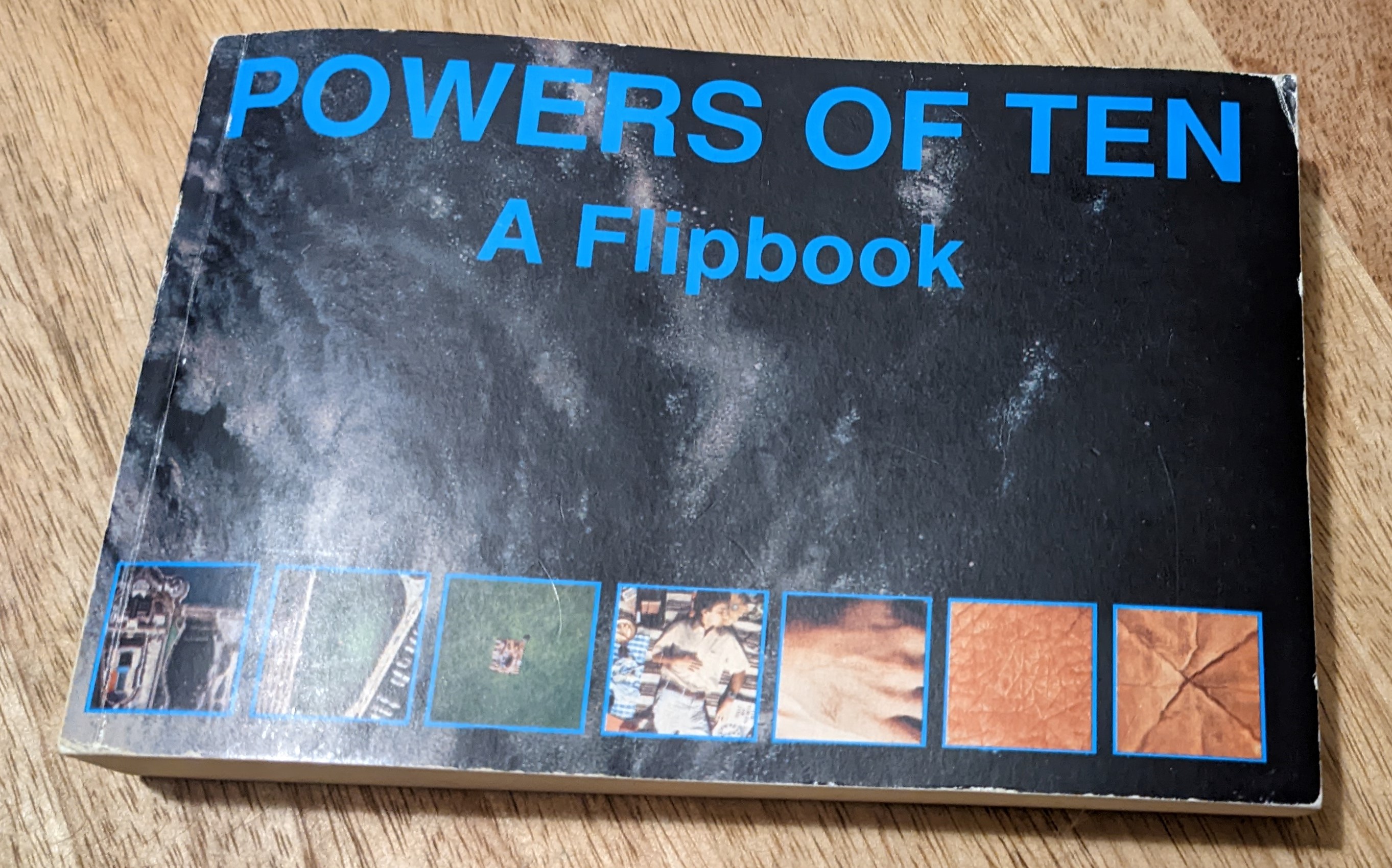
I have a couple of Eames souvenirs. There is a flipbook of Powers of Ten:
Then there is our Eames lounge chair and ottoman. It is an iconic piece of mid-century (20th) furniture, first released in 1956, just before the IGY. About 10 years ago, we bought this one, and despite needing a repair due to a design flaw with the aging epoxy, it suits us fine. The seller told us that our chair once belonged to 1984 VP candidate Geraldine Ferraro, although there is no proof of that.
And finally, the philatelic items. I have the 2008 sheet of 16 commemorative stamps showcasing the important contributions of Charles and Ray Eames to American design. The Eames lounge chair is shown in one of the stamps., top row, second from left.
Charles and Ray Eames sheet, Scott catalog 4133
And I have a first day cover with the stamp of the chair and a corresponding cachet.
Scott catalog stamp 4333f on a first day cover, canceled in Santa Monica on June 17, 2008
The place of issue for these stamps was Santa Monica, California, where the Eames's had a house and studio. In 2014, I visited this Eames House in Santa Monica Canyon on a field trip outing during the International Symposium on Archaeometry held at the Getty Museum and UCLA in Los Angeles.
My photo of the exterior of the Eames House and Studio
In the very first post for this blog, I mentioned that I had been inspired to start it by the story of Julie Powell. I had just watched the movie Julie and Julia (2009), contrasting the early years of Julia Childs' culinary career with the life of Julie Powell, who aspired to cook all 524 recipes in Child's cookbook Mastering the Art of French Cooking (1961) in 365 days, an endeavor she described in a blog. I thought afterwards that a blog of my own could be a good way to present some of my thoughts about the IGY and my collection.
Then I said: "If I do one entry a week (and stay with it!!), I can get 524 blog entries done before the diamond (75th) anniversary of the IGY in 2032-33!" I've now done 113 posts in two years, or just about one a week, so I am on target for my more modest pace, although recently I have slowed down considerably. My efforts have left me even more impressed with the blogging (not to mention cooking) task that Julie Powell set for herself, and at which she succeeded.
Sadly she has died at the age of 49. She kept writing, but never quite matched the success of her blog and resulting book, Julie & Julia: 365 Days, 524 Recipes, 1 Tiny Apartment Kitchen.
Author Julie Powell attends the premiere of Julie & Julia at The Ziegfeld Theatre in New York, on July 30, 2009 (Peter Kramer/AP)
According to this Daily Meal webpage, one of the 25 best selling cookbooks of all time, Julia Child's cookbook (with co-authors Louisette Bertholle and Simone Beck), Mastering the Art of French Cooking (1961), was published not long after the IGY, selling about 1.5 million copies. The two cookbooks on the list published before and closest to the beginning of the IGY were Betty Crocker's Cookbook (1950, 65 million), and the Better Homes and Gardens New Junior Cookbook (1955, 2.6 million). Ahh, makes me think of fish sticks and jello mold!
I have been missing in non-action for a month now. I've just kind of lost motivation, at least for now, to keep the blog going using the pace and rubric I've been mostly following for close to a year: summarizing articles from the IGY Bulletin, one by one. And I've just been languishing a bit in general. So I hope to regain forward momentum soon, perhaps using a different rubric.
I also decided to break my NY Times crossword solving streak at 800+. I realized that although I usually enjoyed doing them and the blog, those activities were sometimes controlling me rather than the other way around. Staring at my computer screen was also starting to make my brain feel congested. Plus, I will need some time in the near future to attend to some other issues, like cleaning out my office at the College, which I am finally vacating this summer. So overall I am trying to change the balance of my activities for now, you might say.
Well, music is a good pick-me-up. The song containing the lyric in this post's title is Mrs. Robinson, by Simon and Garfunkel. You remember ... it goes something like this:
It is from the album Bookends, which was one of my favorites as an undergraduate. It is a concept album about life's journey. I'd best listen to it again, since my location on that route has progressed considerably. I owned the LP for many years, but now I own the CD. For me, the best song on the album was A Hazy Shade of Winter: "Hang on to your hopes my friend. that's an easy thing to say, but if your hopes should pass away simply pretend that you can build them again."
The song was also part of the soundtrack of one of my favorite movies, The Graduate, including the breakout role for Dustin Hoffman. Am I remembering correctly that I saw this in the movie theater with my high school friend Carol? (I guess you wouldn't know.) She was a good person, I wonder what happened to her.
Joe Dimaggio, one of the greatest Yankees and baseball players of all time, finds his way into the title of this post. The years of the IGY, 1957-58, were when I first became aware of professional sports. My family was not into sports, and I gravitated towards the best teams of that era -- the New York Yankees (baseball), Boston Celtics (basketball), and the Baltimore Colts (football) -- rather than the local teams, which weren't very good -- the Washington Senators (baseball) and the Washington football team (there was no regional NBA team). Baseball has always been my favorite sport; I still like the Yankees (and now the Phillies), and am enjoying their amazing run so far this year. I still very casually root for the Celtics, so it is nice to see them in the NBA finals. I'm not even sure where the Colts play any more.
My favorite players from those teams, all hall-of famers, were Johnny Unitas of the Colts, Bob Cousy and Bill Russell (Celtics), and my favorite athletic "hero" ever, Mickey Mantle of the Yankees.
(I recently read Amy Bloom's In Love, a moving account of her husband's assisted suicide. It took me a while to realize that her husband, Brian Ameche, was the son of another Colts star, running back Alan Ameche, who scored the winning touchdown in sudden death overtime in the 1958 NFL championship game against the NY Giants, sometimes called "the greatest game ever played.")
Mickey Mantle, who replaced Joe Dimaggio as the Yankees' center fielder, was no saint (and why should a ballplayer be one), but he was one of the greatest baseball players ever. As a kid and a fan, I used to argue that he was the best of the New York center fielders of the IGY years, but now I would have to concede that Willie Mays of the NY Giants had a better career overall. Sorry, Duke Snider of the Brooklyn Dodgers still comes in third. Mantle was the American League triple crown winner in 1956, the AL most valuable player in 1956 and 1957, an all-star in 1956-1958, World Series champion in 1956 and 1958, and AL champion in 1957. Quite a good run in those IGY years! I started reading Jane Leavy's acclaimed biography of The Mick a couple of years ago. I think I'll go back and finish it!
For some reason, the microcards that were discussed in yesterday's post really intrigued me. I contacted one of Franklin & Marshall College's very helpful librarians, Tom Karel. He told me that the College library did house some microcards. I went over today, and entered a room I suspect is not much used anymore, housing microfilm, microfiche, and yes, some microcards. Wikipedia discusses these technologies in an article on microforms, which says "Three formats are common: microfilm (reels), microfiche (flat sheets), and aperture cards. Microcards, also known as 'micro-opaques', a format no longer produced, were similar to microfiche, but printed on cardboard rather than photographic film."
Here is the shelving for the microcards at F&M, maybe about 50 linear feet, about 150 boxes. (The orange/yellow/gray volumes in the lower right are not microcards.)
One slipcase can hold about 200 microcards. So the 150 boxes at F&M could hold about 30,000 microcards. This is about 50% more than what was needed for storage of the the IGY meteorological data, as mentioned in my previous blog post.
One Landmark of Science microcard looks like this:
First microcard of James Hutton's Theory of the Earth
Each card is 4" x 6", and contains 100 pages of text. So the 30,000 microcards in F&M's collection would be equivalent to about 3,000,000 pages.
The pages are too small to read with the naked eye off these cards. But F&M still has a functional card reader, a Readex Microprint Opaque Viewer. (Readex now seems to specialize in offering collections of digitized online primary source research materials.)
The first page of Hutton's Theory of the Earth (1788) looks like this when magnified on the reader screen:
This article was a report by D.A. Davies, Secretary General of the World Meteorological Organization.
As a specialized agency of the United Nations, WMO is dedicated to international cooperation and coordination on the state and behaviour of the Earth’s atmosphere, its interaction with the land and oceans, the weather and climate it produces, and the resulting distribution of water resources (WMO).
At the close of the International Geophysical Year (IGY), we would like to express, on behalf of the World Meteorological Organization, thanks and appreciation to all meteorological services of the world for their whole-hearted collaboration in this vast project, which provides yet another demonstration of the international spirit for which meteorologists have long been renowned. A special tribute must be paid to the thousands of meteorological observers throughout the world upon whom the IGY imposed many additional duties. We are confident that the same enthusiastic support will continue until the last of the forms containing the meteorological observations has been received at the WMO Secretariat, thus completing the collection of data which constitutes a unique contribution to future developments in the science of meteorology.
Signed: A. Viaut, President D.A. Davies, Secretary-General
Anyway, the Bulletin article goes on to say that the IGY Meteorological Data Centre, located within the WMO, was to publish the essential meteorological data collected during the IGY on "microcards," sensitized 3x5 inch cards on which printed matter was reproduced photographically in greatly reduced form. A special microcard reader could project an enlarged image so that the data could be read.
Microcards were an opaque positive microform, designed by Fremont Rider, librarian at Wesleyan University, in the early 1940s. He designed the microcard to serve as both a catalog card (front of card) and storage medium (reverse, containing up to 250 pages worth of microtext),in order to save shelf space in rapidly growing library collections. Microfiche appeared in the 1960s and supplanted microcards as the standard flat sheet microform (Jamison, 1988).
There were to be four types of IGY microcards recording different types of weather-related data:
Surface observations made on land
Surface observations made at sea
Radiosonde and rawinsonde observations (see previous post)
Upper wind observations
The Bulletin article estimated that about 18,500 microcards would be required to hold the essential meteorological observations of the IGY. A subscription price of $5,900 was established for a compete set of microcards. Today that would be equivalent to an inflation-adjusted $60,000.
Data storage has changed just a bit (pun intended) since the time of the IGY!
We've already talked in earlier posts about the successful launches of Sputnik 1 and Sputnik 2, and the failed launch of Vanguard TV3.
On this date, Jan. 31, in 1958, the U.S. successfully launched its first satellite, Explorer 1, into orbit. Much credit was given to the team of: William H. Pickering, director of the Jet Propulsion Laboratory which built and operated the satellite; James A. Van Allen, physicist at the State University of Iowa who designed and built the instrument on Explorer that discovered the eponymous radiation; and Wernher von Braun, leader of the Army's Redstone Arsenal team which built the first stage Redstone booster that was part of the Jupiter C rocket that carried Explorer 1 into space. The Army had replaced the Navy as the developer of the rocket after the failure of Vanguard TV3, a coup for the ambitious von Braun.
William Pickering, James Van Allen and Wernher von Braun (NASA)
This short JPL video summarizes the preparation, launch, and celebration of Explorer 1:
Explorer 1's orbit had a perigee of 220 miles and an apogee of 1,600 miles. It made one orbit every 115 minutes. The satellite weighed 30 pounds, and was 80 inches long, the same (or similar) size as the model shown in the upstretched arms of the men above. Explorer 1 made its final transmission on May 23, 1958. It entered Earth's atmosphere and burned up on March 31, 1970, after more than 58,000 orbits.
The U.S. did not initially issue a stamp commemorating Explorer 1. I had speculated to myself that the U.S. did not want to highlight this great accomplishment because it was beaten into space by its Cold War rival, the Soviet Union. This was confirmed for me by Matin Modarressi, who I mentioned in a previous post. Matin sent me the link to this document from the Operations Coordinating Board (OCB), dated on Oct. 8, 1958, signed by CIA director Allen Dulles. It states in item #3 that
A suggestion by the Army was then brought up having to do with the possibility of a commemorative postage stamp in honor of the launching of Explorer 1. The majority of the Board felt that it might be unwise to issue such a stamp in view of the obvious disparity which now exists between our accomplishments in the satellite field and those of the USSR.
Fascinating! Also present at that OCB meeting was Abbott Wasburn, mentioned in earlier posts as Deputy Director of the United States Information Agency and a member of the Citizens' Stamp Advisory Committee and also as the head of public relations for General Mills, which was involved in Cold War biological warfare. I am so grateful that Matin shared this with me.
Matin has a very interesting presentation about The Role of Stamps in U.S. Foreign Relations:
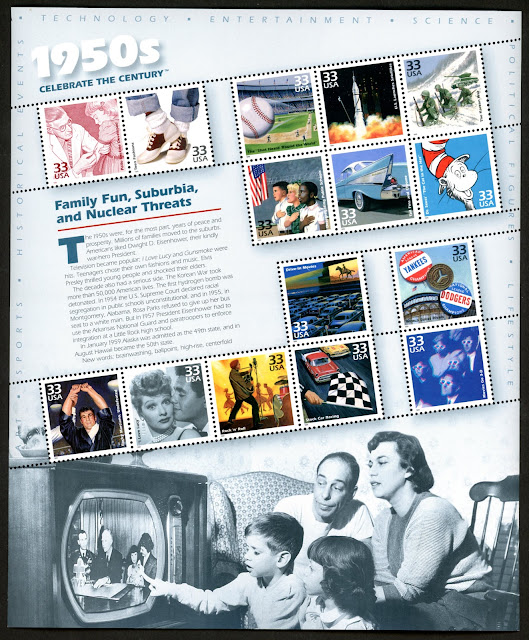
Finally, in 1999, Explorer 1 got its philatelic due, as part of the series of 10 sheets with the theme of Celebrate the Century:
From my collection - Celebrate the Century: 1950s, Scott catalog #3187, with 15 se-tenant stamps
There have also been IGY covers issued on various anniversaries of the Explorer 1 launch. I showed one with a cachet in an earlier post, with Van Allen's signature. I'll show a few more when I review the IGY Bulletin article on Explorer 1 in its March 1958 issue.
starring David Niven,
Cantinflas, and Shirley MacLaine, complemented with a slew of cameo appearances (including
flamenco legend José Greco, who was a visiting professor here at
Franklin & Marshall College in the last few years of his life). I
saw the film (which won the Oscar for Best Picture of the year) as a youngster, and just
re-bought a related book that I had owned for many years after we bought it at the movie theater so long ago.
I am now also re-reading -- after maybe 55 years -- Verne's novel (a free Kindle version is available on Amazon). I was thinking that the latest film adaptation was unfaithful to the book. Then I realized that the hot air balloon trip over the Alps in the new adaptation was also in the 1956 movie but was not in the book, so faithfulness is, well, relative. Anyway, the current adaptation is a new version of the story for a new era, and that's fair enough. I can't help but think that the 1956 movie was made at such a time as to be envisioning the imminent satellite journeys around the Earth. Those newest circumnavigations would take only two hours, about 1000 times faster than Phileas Fogg's trip around the world in 80 days.
I just returned from three weeks of family vacation. I thought I would summarize the last article in the December 1957 IGY Bulletin before I left, then I thought I'd do it while I was away, but I just ended up taking a break. So that post will come in the next couple of days.
Today is Martin Luther King Jr. Day in the U.S., honoring the birthday and legacy of the civil rights leader. King. By the time of the IGY in 1957-58, the 28 year old King had already played a leadership role in the Montgomery bus boycott (1955) and was a co-founder of the Southern Christian Leadership Conference (1957). The IGY may have been a time of international scientific cooperation, but there was also plenty of domestic strife over issues of racism, economic inequality, and civil liberties.
Two U.S. stamps have been issued in King's honor. I don't own either, but I scanned images from my recently purchased Harris U.S. Postage Stamp Catalog. I didn't really need the book, but after looking at it in the public library I couldn't resist the tactile and visual appeal of those glossy pages and pictures.
Cover scan of my catalog
Martin Luther King Jr. commemorative, 1979, Scott #1771
MLK stamp (Scott 3188a, 1999), part of the 1960s Celebrate the Century sheet
I visited the King Center during the Society for American Archaeology annual meeting in Atlanta in 2009.
Martin Luther King Jr. and Coretta Scott King burial monuments, King Center, Atlanta
Anyway, the recent vacation took the four of us to Germany to visit family, and then to Gran Canaria (Spain, but off the west coast of Africa) for two weeks of sunshine and relaxation. We bought our tickets before the onset of Omicron, so we went ahead and took the risk. We avoided indoor crowds, and thankfully made it back ok.
The geology of the island provided a dramatic background to the trip. The seven major islands of the Canaries archipelago are volcanic in origin, formed atop a hotspot in the Earth's mantle as the African tectonic plate drifted over the stationary hotspot, similar to the formation of the Hawaiian Islands. (The idea of hotspots was not yet understood in the pre-plate tectonic days of the IGY.) The Cumbre Vieja volcano on the westernmost island of La Palma, currently over the hotspot, has been recently active and in the news. We stayed near the Bandama Caldera for a week, hiked around it, and even played golf adjacent to it. I didn't play that well, but lost no balls into the caldera or anywhere else during my 9 holes.
My photo of Bandama Caldera, with Pico de Bandama in the background
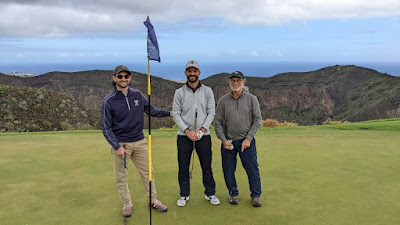
Max, Sam, and myself with the Bandama Caldera behind us at the Real Club de Golf de Las Palmas
The day we moved down to the south coast for another week, we left cooler and cloudy weather behind on the north slope of the central highlands (orographic effect). We did get a lot of wind as we walked a ways into the Maspalomas sand dune area, but at least the wind seemed to keep away the naked hordes that apparently frequent this area.
My photo of the Maspalomas sand dunes
Sunrise from Bandama
I did think a little about celestial orbits on the trip. We watched sunrises from our patio in Bandama the first week, and the second week Max started a golf round before sunrise at the Anfi Tauro golf club. I was surprised to realize that in early January, sunrise was still occurring slightly later each day, even though the shortest day of the year in the northern hemisphere had already occurred at the solstice on Dec. 21. And here is the explanation why! In early January, at 20°N latitude, the sunrise gets slightly later, but so does the sunset, such that the days do indeed become longer.
Times of sunrise and sunset. Gran Canaria is near 20°N latitude.
On the flight home, one of the two movies I watched was Jailhouse Rock, with Elvis Presley. It was released in the Fall of 1957, so it is an IGY era movie. I hadn't seen it in many years. It is light fare, and pretty standard bad boy-makes-good movie, but Elvis and his music were endearing enough. The title song was well choreographed, and Elvis' gyrations elicited an appreciative laugh from me:
Now that I am vaccinated and have also had my booster, I am getting out there a bit more. A week ago I did an overnight trip to Philadelphia. The afternoon I arrived, I went to the Wagner Free Institute of Science as I mentioned in my last post, and noted the synoptic collections there.
The impetus for my visit was to attend a concert by Steely Dan. I am a modest Steely Dan fan, but most of all I wanted to see Donald Fagen, one of the co-founders of the band along with Walter Becker (deceased). It looks like Fagen is the only remaining original member, but I guess he owns the name. These legacy bands sometimes make me wince, but at least it's not The Beach Boys without Brian Wilson.
As a solo artist, Fagen wrote the song I.G.Y., which I consider the musical anthem of the International Geophysical Year. I had a blog post about him and the song back in January. Fagen didn't sing I.G.Y. in this show. The band performed the entire Steely Dan album Aja, and a number of their other hits. Maybe my favorite was Deacon Blues, in this video played by an ensemble similar to the one I saw: The concert was Steely Dannish smooth, albeit a bit loud. I felt distracted by the light show and the whirling dervish guy dancing nonstop like a madman a few seats away. I was chastised for the one photo I took, even though I would guess nothing was said to the 2/3 of
the crowd who remained unmasked, counter to stated protocols (although vaccination proof was checked upon entry). And why couldn't people just sit and listen, rather than the constant flow of people to the bar and popcorn stand.
The day after the concert I went to the Philadelphia Museum of Art. I toured the much-hyped Jasper Johns exhibit. Johns was "discovered" by noted gallery owner Leo Castelli in 1958, during the IGY.
I did not take a photo of one of Johns' iconic flag pictures, with the 48 stars to indicate it represented a time before the statehood of Alaska, which I mentioned in the last post. But I did snap this one painting
Jasper Johns' Target (1958)
from the show dating to the IGY period, Target. Appropriate, since to me it was reminiscent of a cross-section of the Earth's interior, showing our planet's major divisions.
The second exhibit I looked at was on the photography and printing of Richard Benson. The subtitle for the last few panels of the exhibit was "Looking Beyond Prints." The explanatory text explained that "Benson collected antique postage stamps and currency ... viewing them as finely made prints produced in extraordinarily large editions. He turned to the stamps for some of his last photographs, using a scanner in place of the camera... he believed this new stage of digital technology would enable us to hold onto everything old, as in the case of these stamps, which he was delighted to see reproduced in fine detail at an unprecedented scale."
Fancy Cancels (2013), pigment inkjet print. Aprroximately 2' x 3'.
.
Black Jack Stamp with Fancy Cancel (2013), pigment inkjet print. Appoximately 1' x 1.5'.
"Benson eagerly collected examples of the 2-cent Andrew Jackson stamp [Scott #73], known as the Black Jack, printer between 1863 and 1869. He especially loved the 'fancy cancels' found on many examples. These are designs used by postal clerks to mark used stamps in that era. Often carved on cork and paired with a chosen ink color, they are highly individual. Of course, the cancel marks are prints themselves, deigned to obliterate or deface the image below. Here again, as in so much of Benson's work, we encounter anonymous individuals creatively marking their work and time in the world" (Philadelphia Art Museum).
For better or worse, this blog is affecting the way I look at or for things in the world.
This was chronologically the 431st oldest article out of exactly 1500 hits as of today in the New York Times ProQuest database when searching on the term "International Geophysical Year!" I'll have to explore what more "the newspaper of record" has had to say about our favorite scientific enterprise.
The full text reads as follows:
Geophysical Year Starts as World Studies Sun Storm
Scientists of 64 Countries Turn to Instruments for 18 Months of Research
Men Stand By at Poles
Whole-Earth Focus of Joint Effort - U.S. and Soviet to Launch Satellites
By Walter Sullivan
Special to The New York Times
Washington, June 30, 1957
As if to start the International Geophysical Year with a bang, the sun showered the earth with electron particles today, causing severe disturbances in this planet's upper air and magnetic field.
Radio communications on many long-range circuits were at a standstill,
The "year," which will last eighteen months, began at 8 p.m. Eastern Daylight Time, which as midnight Greenwich Mean Time.
President Eisenhower called it today "one of the great scientific adventures of our time."
Scientists the world over -- in sixty-four nations in the East and West -- turned on or checked recording instruments in the eleven sciences on which the effort is focused. These are the fields of study concerned with the earth as a whole.
In anticipation of this day Americans had been placed in the remote corners of the earth -- in specially constructed camps at the South Pole and on drifting ice in the Arctic Ocean.
Men on Mountain Peaks
Men of other nations worked in huts perched on mountain peaks while their instruments recorded the influx of cosmic rays, radio star impulses or other phenomena affected by the current magnetic storm.
They were on summits from Stalin Peak in Bulgaria to Mount Eva Perón in Argentina (neither name has been changed, at least in the I.G.Y. literature).
They were at Tungchwan in the mountains of southwest China, on Mount Norikura in Japan. American scientists were on Sacramento Peak at Sunspot, N.M.
The most dramatic events of the I.G.Y. will probably be the launching of earth satellites by the United States and the Soviet Union. The United States launching is not expected before next spring. The Russians have set no date for their first shot.
Todays upheavals in the earth's atmosphere were the consequence of a solar flare that occurred at 3 a.m. Eastern Daylight Time Friday. It was seen by the observatory at Krasnaya Pakhra twenty miles south of Moscow and reported to the World Warning Center at Fort Belvoir, Va.
A solar flare is an eruption in the chromosphere -- the atmosphere of the sun. It is usually followed, a day or two later, by severe magnetic storms on the earth. The World Warning Center issued an alert at noon Friday and a day later called a Special World Interval.
This was flashed to thousands of scientists around the world and called for the intensified observations in the sciences affected by such solar eruptions. These are concerned with the earth's magnetism, the ionized regions above the atmosphere whose layers normally reflect radio waves, cosmic rays, aurora and even weather.
Early today the deluge of electron particles from the sun reached the outer atmosphere.
The I.G.Y. was timed to coincide with a period of intense sunspot activity, but there has been evidence that the peak of the eleven-year spot cycle has already been reached.
Today's storm may prove to be the most severe of the I.G.Y. The eighteen-month length of the "year" was designed to carry it well beyond the peak of the cycle, to provide contrasting information from a period when the sun is quiet.
President Eisenhower pointed to the international cooperation that has made possible this scientific enterprise, regarded by many as the greatest in history.
He said that, in his view, "the most important result of the International Geophysical Year is the demonstration of the ability of peoples of all nations to work together harmoniously for the common good."
"I hope," he said, "this can become common practice in other fields of human endeavor."
A basic precept of the I.G.Y. is that all information be exchanged. For this purpose three groups of World Data Centers have been established to collect and duplicate the mountains of information collected in the various sciences. The centers are in the United States, the Soviet Union and in Western Europe, with subcenters in Australia and Japan.
While many of the earth sciences are affected by events on the sun, others are more concerned with what takes place on or inside the earth. To study fluctuations in gravity American scientists have set up instruments in an unused tunnel near Dalton Canyon, California; Germans are in a potash mine and Italians are at work in a grotto near Trieste.
I'll make two comments on the contents of this article.
First is the statement that "The most dramatic events of the I.G.Y. will probably be the launching of earth satellites by the United States and the Soviet Union. The United States launching is not expected before next spring. The Russians have set no date for their first shot." Yes, these launches were keynote events of the IGY. Note that both the U.S. and the USSR were expected to launch satellites. Those cagey Russians got Sputnik successfully into orbit without announcing the launch beforehand; the U.S. only got Explorer 1 into space four months later. Other than bragging rights (i.e., propaganda), this is a de facto tie. As I will write about another time, there was a big brouhaha that the Russians "beat us," but the intention and ability of the Soviets to potentially get into space first should have surprised no one who was paying attention.
Second is the statement "Today's storm may prove to be the most severe of the I.G.Y." There are models that predict how a solar cycle will play out, but I wonder how good they were back then. It seems a bit presumptuous to have made this "prediction," and looking back, we can see from solar activity graphs in a previous post that the sun became more active in solar cycle 19 after July, 1957. This compendium of significant historical solar storms does not list the July 1957 event, but it does include five other significant space weather storms that occurred later during the IGY.
Anyway, on this 64th "birthday" of the IGY, let's listen to the relevant Beatles song:
According to Wikipedia, this was one of the first songs Paul McCartney wrote, when he was 14, a year before the start of the IGY. It was finally released on the album Sgt. Pepper's Lonely Hearts Club Band in 1967 (to mark the 10th anniversary of the IGY?), which I have as a CD (scan is below, top). I have seven Beatles albums on vinyl, including what I think is my oldest record, Meet the Beatles! (scan is below, bottom), the second album released by the band in the U.S., in 1964. What can I say, one of my favorite bands ever.
I played When I'm 64 recently for my editor, who was born 11 days before the beginning of the IGY. Not quite an IGY baby. But she's a spring chicken -- we celebrated my 70th birthday, one year delayed, six weeks ago with a family reunion in the Washington, D.C., suburbs not far from where I grew up.
I will suggest some (tenuous?) relationships between all those topics.
One of the four cereals we keep on hand for breakfast (along with generic corn flakes, generic raisin bran, and homemade granola) is General Mills Cheerios. My editor likes to mix Cheerios with the granola, and won't abide by a generic oat cereal (that I could go with).
Scan of actual Cheerios box at right. Note that this is a General Mills product.
Recently, I read the book Baseless, by Nicholson Baker. I had read some of his fiction in the past.
According to the dust jacket blurb:
Baker assembles what he learns, piece by piece, about Project Baseless, a crash Pentagon program begun in the early [19] fifties that aimed to achieve "an Air Force-wide combat capability in biological and chemical warfare at the earliest possible date." Along the way, he unearths stories of balloons carrying crop disease...
The book is presented as a daily journal of sorts, covering just over two months of entries in 2019, describing Baker's quest, thoughts, findings, fears, and his attempts to use the CIA CREST database and the Freedom of Information Act requests to learn about his topic. Those inquiries are sometimes answered, albeit often with redactions, but responses are commonly unduly delayed or the questions mothballed and ignored. This censoring and burial of information that should belong to we-the-people is the flip side of the open archives mentioned in my past post.
A reviewof this book from The Nation describes Baker's hypotheses as plausible narratives, although not fully confirmed by the publicly available information.
You can also watch a video of an interesting conversation about the book with Baker at the Harvest Book Store.
So, connection #1: In his entry for May 2, 2019, Baker writes:
After the war [World War II] General Mills's president, Harry Bullis [emphasis mine], a friend of Allen Dulles, began a balloon program, General Mills Aeronautical Research Laboratory. Abbott Washburn [emphasis mine], General Mills's head of public relations, became director of an ostensibly private undertaking, the Crusade for Freedom, which used CIA funds channeled through the National Committee for Free Enterprise to launch thousands of leaflet-bearing balloons into Czechoslovakia and other countries of Eastern Europe.
These General Mills balloons
fed into the covert plan to destroy Communist food sources, using high-altitude "balloon disseminators" filled with heated containers of wheat stem rust and hog cholera.
Not only did General Mills have the research know-how to make cereal crops thrive, but also to poison and destroy them via germ warfare.
Connection #2: That name, Abbott Washburn, rang a bell in my head, different from the ringing I otherwise hear there. In my post of March 10, on the Citizens' Stamp Advisory Committee (CSAC) which was established in the IGY year 1957, I wrote that Washburn was:
head of public relations for General Mills Inc. in Minneapolis, and then executive vice chairman of Crusade for Freedom, which raised money for Radio Free Europe. He was deputy director of the U.S. Information Agency from 1953-1961, acting as liaison between the broadcast agency and the White House and National Security Council during a peak period of the Cold War. He served on the Citizens' Advisory Committee in this capacity.
I went on to wonder:
why, you might ask, was a representative of the USIA on the Citizens' Advisory Committee? The USIA was an agency responsible for American "public diplomacy" (emphasis mine; read public diplomacy as propaganda, maybe?), especially during the Cold War. It was the largest public relations organization in the world, with an annual budget over $1 billion in the years directly after the fall of the Berlin Wall. It presided over U.S. government communications to over 150 international populations. So yes, you could say those Liberty Series stamps carried an "agenda" around the world.
I find it interesting that Washburn honed his PR skills with a food company that engaged in activities related to biological warfare, moved to the USIA, and then served on the CSAC, presumably as a point person who helped guide stamp design selection to signal our country's national interests.
Connection #3: Note the mention of Harry A. Bullis (1890-1963) in the Baker book entry above. He was President and then Chairman of the Board if General Mills during the IGY. And last post, the author of the 1973 document, The Political Legacy of the Inertnational Geophysical year, was Harold Bullis, This was another case where I thought these two men were the same. The biographical details don't quite match up. The foreword to the IGY report states that
The author of this study, the 11th in the series on “Science, Technology, and American Diplomacy,” is Mr. Harold Bullis, Analyst in Science and Technology with the Congressional Research Service of the Library of Congress. Mr. Bullis holds baccalaureate and masters degrees in physics from the University of Minnesota and Ohio State University as well as a masters degree in public administration from American University. Prior to joining the Library of Congress he served as physicist with the Wright Air Development Center and the Harry Diamond Laboratories.
This must be this L. Harold Bullis, who was "a specialist in science and technology and head of the Geosciences, Materials, and Industrial Technology Section of the Science Policy Research Division of the Congressional Research Service [my emphasis]." I assume he is also the same as this LHB (1927-2015).
Connection #4: Although I haven't been able via obituaries or other online documentation to link these two Harold Bullises with complete certainty, I assume they are father and son, consistent with their ages, and also with a common Minneapolis (General Mills and University of Minnesota) component in their bios. Growing up in the Washington, DC, area, I had a cousin Bernie (connection #5?) who also worked at the Harry Diamond Laboratories, which among other things developed fuzes for munitions such as bombs, rockets and mortar shells. Both Bullises had associations with companies that made devices useful for warfare. (My first real job in the DC area from 1972-74 with Fairchild Space and Electronics Company involved subcontracts for satellite projects of the U.S. Naval Research Laboratory.)
Make of these connections what you will, and chew them over with your next bowl of Cheerios.