Showing posts with label books. Show all posts

Wednesday, November 23, 2022

Powers of Ten and Cosmic View

Powers of Ten is a short film made by the designer team of Charles and Ray Eames to illustrate the vast scale of the universe, from the outermost galaxies to the innermost nucleus of an atom, with human scale approximately in the middle. Starting from a look at picnickers on the shore of Lake Michigan, the scene zooms out by a factor of 10 every 10 seconds, from a scale of 1 meter (100) to a scale of 1024 meters. Then it zooms back to the picnic, and then inwards by a factor of 10 every 10 seconds until it reaches the nuclear scale of 
10-16 meters.

I saw a black-and-white predecessor of this film in my first-year physics course at Cornell in 1968, titled A Rough Sketch for a Proposed Film Dealing With the Powers of Ten. I was kind of blown away by it.

The best version of this film is this finished version of the Rough Sketch, now simply titled Powers of Ten, from 1977. The narration was by noted physicist and public intellectual Philip Morrison.

Other takes on the same theme include this 1996 version, also titled Powers of Ten, an IMAX film narrated by the omnipresent Morgan Freeman, starting on St. Mark's Square, Venice,

and this 1968 animated Cosmic Zoom from the National Film Board of Canada:

Every year I try to do a mini-celebration of Powers of Ten Day on Oct. 10, as I did again last month. When I worked in student life at Franklin & Marshall College in 2010, I organized a Powers of Ten event at 10:10 pm, on 10/10/10, with a showing of the film, or course.

This year I learned that these films emanate from a concept by Kees Boeke, as illustrated in his 1957 book, Cosmic View. Boeke, a Dutch reformist educator, Quaker missionary and pacifist, seems to have been a very interesting and committed individual. His idea for the scale of the universe theme was acknowledged in a couple of the films above.

You can see the pages of the Boeke's book Cosmic View at this website. Just as the Powers of Ten film was narrated by physicist Philip Morrison, this book includes an introduction by Nobel prize winner Arthur Compton. 

Jacket of Cosmic View (1957)

Is it coincidental that this book was published during the International Geophysical Year? At the dawn of the space age, I think that people had an increasing awareness and wonder at the scales of the universe, and it was certainly a challenge for educators to represent this.

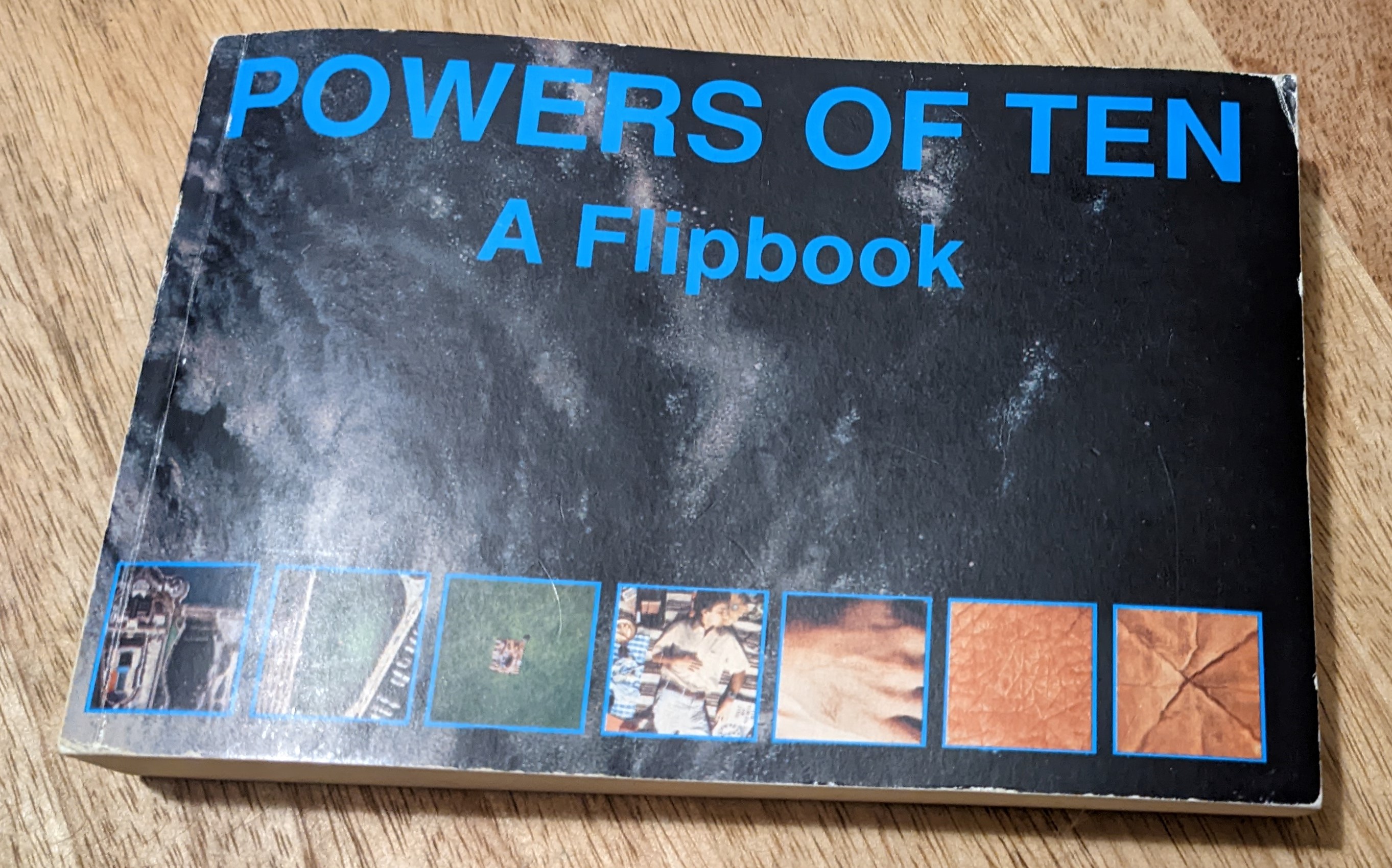
I have a couple of Eames souvenirs. There is a flipbook of Powers of Ten:

Then there is our Eames lounge chair and ottoman. It is an iconic piece of mid-century (20th) furniture, first released in 1956, just before the IGY. About 10 years ago, we bought this one, and despite needing a repair due to a design flaw with the aging epoxy, it suits us fine. The seller told us that our chair once belonged to 1984 VP candidate Geraldine Ferraro, although there is no proof of that.

And finally, the philatelic items. I have the 2008 sheet of 16 commemorative stamps showcasing the important contributions  of Charles and Ray Eames to American design. The Eames lounge chair is shown in one of the stamps., top row, second from left.

Charles and Ray Eames sheet, Scott catalog 4133

And I have a first day cover with the stamp of the chair and a corresponding cachet. 

Scott catalog stamp 4333f on a first day cover, canceled in Santa Monica on June 17, 2008 

The place of issue for these stamps was Santa Monica, California, where the Eames's had a house and studio. In 2014, I visited this Eames House in Santa Monica Canyon on a field trip outing during the International Symposium on Archaeometry held at the Getty Museum and UCLA in Los Angeles.

My photo of the exterior of the Eames House and Studio

Happy Thanksgiving, everyone.

Wednesday, February 09, 2022

More on macrocards

For some reason, the microcards that were discussed in yesterday's post really intrigued me. I contacted one of Franklin & Marshall College's very helpful librarians, Tom Karel. He told me that the College library did house some microcards. I went over today, and entered a room I suspect is not much used anymore, housing microfilm, microfiche, and yes, some microcards. Wikipedia discusses these technologies in an article on microforms, which says "Three formats are common: microfilm (reels), microfiche (flat sheets), and aperture cards. Microcards, also known as 'micro-opaques', a format no longer produced, were similar to microfiche, but printed on cardboard rather than photographic film."

Here is the shelving for the microcards at F&M, maybe about 50 linear feet, about 150 boxes. (The orange/yellow/gray volumes in the lower right are not microcards.)


Each bound bound carton looks like this:

Almost all of F&M's microcard holdings are of the Landmarks of Science (Series 1), formerly produced by the University of OklahomaThis case contains work of James Hutton (1726-1797), the founder of modern geology. 

One slipcase can hold about 200 microcards. So the 150 boxes at F&M could hold about 30,000 microcards. This is about 50% more than what was needed for storage of the the IGY meteorological data, as mentioned in my previous blog post.

One Landmark of Science microcard looks like this:

First microcard of James Hutton's Theory of the Earth

Each card is 4" x 6", and contains 100 pages of text. So the 30,000 microcards in F&M's collection would be equivalent to about 3,000,000 pages. 

The pages are too small to read with the naked eye off these cards. But F&M still has a functional card reader, a Readex Microprint Opaque Viewer. (Readex now seems to specialize in offering collections of digitized online primary source research materials.)


The first page of Hutton's Theory of the Earth (1788) looks like this when magnified on the reader screen:

Of course, now we can find the text of this historic work online. Who would've imagined?

Tuesday, February 01, 2022

64th anniversary of the successful launch of Explorer 1, America's first satellite

We've already talked in earlier posts about the successful launches of Sputnik 1 and Sputnik 2, and the failed launch of Vanguard TV3.

On this date, Jan. 31, in 1958, the U.S. successfully launched its first satellite, Explorer 1, into orbit. Much credit was given to the team of: William H. Pickering, director of the Jet Propulsion Laboratory which built and operated the satellite; James A. Van Allen, physicist at the State University of Iowa who designed and built the instrument on Explorer that discovered the eponymous radiation; and Wernher von Braun, leader of the Army's Redstone Arsenal team which built the first stage Redstone booster that was part of the Jupiter C rocket that carried Explorer 1 into space. The Army had replaced the Navy as the developer of the rocket after the failure of Vanguard TV3, a coup for the ambitious von Braun.

William Pickering, James Van Allen and Wernher von Braun (NASA)

This short JPL video summarizes the preparation, launch, and celebration of Explorer 1:


Explorer 1's orbit had a perigee of 220 miles and an apogee of 1,600 miles. It made one orbit every 115 minutes. The satellite weighed 30 pounds, and was 80 inches long, the same (or similar) size as the model shown in the upstretched arms of the men above. Explorer 1 made its final transmission on May 23, 1958. It entered Earth's atmosphere and burned up on March 31, 1970, after more than 58,000 orbits. 

The U.S. did not initially issue a stamp commemorating Explorer 1. I had speculated to myself that the U.S. did not want to highlight this great accomplishment because it was beaten into space by its Cold War rival, the Soviet Union. This was confirmed for me by Matin Modarressi, who I mentioned in a previous post. Matin sent me the link to this document from the Operations Coordinating Board (OCB), dated on Oct. 8, 1958, signed by CIA director Allen Dulles. It states in item #3 that

A suggestion by the Army was then brought up having to do with the possibility of a commemorative postage stamp in honor of the launching of Explorer 1. The majority of the Board felt that it might be unwise to issue such a stamp in view of the obvious disparity which now exists between our accomplishments in the satellite field and those of the USSR.

Fascinating! Also present at that OCB meeting was Abbott Wasburn, mentioned in earlier posts as Deputy Director of the United States Information Agency and a member of the Citizens' Stamp Advisory Committee and also as the head of public relations for General Mills, which was involved in Cold War biological warfare. I am so grateful that Matin shared this with me. 

Matin has a very interesting presentation about The Role of Stamps in U.S. Foreign Relations:


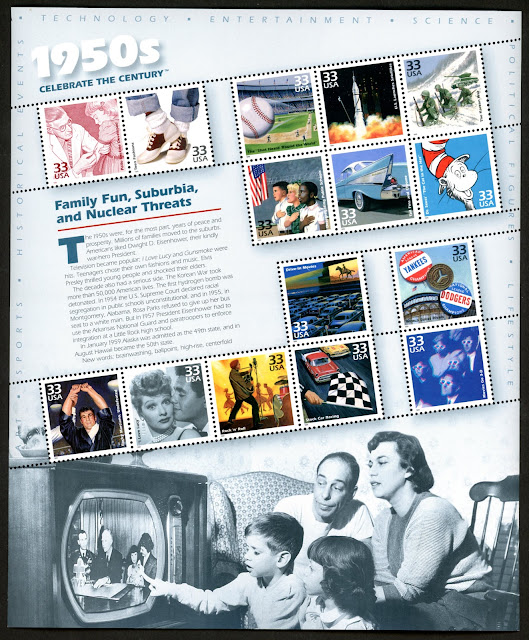
Finally, in 1999, Explorer 1 got its philatelic due, as part of the series of 10 sheets with the theme of Celebrate the Century:

Scott catalog #3187d (1999), Explorer 1

Obverse of Scott catalog #3187d

From my collection - Celebrate the Century: 1950s, Scott catalog #3187, with 15 se-tenant stamps

There have also been IGY covers issued on various anniversaries of the Explorer 1 launch. I showed one with a cachet in an earlier post, with Van Allen's signature. I'll show a few more when I review the IGY Bulletin article on Explorer 1 in its March 1958 issue. 

I am currently watching on PBS the new adaptation of Around the World in 80 Days. It's different from both the original 1872 novel by Jules Verne and the 1956 (IGY-era) film adaptation

starring David Niven, Cantinflas, and Shirley MacLaine, complemented with a slew of cameo appearances (including flamenco legend José Greco, who was a visiting professor here at Franklin & Marshall College in the last few years of his life). I saw the film (which won the Oscar for Best Picture of the year) as a youngster, and just re-bought a related book that I had owned for many years after we bought it at the movie theater so long ago.

I am now also re-reading -- after maybe 55 years -- Verne's novel (a free Kindle version is available on Amazon). I was thinking that the latest film adaptation was unfaithful to the book. Then I realized that the hot air balloon trip over the Alps in the new adaptation was also in the 1956 movie but was not in the book, so faithfulness is, well, relative. Anyway, the current adaptation is a new version of the story for a new era, and that's fair enough. I can't help but think that the 1956 movie was made at such a time as to be envisioning the imminent satellite journeys around the Earth. Those newest circumnavigations would take only two hours, about 1000 times faster than Phileas Fogg's trip around the world in 80 days.

Wednesday, January 19, 2022

IGY Bulletin, Number 6, December 1957 - Second Soviet satellite

This issue of the IGY Bulletin closes with a short piece on the launch of Sputnik 2 on Nov. 3, 1957. The text issued by the Russian news agency Tass was included verbatim. It stated that the satellite was instrumented to measure solar ultraviolet radiation and x-rays, cosmic rays, temperature, and pressure. Data were transmitted to Earth via radio waves for a week after launch.

This satellite project was giving the go-ahead after the successful launch of Sputnik 1, and was completed within a month to launch in time to honor the 40th anniversary of the Russian Revolution. 

Sputnik 2 weighed 1100 pounds, about six times as much as Sputnik 1. Clearly, the Soviet rockets were able to carry significant payloads. Sputnik 2 stayed in orbit through April 14, 1958, when it burned up in the atmosphere. It completed 2,370 revolutions around the Earth.

Sputnik 2 also carried the first animal into orbit, the dog Laika, as described in this article on the 60th anniversary of its launch.  The Soviet Union had already gained experience in launching animals via rockets into the stratosphere. Laika had implanted gauges for measuring blood pressure, respiration, and tracing of electrocardiograms. Laika was doomed to die since there was no way at that time to return to Earth. She survived the launch, but it was revealed years later that she died not long afterwards due to excessive heat. Laika's fate stimulated some of the early protests for animal rights.

November 13, 1957. Dog Laika in a hermetic cabin before installation on the satellite (Tass)

This post from the Drew Ex Machina blog provides more information on the Sputnik 2 mission and Laika.

I own a 52-page booklet entitled Soviet Sputniks, published during the IGY in 1958 by Soviet News as booklet #25. It focuses on the basics of the Soviet satellite program, and specifically on Sputniks 1 and 2.

Scan of cover of Soviet Sputniks

The booklet contains a figure showing the biological monitoring of Laika.

I was inspired by this dog's tale (not her tail) to order the eponymous prize-winning graphic novel Laika, published in 2007 by Nick Abadzis.

Cover of Laika

Images from the graphic novel have also been set to music by Luca Tozzi in this video.

The Sputniks have been well represented on stamps. The Soviet Union issued a set of four stamps in 1957 and 1958 (Scott #2032-2036) honoring Sputnik 2, depicting the allegorical statue "To the Stars" by artist and sculptor Yevgeny Vuchetich.

Russia Sputnik 2 stamps (Scott #2032-2036) from my collection

Laika, the "first space traveler," was commemorated earliest along with Sputnik 2 on two Romanian stamps (Scott #1200-1201) issued on Dec. 20, 1957.

Romania Sputnik 2-Laika stamps (Scott #1200-1201) from my collection

While searching for some information on this post, I also came across a pretty cool Tass web page about Sputnik 1.

The U.S. would soon get its turn for sending a satellite into space. Stay tuned.

Saturday, November 13, 2021

IGY Bulletin, Number 5, November 1957 - Airglow measurements during the IGY

The second article in this issue of the IGY Bulletin returns to the topic of airglow.  As I read the article and looked a some more recent web pages and videos on airglow, I had to remind myself that the whole reason for the IGY was to add to our scientific knowledge about many geophysical phenomena. So whatever you might read or view about airglow (or pretty much anything else!) today may be somewhat different than what the IGY Bulletin said almost 65 years ago because, well, scientific knowledge is cumulative and is always subject to revision and improvement. Of course that is also true in any other area, such as understanding viruses and climate change. Duh. 

This article's topic (as will many others) involves the electromagnetic spectrum, so let's start with a little pictorial refresher of that. The diagram below shows the electromagnetic spectrum with commonly named types of radiation, and the corresponding wavelengths in nanometers (nm, one billionth of a meter) and frequencies in hertz (Hz, cycles per second). The visible portion of the electromagnetic spectrum is the narrow region with wavelengths between about 400 and 700 nm. Wavelength and frequency are related by the equation c = λ x f, where c is the speed of light (3 x 10⁸ meters per second).

The electromagnetic spectrum (Chemistry Library)

The Bulletin article starts off with a description of airglow:

A faint, usually invisible glow -- the night airglow -- occurs in the earth's atmosphere and is a subject of considerable scientific interest and study during the IGY. Although not generally identifiable by the naked eye, airglow supplies much of the light of the night sky. One investigator has roughly estimated its contribution to the visible light -- in the absence of moonlight and aurora -- at 40%, which is somewhat greater than that contributed by starlight.

This video gives a contemporary summary of airglow:

Prominent colors found in airglow include green from an atomic oxygen transition; yellow from sodium; red from oxygen; infrared from hydoxyl (OH). I asked myself, sodium in the atmosphere? Turns out there is a sodium layer in the atmosphere which originates from the ablation of meteorites.

Airglow is due to emission from excited states of atoms and molecules formed by processes resulting (directly or indirectly) from solar radiation. Airglow is an example of luminescence, the spontaneous emission of light by a substance (not resulting from heat, which would be incandescence). It includes chemiluminescence (the emission of light as a result of a chemical reactions) and fluorescence (emission of photons/light after the excitation of atoms and molecules to higher but unstable energy states).

Airglow originates in the mesosphere part of the atmosphere, at altitudes of about 80-100 km, as shown in an earlier post.

The article states that nine countries were to participate in IGY airglow studies. For the USNC-IGY program, photometers (instruments that measures the strength of electromagnetic radiation) were to periodically scan the skies to measure airglow. Pen-and-ink records  would be transferred to punch cards which were fed into computers. Various corrections would then be made to compute the absolute intensity of the airglow in different areas of the sky.

The heights of the airglow were to be determined using rocket soundings, triangulation from different ground stations, and analyzing the increase of intensity towards the horizon.

Airglow has dynamic characteristics in space and time that were also to be studied during the IGY.

One of the books I have in my IGY library -- Geophysics and the IGY: Proceedings of the Symposium at the Opening of the International Geophysical Year -- does have an article on airglow, which bears similarity to this one in the IGY Bulletin. Perhaps the author is the same, although Bulletin articles are not attributed. The title page and table of contents for the book are shown below. One article on The Night Airglow, the scan of which is here, is by Franklin E. Roach. Darn, this book is another one of those good IGY resources I own that I haven't really much looked at.


Sunday, September 12, 2021

IGY Bulletin, Number 2, August 1957 - Antarctic Notes

The last article in the second issue of the IGY Bulletin (August, 1958) was just a page of preliminary results from the Antarctic.

Weather at the South Pole

Some interesting early results:

1. A new world record for lowest temperature on the Earth's surface was measured as -100.4°F (-73.5°C) at the U.S. South Pole Station on May 11, 1957. (As of the present day, the lowest natural temperature ever directly recorded on the Earth's surface is  −128.6 °F (−89.2 °C) at the Soviet Vostok Station in Antarctica on 21 July 21, 1983.)

2. A few hundred feet above the surface at the Admundsen-Scott South Pole Station, the temperature increases as much as 50°F, then decreases at higher heights to the top of the troposphere.

3. Record high winds for Antarctica were also recorded at the South Pole, up to 47 knots.

For your interest, Wikipedia has a comprehensive list of weather records

Neutron Monitor Studies

A "neutron pile monitor" designed and built by John A. Simpson of the University of Chicago was installed on the icebreaker USS Arneb and operated during Operation Deep Freeze I and II from 1955-57.

A helpful note from Wikipedia: "A neutron monitor is a ground-based detector designed to measure the number of high-energy charged particles striking the Earth's atmosphere from outer space. For historical reasons the incoming particles are called "cosmic rays", but in fact they are particles, predominantly protons and Helium nuclei. Most of the time, a neutron monitor records galactic cosmic rays... Occasionally the Sun emits cosmic rays of sufficient energy and intensity to raise radiation levels on Earth's surface to the degree that they are readily detected by neutron monitors. They are termed 'ground level enhancements' (GLE)."

I mentioned the USS Arneb and an associated postmarked cover in an earlier post

Finally, the article notes that on Feb. 23, 1956, solar cosmic rays were measured in association with a solar flare, for only the 5th time. This was one of the notable historic solar storms. The Arneb, which measured solar cosmic rays at various latitudes as it sailed the seas,  detected particles from this flare while in the harbor at Wellington, New Zealand.

I have a book from the former library of John Simpson of the Enrico Fermi Institute for Nuclear Studies at the University of Chicago. The inscription inside the book is below.


The book was published in 1956 by the American Geophysical Union as Geophysical Monograph Number 1 (there are now 264 volumes in this series) with articles from a symposium on Antarctica in the International Geophysical Year:


The contents list an article by John Simpson himself on "Cosmic-ray experiments derived from recent U.S. Antarctic expeditions", and additional articles by noted scientists and IGY luminaries:

Sunday, August 29, 2021

IGY Bulletin, Number 1, July 1957 - Status report: seismology, gravity and longitude & latitude

This was the first of three articles in the IGY Bulletins that will present the status of activity in each IGY area. Recall that from my post of Nov. 21, 2020, these areas are:

  1. World Days and communications
  2. meteorology
  3. geomagnetism
  4. aurora and airglow
  5. ionosphere
  6. solar activity
  7. cosmic rays
  8. longitudes and latitudes
  9. glaciology
  10. oceanography
  11. rockets and satellites
  12. seismology
  13. gravity
  14. nuclear radiation
For the three areas covered in this IGY Bulletin article, what were some of the IGY goals? I'll number these areas according to the list above.

8. Longitudes and latitudes objectives included:
  • precise determination of latitudes and longitudes, to within a few feet
  • determination of the shape (figure) of the Earth
  • measurement of irregularities in Earth's rotation 

12. Seismology objectives included determination of:
  • Antarctic crustal structure
  • Antarctic ice thickness
  • layers and their thicknesses in the ocean crust

13. Gravity objectives included:
  • augmenting the global network of gravity measurements, especially in the Southern Hemisphere and polar regions
  • better determination of the solid Earth's response to the tides
  • enhanced measurement of gravity at sea
I assume we will see results of these pursuits in future issues of the IGY Bulletin, to be summarized here in future posts.

In my geophysics courses at Franklin & Marshall College, I taught all three of the topics that are the subject of this Bulletin article. Geophysicists often distinguishes between "pure" and "applied" geophysics. Pure geophysics (aka physics of the Earth, or solid Earth geophysics) is more or less the physics of the Earth in its natural state, including earthquake seismology, geomagnetism, and the gravity field of the Earth. Applied geophysics involves surveys (e.g., seismic, gravity, magnetic, electrical), using natural or artificial energy sources, to locate things in the Earth's subsurface of economic or cultural interest such as hydrocarbons, ores, and archaeological structures. 

As our geosciences curriculum at F&M changed over the years, I taught separate courses on solid Earth geophysics and applied geophysics, and courses that somewhat combined these topics, I can count 9 or 10 textbooks on my bookshelf that I used for these courses. I probably changed them more than was necessary, but I was constantly trying to find that "better" (also in print, up to date, and not too expensive) guide for undergraduates who typically had more interest in geology than geophysics, and often came in with only modest quantitative skills. 

Below are the covers of my favorite three of the textbooks. A common thread is that they are all explicitly written for geologists, without too much calculus, and more compatible with the students I taught.


Monday, May 10, 2021

Cheerios, the U.S. biological warfare program, the Citizens' Stamp Advisory Committee, and the Congressional IGY report

I will suggest some (tenuous?) relationships between all those topics.

One of the four cereals we keep on hand for breakfast (along with generic corn flakes, generic raisin bran, and homemade granola) is General Mills Cheerios. My editor likes to mix Cheerios with the granola, and won't abide by a generic oat cereal (that I could go with).

Scan of actual Cheerios box at right. Note that this is a General Mills product.


Recently, I read the book Baseless, by Nicholson Baker. I had read some of his fiction in the past. 

According to the dust jacket blurb:
Baker assembles what he learns, piece by piece, about Project Baseless, a crash Pentagon program begun in the early [19] fifties that aimed to achieve "an Air Force-wide combat capability in biological and chemical warfare at the earliest possible date." Along the way,  he unearths stories of balloons carrying crop disease...
The book is presented as a daily journal of sorts, covering just over two months of entries in 2019, describing Baker's quest, thoughts, findings, fears, and his attempts to use the CIA CREST database and the Freedom of Information Act requests to learn about his topic. Those inquiries are sometimes answered, albeit often with redactions, but responses are commonly unduly delayed or the questions mothballed and ignored. This censoring and burial of information that should belong to we-the-people is the flip side of the open archives mentioned in my past post.

review of this book from The Nation describes Baker's hypotheses as plausible narratives, although not fully confirmed by the publicly available information.

You can also watch a video of an interesting conversation about the book with Baker at the Harvest Book Store.

So, connection #1: In his entry for May 2, 2019, Baker writes:
After the war [World War II] General Mills's president, Harry Bullis [emphasis mine], a friend of Allen Dulles, began a balloon program, General Mills Aeronautical Research Laboratory. Abbott Washburn [emphasis mine], General Mills's head of public relations, became director of an ostensibly private undertaking, the Crusade for Freedom, which used CIA funds channeled through the National Committee for Free Enterprise to launch thousands of leaflet-bearing balloons into Czechoslovakia and other countries of Eastern Europe.

These General Mills balloons

fed into the covert plan to destroy Communist food sources, using high-altitude "balloon disseminators" filled with heated containers of wheat stem rust and hog cholera.  

Not only did General Mills have the research know-how to make cereal crops thrive, but also to poison and destroy them via germ warfare.

Connection #2: That name, Abbott Washburn, rang a bell in my head, different from the ringing I otherwise hear there. In my post of March 10, on the Citizens' Stamp Advisory Committee (CSAC) which was established in the IGY year 1957, I wrote that Washburn was:
head of public relations for General Mills Inc. in Minneapolis, and then executive vice chairman of Crusade for Freedom, which raised money for Radio Free Europe. He was deputy director of the U.S. Information Agency from 1953-1961, acting as liaison between the broadcast agency and the White House and National Security Council during a peak period of the Cold War. He served on the Citizens' Advisory Committee in this capacity.

I went on to wonder:

why, you might ask, was a representative of the USIA on the Citizens' Advisory Committee? The USIA was an agency responsible for American "public diplomacy" (emphasis mine; read public diplomacy as propaganda, maybe?), especially during the Cold War. It was the largest public relations organization in the world, with an annual budget over $1 billion in the years directly after the fall of the Berlin Wall. It presided over U.S. government communications to over 150 international populations. So yes, you could say those Liberty Series stamps carried an "agenda" around the world. 

I find it interesting that Washburn honed his PR skills with a food company that engaged in activities related to biological warfare, moved to the USIA, and then served on the CSAC, presumably as a point person who helped guide stamp design selection to signal our country's national interests.

Connection #3: Note the mention of Harry A. Bullis (1890-1963) in the Baker book entry above. He was President and then Chairman of the Board if General Mills during the IGY. And last post, the author of the 1973 document, The Political Legacy of the Inertnational Geophysical year, was Harold Bullis, This was another case where I thought these two men were the same. The biographical details don't quite match up. The foreword to the IGY report states that

The author of this study, the 11th in the series on “Science, Technology, and American Diplomacy,” is Mr. Harold Bullis, Analyst in Science and Technology with the Congressional Research Service of the Library of Congress. Mr. Bullis holds baccalaureate and masters degrees in physics from the University of Minnesota and Ohio State University as well as a masters degree in public administration from American University. Prior to joining the Library of Congress he served as physicist with the Wright Air Development Center and the Harry Diamond Laboratories.

This must be this L. Harold Bullis, who was "a specialist in science and technology and head of the Geosciences, Materials, and Industrial Technology Section of the Science Policy Research Division of the Congressional Research Service [my emphasis]." I assume he is also the same as this LHB (1927-2015).

Connection #4: Although I haven't been able via obituaries or other online documentation to link these two Harold Bullises with complete certainty, I assume they are father and son, consistent with their ages, and also with a common Minneapolis (General Mills and University of Minnesota) component in their bios. Growing up in the Washington, DC, area, I had a cousin Bernie (connection #5?) who also worked at the Harry Diamond Laboratories, which among other things developed fuzes for munitions such as bombs, rockets and mortar shells. Both Bullises had associations with companies that made devices useful for warfare. (My first real job in the DC area from 1972-74 with Fairchild Space and Electronics Company involved subcontracts for satellite projects of the U.S. Naval Research Laboratory.)

Make of these connections what you will, and chew them over with your next bowl of Cheerios.

Monday, May 03, 2021

Three U.S. government reports for my IGY archive

I've recently obtained three useful government documents pertaining to the IGY. I have not yet read any of them all the way through, so I won't comment on their contents in any detail, although I hope to draw on them in future posts. 

The first is titled Proposed United States Program for the International Geophysical Year 1957-58.  It was put together by the United States National Committee and published in August 1956, 109 pages. It gives a clear overview of the expected IGY work in each of the major areas of research. It is available for download from the National Academies Press. Until recently, this was the only one of these three documents that was readily available for download as a complete document.

A some point in years past I picked up a hard copy of this report (see scan of the cover).

Second, I kept running into references to National Academy of Sciences 1965 Report on the U.S. Program for the International Geophysical Year: July 1, 1957 - December 31, 1958 , but I was surprised not to be able to find a downloadable copy. Because of the great help of the National Academies, this document was tracked down, posted, and can now be downloaded here. It is 906 pages, and again is organized according to the areas of study of the IGY. What a valuable resource! The title page is shown to the right. Note that this is IGY General Report Number 21; I guess I will now have to figure out what and where those preceding 20 reports are.

Third and last is this report: Bullis, H., 1973; The Political Legacy of the International Geophysical YearLibrary of Congress, Science Policy Research Division., United States House of Representatives, Committee on Foreign Affairs, Subcommittee on National Security Policy and Scientific Developments; Washington, D.C.; U.S. Government Printing Office, 64 p. It can be viewed at the web site of the Hathi Trust, a partnership of academic and research institutions, offering a collection of millions of titles digitized from libraries around the world, Not being at a partner institution, I could only download or print this document one page at a time. So I downloaded each page, collated it into a single document, which you can access from my server.  Again, the title page is shown at right.

My college librarian assures me that posting this is ok for a government document. I'll also say here, in response to a question (complaint?) I received, that I do not guarantee any consistency in citation styles sources I refer to in my posts. And, I'll have more to say about the author of this report, Harold Bullis, in my next post.

The Foreword of this document starts with some hopeful words in the midst of the Cold War:

This study examines in detail a specific example of how the world scientific community has worked together in cooperation and good will toward resolving international problems. Its subject is the International Geophysical Year (IGY), the largest and most complex international scientific undertaking ever attempted.

In keeping with the objectives of the series of which it is one part, this study analyzes the contributions made by the IGY in overcoming ideological differences as a means of building bridges between science and diplomacy. More specifically, it attempts to identify and explain the attitudes, behavior patterns, and procedures followed in the IGY as a step toward détente.

Only time will tell of course whether the laudable example set by the IGY represents the major turning point in history claimed by some. Of importance here and now is the message conveyed in this study that indeed international cooperation in science and technology is possible. What remains is for that example to be emulated and extended.

Being able to access government documents online is a pretty amazing capability (although I anticipate making some comments in the next post on documents that are harder to come by).  

Of course, there is a National Archives stamp! Below is the stamp (Scott #2081, 1984) commemorating the founding of the U.S. National Archives. I don't own it, so this image is thanks to Mystic Stamps. I'm not very keen on this stamp design. Why George Washington and Abe Lincoln (with that exaggerated stovepipe hat) profiles? Aren't Washington and Lincoln on enough other stamps? Honor the archivists and the librarians more directly somehow.


Friday, February 12, 2021

U.S. IGY stamp - description in The Bureau Specialist

After my previous posts on the U.S. IGY stamp as described in the Scott Catalog and in the Postal Bulletin, I thought I would add a description from the monthly journal of the United States Stamp Society (mentioned in a previous post), which today is called The United States Specialist, but in 1958 was The Bureau Specialist. As far as I know, this is the only detailed article published in a journal/magazine that focuses solely on this stamp. There are other articles on various IGY stamps and covers that include this stamp - I'll post on those soon. I also look forward to an upcoming article on the IGY stamp in Charles Posner's series, Cataloging U.S. Stamps of the 1950s, in the American Philatelist.

The USSS describes itself as

a “non-profit” volunteer-run association of collectors devoted to the study of postage and revenue stamped paper produced for use in the United States and U.S. administered areas. 

Its monthly publication, the The United States Specialist, is "the world’s leading journal of modern U.S. philately."

Thanks to the USSS for permission to reproduce the text and images of this piece. If you are a member, you can download the original article from its archives.

Again, I have some explanatory footnotes at the bottom, things I learned from the article. 

---------------------------------------------------------------------------------------------------

The Bureau Specialist
Vol. XXX, No. 2 FEBRUARY, 1959 Whole Number 348

GEOPHYSICAL YEAR ISSUE
3¢: BLACK 8: ORANGE—ISSUED MAY 31, 1958
SOL GLASS1

On November 2, 1957 Postmaster General Arthur E. Summerfield2 made known a list of nine selections3 for commemorative postage stamps as recommended by the Citizen’s Stamp Advisory Committee4 to be issued during 1958, one of these being a stamp honoring the International Geophysical year. It was initially planned to issue this stamp on December 31, however, it was deemed advisable to move the issuance date forward to May 315. This information was announced January 22, 1958 and on March 29, 1958 details of the design were made known.

Design
The design of this stamp6 is based on a photograph of the sun and depicts an area of intense solar activity such as occurs periodically and is among the phenomena being studied during the 18-month period of the International Geophysical Year. Super-imposed above the solar disk and the fiery solar prominences emanating from it is a segment of Michaelangelo’s famous fresco “The Creation of Adam”. Across the top of the stamp is the wording INTERNATIONAL GEOPHYSICAL YEAR I957-58", arranged in two lines, and across the bottom is "U. S. POSTAGE 3c”. All lettering is in white face gothic.

Ervine Metzl7, the designer of the stamp, explained that “In the small confines of a postage stamp we have endeavored to picture a man’s wonder at the unknown together with his determination to understand it and his need for Spiritual inspiration to further his knowledge.”

Mr. Metzl has been a member of the Citizen’s Stamp Advisory Committee since its inception in 1957. He attended the Art Institute in Chicago, where he was born, and studied in Munich, Rome, Paris and London. He is presently a free lance artist with studio at 20 Park Avenue, New York, and enjoys high repute as a book illustrator and designer. He is a teacher, editor and writer — having taught at Columbia University — and is a past president of the Society of Illustrators.

First Day Ceremonies
Ceremonies inaugurating the release of the International Geophysical Year commemorative stamp were held in conjunction with the “COMPEX 1958” philatelic exhibition at the Hotel LaSalle in Chicago, at I0:00 A. M., May 31, 1958, with
Ernest Kehr8, International Secretary of COMPEX and Philatelic Editor of the New York Herald Tribune, presiding. The Post Office Department was represented by L. Rohe Walter9, Special Assistant to the Postmaster General and Franklin R. Bruns, Jr.10, Director, Division of Philately. Mr. Walter delivered the principal address and said in part:

Many stamps have paid tribute to the famous men and women of the United States and to the great events of our nation’s history and its natural wonders.

This International Geophysical Year stamp we dedicate today is unique—and its uniqueness, it seems to me, gives it added significance. The theme of the International Geophysical year is knowledge.

Its focal point is the sun, during an 18-month interval that includes a period of maximum solar activity which strongly influences many of the natural phenomena.

Its ideals are the reflection of the hopes of men and women of good-will for a better world of tomorrow based on international understanding and peace.

At the conclusion of his address Mr. Walter presented souvenir albums, each containing a sheet of the new stamps, autographed by Postmaster General Arthur E. Summerfield, to a group of distinguished persons. Before presenting the albums, Mr. Walter stated: “Let me say that this nation is deeply indebted to the National Academy of Science and its National Committee for the International Geophysical year for its tireless planning and effective coordination of the United States program, consistent with the overall program of the International Council of Scientific Unions.”

Statistical Data
Issued May 31, 1958 at Chicago, Illinois. 3c Black and Orange. Perf. 11 by 10-1/2. Stamp size 0.84 by 1.44 inches. Printed on the Giori Press from 200-subject, electrolytic, steel intaglio plates, dry printing, on 
pre-gummed paper11. The 200-subject sheets were perforated on the flat sheet (L) perforator and cut into post office panes of 50 stamps each, arranged ten horizontal by five vertical rows of stamps to the pane.

Designed by Ervine Metzl of New York City. Modeled by Charles R. Chickering12 and William K. Schrage, Bureau of Engraving and Printing.

Engravers:—Vignette, Richard M. Bower. Lettering and Numerals, Robert J. Jones. First printing order March 19, 1958, 120,000,000. First delivery April 29, 195813 to Hawaii and Puerto Rico. 

Five models were prepared by the Bureau of Engraving, the accepted model was approved by Postmaster General Arthur E. Summerfield on March 7, 1958 and the Die Proof was also approved by him on March 19, 1958.

[Five models proposed for the IGY  stamp; top right was the winner]

Plate numbers used in printing, 25978 and 25985, to press, April 14, 1958; 25990 and 25993, to press, April 21, 1958; 26010, to press, May 6, 1958.

First Day sale May 31, 1958 at Chicago, Illinois. Covers cancelled 397,000, Stamps sold 1,011,664.

---------------------------------------------------------------------------------------------------

1 According to the American Philatelical Society Hall of Fame (APSHF), Sol Glass (1893-1973) was one of the greatest experts of United States 20th century stamps. His book, United States Postage Stamps 1945-1952 (1954) received national and international awards. He was a member of the first Citizens' Stamp Advisory Committee from 1957 to 1961, during which the IGY stamp was released.

2 Arthur E. Summerfield was the 57th Postmaster General, a political appointment by President Eisenhower. He presided over a modernization of the Post Office Department, including the creation of the Citizens’ Stamp Advisory Committee in an effort to encourage citizen involvement in postal policy.

3 The U.S. issued a total 18 commemorative stamps and three airmail stamps in 1958.

4 The Citizens’ Stamp Advisory Committee is appointed by the Postmaster General. The group recommends subjects for future stamp issues, made with all postal customers in mind, including stamp collectors.

5 May 31, 1958, was 11 months into the IGY, which began on July 1, 1957. December 31, 1958, was the last day of this 18-month "year."

6 See my earlier post

7 Metzl designed the stamp with an original drawing on which the stamp was based. I'll have more to say about him in a later post.

8 Ernest Anthony Kehr (1911-1986) was one of philately's most distinguished spokesmen. Over a forty-year period, Kehr presented more than 2,000 radio and television programs promoting philately. He wrote several popular books of which The Romance of Stamp Collecting (1947) was a philatelic bestseller.

9 L. Rohe Walter (1899-1966) was special assistant to Postmaster General Summerfield. He was the liaison between the Post Office Department's Stamp Advisory Committee and philatelists (obituary, New York Times, 4/24/66). 

10 Franklin Richard Bruns Jr. (1912-1979) was widely known for his nationally syndicated stamp column that appeared in some 30 newspapers between 1932 and 1972 (was this the one I read in the Washington Evening Star newspaper as a youth?).  He was also on the first Citizens Advisory Committee (1951-1957). He became curator of the Smithsonian Institution's philatelic collection in 1951, and was the first curator of the Cardinal Spellman Philatelic Museum (1957-1962).

11 The last episode of the 1996 season of the sitcom Seinfeld, The Invitations, had George's fiancée Susan die after licking the toxic flaps of too many gummed envelopes, since George had opted for the cheapest envelopes for their wedding invitations. The episode has been linked anecdotally to an increase in worries about the health risks of licking gummed paper, and it has been speculated that it may have contributed to the growing popularity of self-adhesive stamps in the United States. First introduced unsuccessfully in the U.S. with the 1974 Christmas stamp, self-adhesive stamps were reintroduced in 1989; by 2013 almost all U. S. stamps issued had become self-adhesive. Nicholas Lombardi (Self-adhesive stamps; in R.A. Juell, L.R. Batdorf, and S.J. Rod, eds.; Encyclopedia of United States Stamps and Stamp Collecting, 2nd ed.; United States Stamp Society, 2016; p. 437-445) suggests that "the introduction of self-adhesive postage stamps in the United States could be regarded as being the most important stamp production innovation of the past century."

I recently purchased this inexpensive, beautifully produced, highly informative 750-page tome (I'll refer to it as EUSSSC)


1
2
 Model here refers to what is also termed an essay, an image of the stamp design considered for use, including alternate versions of a particular design, or an alternate design altogether. Models can be suggested by engravers based on how a design will best translate into a printed stamp. Model can also refer to the final approved illustration of a stamp (EUSSSC, p. 375, p. 575, glossary). Charles Chickering was a noted stamp designer and engraver, employed by the Bureau of Engraving and Printing from 1947-1962. As I have been reading more about him, it's clear he is deserving of his own post at a later time.

13 Note that the first delivery date of the stamp to post offices was a month before the official issue date. Although stamps should not be sold before the issue date, stamps have sometimes mistakenly been sold before the FDOI.