Friday, September 03, 2021

IGY Bulletin, Number 2, August 1957 - Rockets & Satellites: Radio Tracking System

Both the U.S. and the Soviet Union were expected to launch satellites during the IGY, so it was necessary to develop methods to track them. This article from the IGY Bulletin describes the Minitrack system developed by the Naval Research Laboratory to do that. I'll also use some supplementary material from a very useful Wikipedia article. (Much as I try to use alternate sources to sample other interesting and authoritative websites, Wikipedia truly is an amazing resource.)

The U.S. Naval Research Laboratory began operations in 1923, seven years after  Thomas Edison suggested that the Government establish “a great research laboratory.” NRL developed the first operational American radar, in time for use in World War II. It became a global leader in space science and development as a predecessor to the formation of NASA in 1958.

When plans for satellites emerged in the years preceding the IGY, the question naturally arose as to how to track them. Three approaches were considered: optical tracking, radar, and the NRL plan to measure angles using radio wave interferometry. The optical and radar approaches would work with a passive target, but had the major problem of finding the target in the first place, since they had very small fields of view. The NRL technique required a transmitter be placed on the target, but could easily measure a target anywhere in a wide field of view. The NRL proposal was accepted and turned into the basis of the Minitrack system.

The Minitrack transmitter that would send the signal from the satellite had a power level of about 0.05 watts. (A cell phone today emits on the order of one watt, 20 times greater.) The frequency of the signal was 108 cycles/second (hertz), or super/very low frequency.

The figure below from the Bulletin articles suggests how this system would work. Points A1 and A2 in figure 1(a) are two receiving antennas at the ground station. If the signals were arriving vertically, there would be no phase difference between the two sinusoidal waves; in other words, the distance P1-A2 would be zero. As the angle of the satellite tilts from the vertical (as shown in the figure), the length of this phase difference increases, and indicates the angle of the satellite from being straight overhead (the zenith). With two pairs of antennas perpendicular to each other, as shown in figure 1(b), two angles would determine completely the direction of the satellite from the antennas. 

IGY Bulletin,  #2, Fig. 1(a) and (b)  -Phase measurement in the Minitrack system

A so-called "picket fence" at longitude 75°W was to have eight stations spaced out in latitude so that the satellite would not be missed as it crossed that meridian. Two of the stations were in the U.S., two in the Caribbean, and four in South America. A photo of the station at Blossom Point, Maryland, is shown below.

Blossom Point Minitrack station (NRL)

I mentioned in an earlier post that, during my first "real" job with Fairchild Space and Electronics Company in Germantown, MD, I was involved in a couple of subcontracted projects with the NRL analyzing satellite power requirements for their satellites. One of these was for TIMATION-3, a satellite with technology that was a stepping stone to the development of GPS.

I still have that report from 1973! It was the first really substantial professional thing I helped write. The cover page, slightly weathered, was signed by my excellent group lead Doug Rusta and by me.  I generated hundreds of pages of tables and graphs for this report, many of which were hand written and plotted on graph paper, respectively.

Title page, report on the power subsystem for NRL's TIMATION III satellite

Hope you enjoyed today's physics lesson!
Thursday, September 02, 2021

IGY Bulletin, Number 2, August 1957 - World Days During IGY

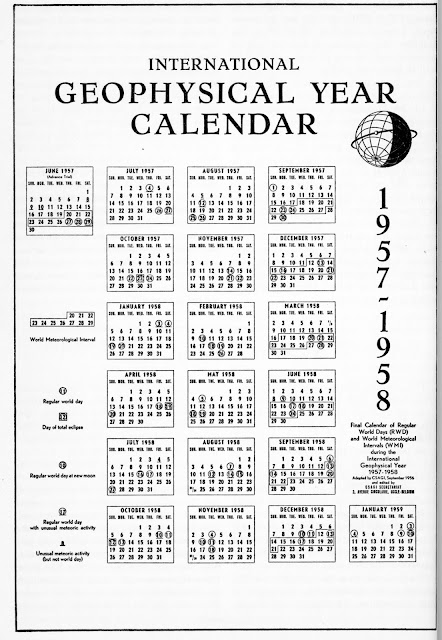
I am going to re-hash a little and add to what I said in an earlier post about the IGY calendar, because that is the subject of the second article in IGY Bulletin #2. (Anyway, a little review is appropriate before the IGY quiz I am thinking about administering.)

Recall that the IGY aimed, when appropriate and possible, to make synoptic (simultaneous, at different locations) measurements of geophysical phenomena across the globe, so that a snapshot in time could be taken for a particular phenomenon. The World Days program was established to enable even more intensive measurements during some periods of the IGY.

The article explains that there were three classes of days or periods during which special experiments or more intensive observations were made:

1. Regular World Days - three or four days each month, selected in advance. Two are consecutive days during new moon (e.g., 8/25-8/26/57 in the calendar below; others are at times of special meteor showers such as the Perseids, 8/12/57) or near one of the lunar quarter phases (e.g., 1st quarter, 7/4/57). RWDs also included total solar eclipses (e.g., 10/23/57) with adjacent days.

2. World Meteorological Intervals - series of 10 consecutive days, every three months, including a solstice or equinox (e.g., 9/18-9/27/57).

3. Special World Intervals - designated during the IGY when forecasts suggest high solar activity, such as the magnetic storm of February, 1958.

Calendar of special IGY days, from IGY Bulletin #2, August, 1957

By the way, if you haven't already noticed, most images that I include are shown enlarged in a new window if you click on them.

Wednesday, September 01, 2021

IGY Bulletin, Number 2, August 1957 - Status Report: Meteorology, Oceanography & Glaciology

Finally moving on to the SECOND issue of the IGY Bulletin, for August, 1957.

IGY Bulletin #2, August, 1957, p. 1

This issue is 15 pages, comprising five articles. You'll find my scan of the issue here.

The articles in this issue are:

  1. Status Report: Meteorology, Oceanography & Glaciology
  2. World Days During IGY
  3. Rockets & Satellites: Radio Tracking System
  4. CSAGI and the International Geophysical Year
  5. Antarctic Notes
The first article highlights three more areas of planned IGY studies, which I've again numbered according to the original list, and bulleted some of the key endeavors.

2. Meteorology objectives included:
  • studying major atmospheric circulation patterns, and latitudinal heat transfer
  • adding extra weather stations to improve global coverage, especially in the Arctic and Antarctic regions, by making measurements at the surface and at altitudes using balloons and aircraft
  • coordinating Antarctic measurements via the IGY Antarctic Weather Central at the Little America station
  • developing a pole-to-pole chain of meteorological stations in a longitude band between 70-80ยบ W (passing through the eastern U.S.)
7. Glaciology objectives included:
  • investigating mass budgets of glaciers (accumulation vs. ablation), and mass and energy transfers between glaciers and their environments
  • calculating volumes of polar ice sheets and of sea ice, including seismic surveys to determine ice sheet thicknesses
  • determining patterns of regional climate variations and their historic patterns

8. Oceanography objectives included:

  • better understanding of three-dimensional oceanic circulation patterns via shipborne measurements at the surface and at depth
  • examining heat and water transfer between the oceans, atmosphere, cryosphere, and other components of the hydrosphere
  • improving information on sea level rise at various time scales, using many more observation points
  • installing observatories on more remote islands around the world, including drifting sea ice stations in the Arctic

These days we often use the rubric of Earth systems science to teach geosciences. The different "components" of the Earth system are interconnected in many and complex ways. These "spheres" include the geosphere (solid Earth), hydrosphere (water), cryosphere (ice), atmosphere, and biosphere. If you like, add the pedosphere (soil) and ionosphere/magnetosphere. We can roughly break down the 13 IGY areas of study into these "spheres" as follows:

  • geosphere - geomagnetism; longitudes and latitudes; seismology; gravity
  • hydrosphere - oceanography
  • cryosphere - glaciology
  • atmosphere - meteorology; nuclear radiation
  • biosphere
  • pedosphere
  • ionosphere/magnetosphere (and on into space) - aurora and airglow; geomagnetism (again); ionosphere; solar activity; cosmic rays; rockets and satellites
  • other - World Days and communications
This diagram suggests the complex interrelationships of the various "spheres":
The interaction of these spheres is an important part of contemporary climate science, and understanding climate change.